


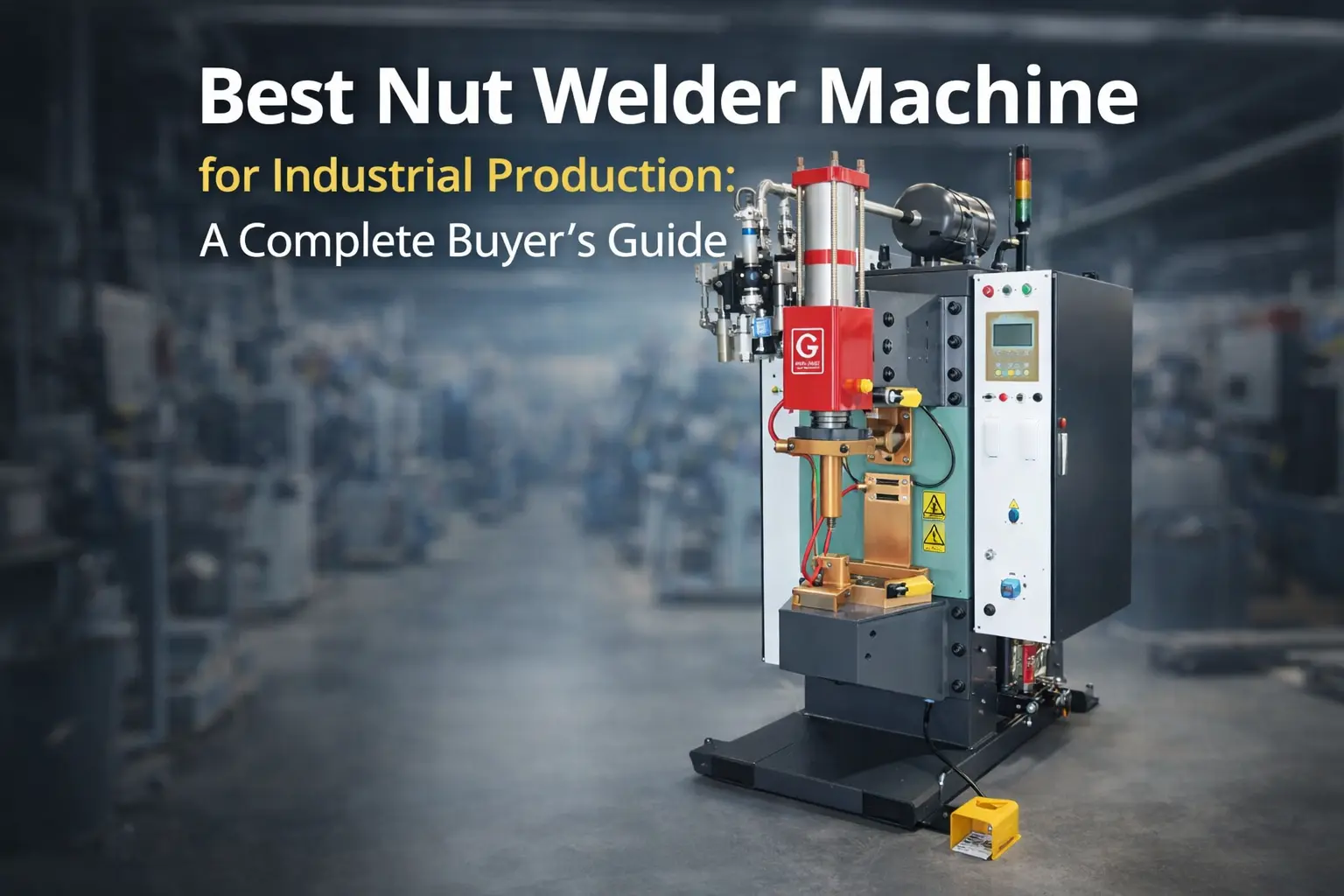
In modern manufacturing, reliable and repeatable fastening solutions are essential for achieving structural integrity, production efficiency, and cost optimization. A nut welder plays a critical role in this ecosystem, enabling manufacturers to permanently attach nuts to sheet metal components through resistance welding technology.
For OEMs, automotive suppliers, appliance manufacturers, and industrial fabricators, nut welding is not just a joining process it is a foundation of high-speed automated assembly. This guide explores how nut welders work, their industrial applications, key advantages, and how advanced solutions from Heron Welder support precision-driven production environments.
What is a Nut Welder?
A nut welder is a specialized resistance welding machine designed to weld metal nuts onto a base material, typically sheet metal. The process creates a permanent, high-strength mechanical joint without the need for screws, adhesives, or secondary fastening operations.
Unlike traditional fastening methods, nut welding ensures:
- Permanent attachment
- High torque resistance
- Consistent positioning
- Faster assembly cycles
Nut welders are widely used in industries where structural reliability and production speed are critical.
How Nut Welding Works
Nut welding is based on resistance welding principles, where electrical current and pressure are applied simultaneously to generate localized heat at the contact point.
Step-by-Step Process
- Positioning the Nut
The nut is accurately placed on the workpiece using an electrode or automated feeder system. - Clamping Force Application
Electrodes apply controlled pressure to hold the nut in place. - Electrical Current Flow
High current passes through the nut and sheet metal interface. - Heat Generation & Fusion
Electrical resistance generates heat, causing localized melting. - Solidification
Once current stops, the molten metal solidifies, forming a strong weld joint.
The result is a clean, durable, and highly repeatable fastening point suitable for mechanical loading.
Types of Nut Welding Systems
Modern manufacturing environments use different nut welding technologies depending on production needs.
1. Manual Nut Welders
- Operator-controlled systems
- Suitable for low-volume production
- Flexible but less consistent
2. Semi-Automatic Nut Welders
- Assisted positioning systems
- Improved repeatability
- Ideal for medium-scale production
3. Fully Automated Nut Welding Systems
- Integrated with robotic arms or CNC lines
- High-speed production capability
- Used in automotive and mass manufacturing
4. Capacitor Discharge Nut Welders
- Extremely fast welding cycle
- Minimal heat distortion
- Ideal for thin sheet metals
Key Industrial Applications of Nut Welding
Nut welders are used across multiple industries where precision fastening is essential.
Automotive Manufacturing
- Car body panels
- Chassis assemblies
- Engine compartments
- EV battery housings
Home Appliance Industry
- Washing machines
- Refrigerators
- Air conditioning units
- Metal enclosures
Electrical & Electronics
- Control cabinets
- Power distribution boxes
- Industrial enclosures
Construction & Metal Fabrication
- Steel frames
- Structural assemblies
- HVAC systems
Aerospace & Transport Equipment
- Lightweight structural components
- High-strength assembly points
Advantages of Using a Nut Welder
Nut welding offers significant advantages over mechanical fastening methods like riveting or bolting.
1. High Strength and Durability
The welded joint provides superior resistance to torque, vibration, and mechanical stress.
2. Faster Production Cycles
Eliminates drilling, threading, and manual fastening steps.
3. Cost Efficiency
Reduces consumables such as screws, washers, and adhesives.
4. Automation Compatibility
Easily integrates into robotic production lines and smart factories.
5. Clean and Aesthetic Finish
No visible fasteners on the reverse side of the material.
Nut Welding vs Other Fastening Methods
Understanding the difference between nut welding and other fastening techniques helps manufacturers choose the right solution.
Nut Welding vs Riveting
- Nut welding provides higher torque strength
- Riveting is mechanical but less suitable for high-load applications
Nut Welding vs Bolting
- Bolting requires threading and manual assembly
- Nut welding eliminates secondary assembly steps
Nut Welding vs Adhesive Bonding
- Welding offers immediate structural strength
- Adhesives require curing time and may degrade over time
Critical Factors for High-Quality Nut Welding
To ensure consistent welding performance, manufacturers must control several process variables:
1. Material Compatibility
Sheet thickness, nut material, and coating must be compatible for strong bonding.
2. Welding Current Control
Precise current control ensures proper heat generation without material damage.
3. Electrode Design
Electrode shape affects pressure distribution and weld quality.
4. Alignment Accuracy
Misalignment can lead to weak welds or deformation.
5. Cooling System Efficiency
Proper cooling prevents electrode wear and ensures consistent production.
Automation in Nut Welding Systems
Modern factories are rapidly shifting toward automated welding solutions to increase productivity and reduce labor dependency.
Advanced systems from Heron Welder integrate:
- Robotic nut feeding systems
- CNC-controlled positioning
- Real-time weld monitoring
- MFDC (Medium Frequency Direct Current) technology
- High-speed production cycles
This level of automation ensures consistent quality across thousands of weld points per shift, making it ideal for mass production industries such as automotive and appliance manufacturing.
Best Practices for Nut Welding Operations
To maximize performance and reduce defects, manufacturers should follow these best practices:
- Regular electrode maintenance and cleaning
- Proper calibration of welding current
- Use of high-quality fasteners and sheet materials
- Routine inspection of weld strength
- Implementation of automated quality control systems
Following these practices ensures long-term production stability and reduces downtime.
Future of Nut Welding Technology
The future of nut welding is closely tied to Industry 4.0 and smart manufacturing trends. Key developments include:
- AI-based weld monitoring systems
- Predictive maintenance for welding machines
- Fully autonomous welding lines
- Energy-efficient MFDC systems
- Integration with digital twin manufacturing environments
These innovations are transforming nut welding into a highly intelligent and data-driven process.
FAQs About Nut Welders
1. What materials can be used in nut welding?
Nut welding is commonly used on low-carbon steel, stainless steel, and coated sheet metals, depending on application requirements.
2. Is nut welding stronger than traditional threading?
Yes, in many applications nut welding provides higher resistance to vibration and torque compared to threaded inserts.
3. Can nut welders be automated?
Yes, modern nut welding systems can be fully integrated into robotic production lines for high-volume manufacturing.
4. What industries use nut welders the most?
Automotive, appliance manufacturing, electrical enclosures, and metal fabrication industries are the largest users.
5. How do I ensure weld quality in nut welding?
Proper control of welding current, electrode condition, and material alignment are essential for consistent weld quality.
Conclusion
A nut welder is an essential tool in modern industrial manufacturing, enabling strong, fast, and cost-effective fastening solutions. From automotive production lines to appliance manufacturing, it ensures structural reliability and scalable efficiency.
With advanced engineering, automation capabilities, and precision control systems, Heron Welder delivers high-performance nut welding solutions designed to meet the demands of global OEMs and industrial producers.
Request a Custom Solution
If you are looking to improve production efficiency, upgrade your fastening process, or integrate automated nut welding into your manufacturing line, Heron Welder can provide tailored engineering solutions for your specific needs.
Contact their technical team to explore customized nut welding systems designed for high-speed, high-precision industrial applications.

 English
 Arabic
 French
 Spanish
 Portuguese
 Deutsch
 Turkish
 Dutch
Dutch
 Italiano
 Russian
 Portuguese (Brazil)
 Greek
Greek