


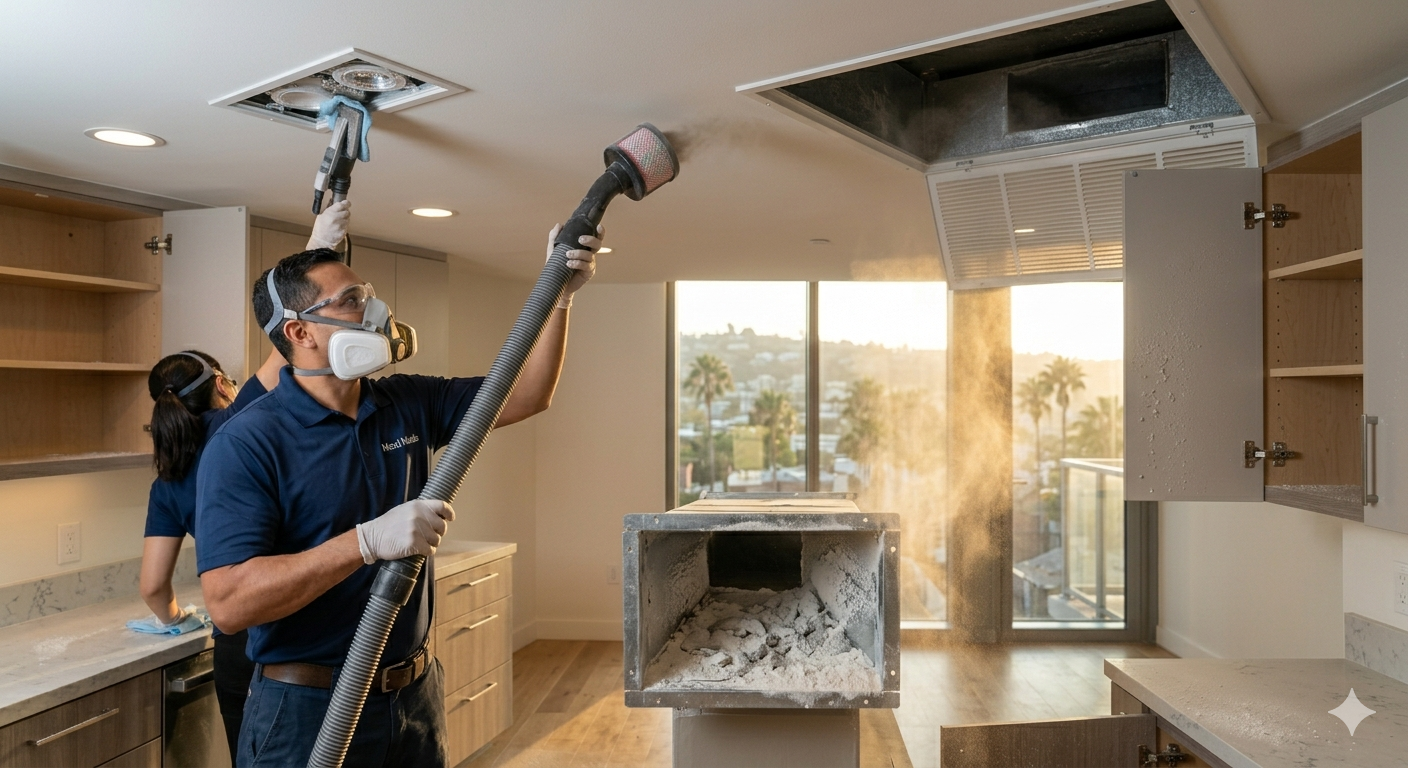
You just finished a renovation. The contractors are gone, the new floors are in, the kitchen looks exactly how you planned it for months. You run a cloth across the counter and it comes back gray. You check the windowsill — gray again. You look up at the light fixture and notice a fine coat of white powder sitting on every surface it touches.
A week later, same thing.
This is one of the most common frustrations homeowners face after a renovation, and it has a straightforward explanation. Construction dust is not like regular household dust. It behaves differently, settles differently, and requires a completely different approach to remove it properly. If your home still feels dusty weeks after construction ended, the problem is not that you haven't cleaned enough. The problem is that the right cleaning never happened in the first place.
Why Construction Dust Is So Hard to Get Rid Of
Regular household dust is made up of skin cells, fabric fibers, and outdoor particles. It settles quickly and wipes away easily. Construction dust is a different material entirely.
Drywall dust, in particular, is extremely fine — far finer than anything produced by normal daily living. It stays airborne for extended periods, which is why surfaces you cleaned yesterday look dusty again today. It is not new dust arriving from outside. It is the same construction dust, still circulating through the air and settling all over again.
Add to this the sawdust from cut lumber, the silica particles from concrete or tile work, and the insulation fibers that travel through air currents, and you have a mixture of materials that settles into every crack, every vent, every cabinet hinge, and every surface in the home — including the ones that were behind closed doors during the renovation.
Standard cleaning removes what sits on top. It does not address what has worked its way into grout lines, into carpet fibers, or into the ductwork of your home's ventilation system. Until those deeper sources are cleaned, the dust keeps coming back.
The Role Your HVAC System Is Playing
Here is something most homeowners do not realize until someone points it out. Your heating and cooling system circulates air through the entire home constantly. During renovation, that system was pulling construction dust into its returns and pushing it back out through every vent.
By the time construction ends, your ductwork has become a reservoir for fine particulate. Every time your system runs, it redistributes that dust throughout the home. This is why rooms far from the renovation area still feel dusty. This is why you can clean a room thoroughly and find it coated again within 24 hours.
Professional Deep Cleaning that addresses vents, returns, and ceiling fixtures is an essential part of solving this problem — not an optional add-on. Without it, no amount of surface cleaning will produce lasting results.
What Regular Cleaning Misses
When homeowners try to tackle post-renovation dust themselves, they typically start with the obvious surfaces — counters, floors, window ledges. These get clean. Then the dust comes back. So they clean again. The cycle repeats because the source of the dust has not been addressed.
A professional maid service trained in post-construction environments follows a completely different sequence. Work starts at the highest points in each room — ceiling fans, light fixtures, the tops of cabinets — and moves systematically downward. This ensures that dust dislodged from upper surfaces falls onto areas not yet cleaned, rather than resettling on surfaces already done.
From there, every horizontal surface gets attention — shelves, windowsills, baseboards, door frames, cabinet interiors, and the edges around newly installed appliances. Floors are the last thing addressed, once everything above them has been properly cleared.
This top-to-bottom, room-by-room sequence is the only approach that actually breaks the cycle of dust returning. Anything less and you are cleaning the same particles off the same surfaces in a different order.
What Floors and Carpets Are Holding
Hard floors after a renovation carry a layer of fine grit that is not always visible but is consistently felt underfoot. It causes premature scratching on hardwood and makes tile feel rough. Proper floor cleaning after construction requires more than mopping — it requires the right products for each surface type and the knowledge to use them without damaging new finishes.
Carpeted areas present an even bigger challenge. Construction dust settles deep into carpet fibers where it compacts over time. Vacuuming pulls up the surface layer but leaves the embedded particles behind. Professional Carpet cleaning using hot water extraction reaches those deeper layers and removes what surface cleaning cannot — improving both the appearance of the carpet and the air quality in the room.
For furniture that was present during renovation, the same logic applies. Sofas, chairs, and fabric headboards absorb fine dust during construction. Without professional upholstery cleaning, those pieces continue releasing particles into the air every time someone sits down.
The Kitchen and Bathroom Problem
Kitchens and bathrooms get overlooked during post-renovation cleaning more often than any other rooms. Both are full of surfaces that collect residue in ways that are not immediately obvious.
Inside kitchen cabinets, construction dust mixes with adhesive residue from packaging and settles onto shelves where dishes and food containers will sit. Grease from cooking bonds with drywall particles on surfaces near the stove. Before any kitchen is safe for food preparation, it needs a thorough wipe-down of every interior surface — not just the countertops visitors can see.
In bathrooms, newly grouted tile develops a haze that looks like dust but is actually grout residue left on the tile surface during installation. This haze must be removed with the correct technique within a specific timeframe. Leave it too long and it bonds permanently to the tile. Refrigerator interiors that collected dust during renovation also need proper attention before food goes back inside — a detail that Refrigerator Cleaning handles as part of a complete post-renovation reset.
When to Bring In Professionals
The right time to schedule professional cleaning after construction is immediately after the last contractor leaves — not after you have spent two weeks trying to manage it yourself.
Many homeowners wait, assuming the dust will settle and the worst of it will clear on its own. It does not. The longer fine construction particles sit in vents, in carpet fibers, and on surfaces, the more they compact and the harder they become to remove. Grout haze that is addressed within days comes off cleanly. Grout haze left for a month may be permanent.
For homeowners who are also coordinating a move, combining post construction cleaning with professional move-out cleaning from the previous property — or a move-in clean for the new one — simplifies the entire transition and ensures both spaces are genuinely ready.
For Businesses Reopening After Renovation
Commercial properties face the same dust problem with higher stakes. Employees returning to an office after a renovation should not be breathing construction particulate at their desks. Customers walking into a newly renovated retail space or restaurant should not notice dust on every surface.
Professional office cleaning services after a commercial renovation follows the same systematic approach — high to low, vent to floor, room by room — but scaled to the size and specific needs of the facility. For larger commercial spaces, janitorial services scheduled after the initial deep clean maintain the results going forward.
The Answer to Why the Dust Keeps Coming Back
Your home is still dusty after construction because construction dust is embedded in places standard cleaning does not reach. It is in your vents, in your carpet, in your cabinet interiors, and still circulating through your air supply. Cleaning the visible surfaces repeatedly will not fix this. A systematic, professional approach that addresses every layer — from ceiling to floor, from ductwork to upholstery — is what actually solves it.
At Mexi Maids Cleaning San Diego, post-construction cleaning is handled with exactly this kind of attention. Every room, every surface, every source. Because a renovation this significant deserves a clean this thorough.

 Arabic
 French
 Spanish
 Portuguese
 Deutsch
 Turkish
 Dutch
Dutch
 Italiano
 Russian
 Romaian
 Portuguese (Brazil)
 Greek
Greek