


Let me start with something I have heard hundreds of times from women who finally walk into a clinic after months of discomfort. “I thought it was just period pain.” “I assumed it would go away on its own.” “I didn't want to make a fuss over something small.”
I understand that hesitation. But here is what I have learned after years of studying women's health patterns. Pelvic pain is not something you should "wait and see" about. It is your body's way of sending you a message. And one of the most common messages is this: there is an infection that needs attention.
Let me walk you through what the research and clinical data actually say about pelvic pain and its connection to underlying infections. No scare tactics. Just the facts.
The Difference Between Normal Discomfort and Warning Pain
First, let us be honest about what "normal" looks like. Mild cramping around your period, a little twinge during ovulation, or a dull ache after a long day of standing these happen. They are usually harmless.
But here is where the line gets crossed. Pain that stays even when you are not menstruating. Pain that gets worse over time instead of better. Pain that comes with a fever, unusual discharge, or a burning sensation when you urinate. That is not normal. That is a signal.
When a woman describes pelvic pain that feels deep, constant, or throbbing and it has been there for more than a few days the first possibility any competent doctor considers is an infection.
The Usual Suspects: Infections That Cause Pelvic Pain
Let me name the most common ones, because knowing what you are dealing with makes the whole thing less scary.
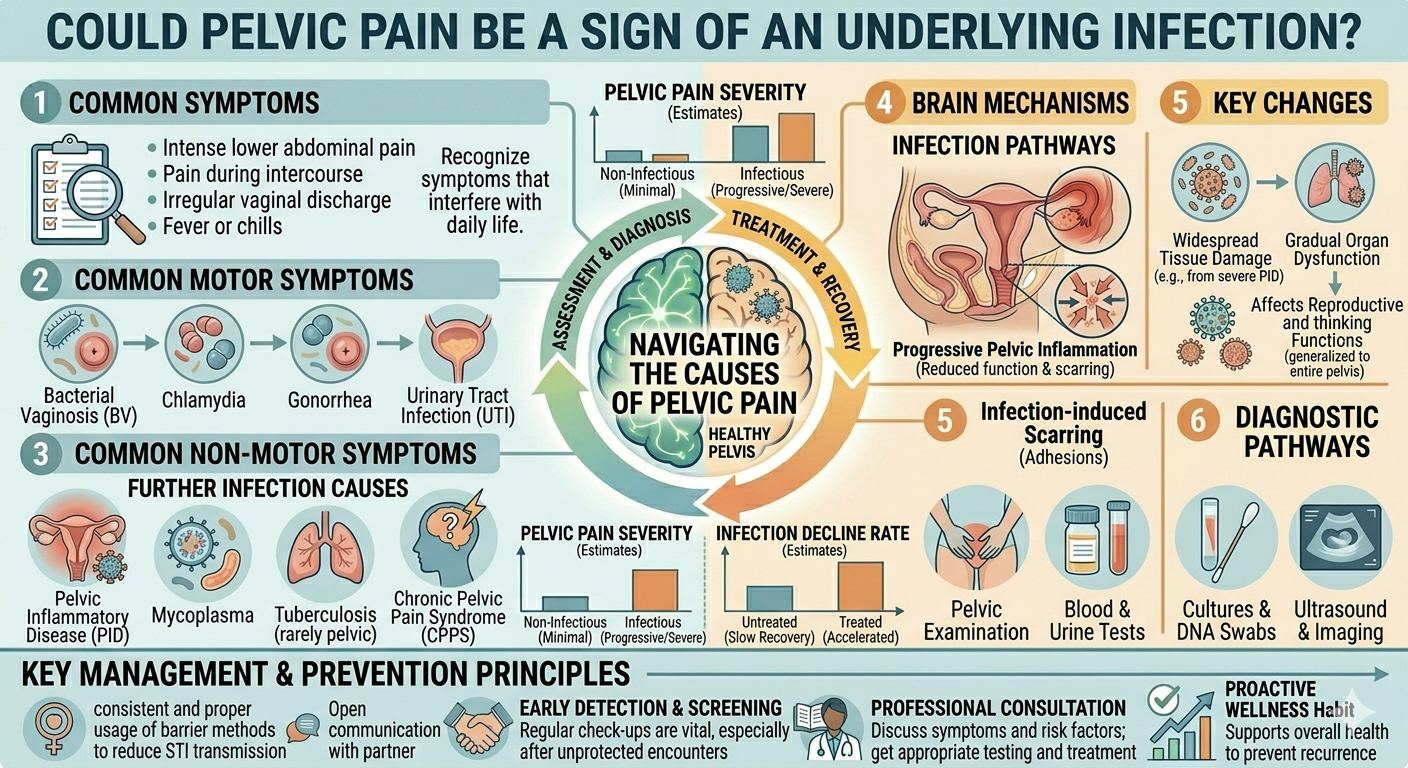
Pelvic Inflammatory Disease (PID) is at the top of the list. PID happens when bacteria usually from sexually transmitted infections like chlamydia or gonorrhoea travel from the vagina or cervix up into the uterus, fallopian tubes, or ovaries. The result is inflammation, scarring, and pain that can range from a dull ache to sharp, severe cramps. What worries me about PID is that it can be "silent" for some women. They have no dramatic symptoms, just a vague pelvic discomfort that they ignore. By the time they seek help, the infection may have already caused permanent damage to the fallopian tubes.
Urinary Tract Infections (UTIs) are another common cause. Most people think of burning urination when they hear UTI. But a bladder or kidney infection can also present as lower belly pain or pressure. If the infection climbs to the kidneys, the pain shifts to the sides or lower back, often accompanied by fever and chills.
Sexually Transmitted Infections (STIs) like chlamydia and gonorrhoea are notorious for causing pelvic pain in their advanced stages. In the early stages, they might have no symptoms at all. That is why routine screening matters. By the time pain appears, the infection has usually been there for weeks or months, and it may have already caused inflammation in the upper reproductive tract.
Endometritis is an infection of the uterine lining. It can happen after childbirth, miscarriage, or any procedure that enters the uterus, like an IUD insertion or a D&C. The pain feels like severe menstrual cramps, often with a foul-smelling discharge and low-grade fever.
Tubo-ovarian abscess is a more serious complication where an infection creates a pocket of pus in the fallopian tube or ovary. The pain is usually sharp, localised to one side, and severe enough to make you stop what you are doing. This requires immediate medical attention.
How to Tell If Your Pain Is Infection-Related
I am often asked, "How do I know if it is an infection or just something else?" There is no 100% home test, but here are the red flags that strongly point toward an infection.
Pain that is constant, not cyclic. Infection pain does not follow your menstrual calendar. It shows up and stays.
Pain accompanied by fever or chills. That is your immune system sounding the alarm.
Pain with abnormal discharge. Yellow, green, grey, or foul-smelling discharge almost always means infection.
Pain during or after sex. Deep pain during intercourse is a classic sign of pelvic inflammation.
Pain with urinary symptoms. Burning, frequency, or urgency alongside pelvic pain points to a UTI or something affecting the bladder.
If you have two or more of these, please do not wait. The longer an infection sits, the more damage it can do.
What Happens If You Ignore It?
I will not sugarcoat this. An untreated pelvic infection can lead to some serious outcomes.
Chronic pelvic pain that lasts for years. Scarred fallopian tubes that cause infertility. Ectopic pregnancy, which is life-threatening. Adhesions bands of scar tissue that stick organs together and cause constant pulling pain. Sepsis, in extreme cases where the infection spreads to the bloodstream.
None of these are inevitable. They are avoidable. But the window to avoid them is early diagnosis and treatment.
When and Where to Seek Help
If you have had pelvic pain for more than a week, or if the pain is severe enough to interfere with your daily life, make an appointment. Do not wait for your annual checkup. Do not hope it goes away.
A proper evaluation will include a detailed history, a pelvic exam, possibly an ultrasound, and sometimes swabs or blood tests. Most infections are treatable with a course of antibiotics. Some may require a short hospital stay or minor procedure if an abscess has formed. But the treatment is straightforward when caught early.
If you are in the Delhi NCR region, particularly in the southern part of the city, I strongly recommend that you visit the best gynecologist in south Delhi for a thorough evaluation. Look for someone who specializes in infectious diseases of the reproductive tract and has experience with chronic pelvic pain. A clinic with in-house ultrasound and lab services will save you time and repeated visits.
For women who prefer a female doctor and many do, especially when discussing symptoms that feel personal or embarrassing you should consult the best female gynecologist in South Delhi. Female gynecologists often bring an additional layer of understanding and comfort to these conversations. They have likely treated hundreds of women with exactly the same symptoms you are experiencing.
Do not let hesitation or embarrassment delay you. These doctors see pelvic infections every single day. They will not judge you. They will help you.
The Bottom Line
Pelvic pain is not a "mystery" that you have to live with. In a large number of cases, it is an infection that can be identified, treated, and cured. The key is acting early.
Do not normalize pain that does not feel normal to you. Trust your body. And when your body sends a signal, give it the attention it deserves. A short visit to a gynecologist could save you months of suffering and protect your fertility for the future.


 English
 Arabic
 French
 Spanish
 Portuguese
 Deutsch
 Turkish
 Italiano
 Russian
 Romaian
 Portuguese (Brazil)
 Greek
Greek