


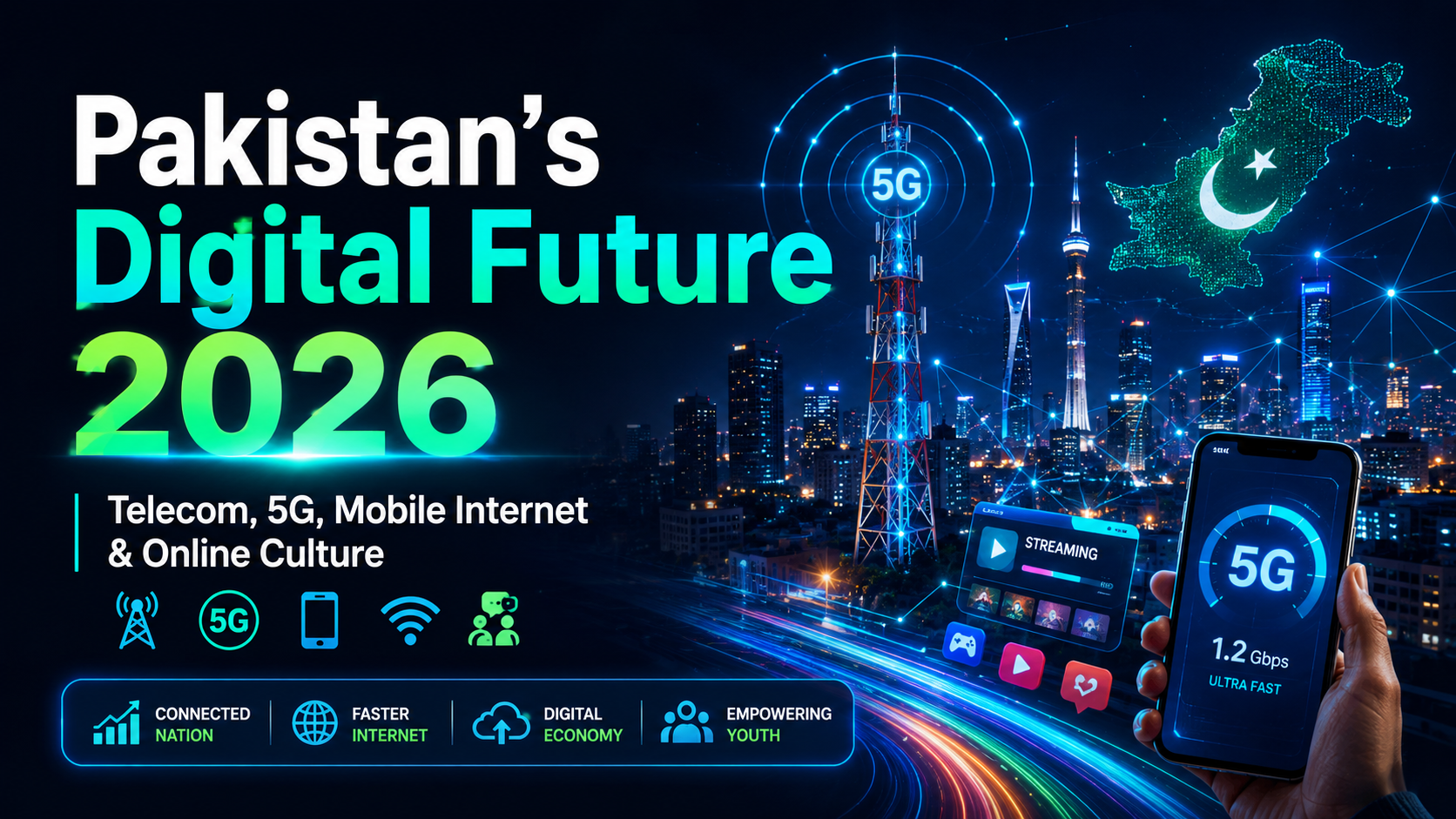
Pakistan’s digital future is no longer just about faster internet or cheaper mobile packages. In 2026, the real story is bigger than that. It is about how telecom networks, 5G planning, fiber internet, smartphone access, digital payments, online entertainment, sports conversations, and social media culture are all becoming part of everyday life.
For a long time, people in Pakistan looked at telecom only as a basic utility. A mobile network was something used for calls, messages, and data bundles. But now, the same network is connected to online banking, remote work, e-commerce, streaming apps, school learning, digital identity, content creation, and even how fans follow dramas, cricket, and music trends.
This shift is why Pakistan’s digital future depends on more than one thing. It needs stronger infrastructure, better policies, affordable smartphones, reliable broadband, safer SIM verification, and improved mobile network quality. At the same time, it also depends on how people use the internet for entertainment, news, learning, shopping, and community conversations.
Pakistan’s Digital Future Starts With Stronger Telecom Infrastructure
Every digital economy needs a strong network foundation. Without towers, fiber backhaul, data centers, submarine cables, and reliable power systems, even the best apps and digital services cannot work properly.
This is why telecom infrastructure sharing is becoming an important discussion. Instead of every company building separate towers and systems in every area, shared infrastructure can reduce costs and improve coverage. A detailed discussion on how telecom infrastructure sharing could help Pakistan improve connectivity shows why this model may become more important as demand for mobile data keeps growing.
The same applies to fiber networks. Many users only see the internet speed on their phones or Wi-Fi routers, but behind that speed is a larger system of cables, routing equipment, and backhaul capacity. That is why fiber backhaul is becoming the quiet reason behind better internet performance. If backhaul is weak, even a strong mobile tower cannot deliver a smooth experience.
Pakistan also depends heavily on international connectivity. Submarine cables may not be visible to ordinary users, but they are one of the most important parts of the country’s digital backbone. The role of submarine cables as Pakistan’s hidden internet lifeline matters because almost every global app, cloud service, streaming platform, and communication tool depends on international data routes.
5G Is Not Just About Speed
Most people think 5G only means faster downloads. That is part of the story, but not the full picture. In reality, 5G can change how businesses, cities, hospitals, factories, farms, and public services connect with each other.
A good example is 5G network slicing and how it may turn mobile internet into a premium service. Network slicing allows telecom operators to create different virtual network layers for different needs. For example, one slice could support normal mobile users, while another could support hospitals, smart factories, or emergency services that need more reliable connectivity.
There is also growing interest in Pakistan’s 5G spectrum auction and how it could decide the real speed of digital growth. Spectrum is like digital road space. If operators do not get enough suitable spectrum at reasonable conditions, 5G rollout can become slow, expensive, or limited to only major cities.
For companies, the bigger opportunity may come from private networks. Private 5G networks are becoming the new digital backbone for businesses because they can support factories, warehouses, ports, campuses, and large business operations with secure and controlled connectivity.
This matters because Pakistan’s digital future will not be built only by consumer internet users. It will also be shaped by industries that need faster automation, better tracking, real-time data, and connected machines.
eSIM, VoLTE, and Better Mobile Experiences
Digital transformation is not always about big infrastructure projects. Sometimes, small user-facing changes can make a big difference.
One example is eSIM. Traditional SIM cards are still common, but eSIM can make mobile switching easier, especially for frequent travelers, business users, and people who manage multiple numbers. The article on how eSIM in Pakistan is slowly changing how people use mobile services explains why this shift can improve convenience over time.
Another important upgrade is VoLTE. Many users complain about call drops, poor voice quality, or calls switching away from 4G. That is why VoLTE in Pakistan could fix the call quality problem users complain about daily. Better voice quality is not a luxury anymore, especially when calls are used for work, banking, deliveries, customer support, and family communication.
Mobile number portability is another consumer-friendly feature. It gives users more control by allowing them to keep their number while changing networks. Still, many people do not use it because they are unaware of the process or do not want the hassle. That is why mobile number portability gives users power but many still do not use it is an important consumer topic.
Mobile Network Quality Matters More Than Cheap Data
For years, the telecom market focused heavily on low-cost data bundles. Cheap internet helped millions of users come online, but now users want something more important: reliable quality.
A cheap package does not help much if videos keep buffering, calls drop, online classes disconnect, or payment apps fail at the wrong time. This is why mobile network quality in Pakistan is now more important than cheap data.
Network quality affects students, freelancers, small business owners, drivers, shopkeepers, content creators, and remote workers. It also affects people in smaller cities and rural areas, where one weak signal can limit access to education, job opportunities, and digital services.
Telecom complaints also reveal what users actually experience on the ground. The discussion on how telecom consumer complaints show what mobile users really need makes it clear that customer experience must become a serious part of telecom planning.
Rural Broadband Is the Real Test
Pakistan’s digital future cannot be measured only by internet speed in big cities. The real test is whether small towns, villages, and underserved areas can also access reliable broadband.
This is why rural broadband in Pakistan is becoming a test for digital inclusion. If rural users remain disconnected or poorly connected, the digital economy will remain uneven.
Fiber-to-the-home is also part of this story. Many homes still depend on unstable connections, shared bandwidth, or limited local providers. The rise of FTTH internet as Pakistan’s real broadband test shows how fixed broadband can support streaming, remote work, online education, gaming, and digital businesses.
The challenge is not only technical. It is also about affordability, awareness, service quality, and local availability. A connection that works well in one city may not be available in another. That gap must close if Pakistan wants real digital progress.
Smartphone Affordability Can Decide Who Gets Left Behind
Internet access is not only about network coverage. People also need devices that can support modern apps, video calls, banking tools, learning platforms, and security updates.
That is why smartphone affordability is still blocking Pakistan’s mobile internet growth. If smartphones become too expensive, many users stay limited to older devices that cannot fully support modern digital services.
This affects students, low-income families, gig workers, small sellers, and people trying to join the online economy. A better digital future needs affordable devices, better financing options, local availability, and policies that do not make basic digital access harder.
Taxes also play a role. The article on how telecom taxes in Pakistan are making mobile services more expensive connects directly with this issue. When telecom services and devices become expensive, the digital divide becomes wider.
PTA Registration, SIM Verification, and Digital Trust
As more people come online, trust and security become more important. Mobile numbers are now linked with banking apps, social media accounts, delivery services, government systems, and digital wallets. This makes SIM verification and device registration more than simple administrative processes.
The article on how SIM verification in Pakistan is becoming a bigger consumer issue highlights why identity, safety, and convenience need to be balanced. Users want protection from fraud, but they also want simple and fair processes.
Similarly, PTA device registration has become a key part of the mobile phone market. Device registration affects buyers, sellers, importers, and ordinary users who want to make sure their phones work properly on local networks.
Digital trust also includes cybersecurity. As telecom networks support more services, they also become bigger targets for fraud, spam, hacking, and misuse. That is why discussions like this Medium analysis on telecom and digital security fit naturally into the wider conversation about Pakistan’s digital future.
IoT Can Connect Farms, Factories, and Cities
The Internet of Things, or IoT, is another major part of the digital future. IoT means connecting devices, sensors, machines, vehicles, and systems so they can collect and share data.
This can help farms monitor water use, factories track production, cities manage traffic, and businesses improve logistics. The article on how IoT in Pakistan telecom could connect farms, factories, and cities explains why telecom networks will be important for this transformation.
IoT is not only a futuristic idea. It can solve real problems. Farmers can use connected tools for irrigation. Logistics companies can track vehicles. Energy companies can monitor systems. Retailers can manage inventory. Cities can improve public services.
But IoT needs stable networks, affordable devices, cloud systems, and proper data security. Without those, the technology remains limited to pilots and presentations instead of becoming useful in everyday life.
Green Telecom and Reliable Power
One of the less-discussed parts of telecom is energy. Mobile towers, data centers, and network systems need reliable power. In a country where energy cost and availability can be challenging, telecom companies must think seriously about efficiency.
That is why green telecom could help Pakistan build more reliable networks. Solar power, better batteries, efficient equipment, and smarter energy management can reduce costs and improve uptime.
Green telecom is not only about the environment. It is also about service reliability. If network sites have better power backup and lower operating costs, users can experience fewer disruptions. This becomes even more important as demand for mobile data, cloud services, and online apps continues to grow.
Data centers are also becoming more important. The article on how telecom data centers are becoming new digital infrastructure shows how local hosting, cloud services, and enterprise platforms can support faster and more stable digital services.
Digital Payments and the Everyday Economy
Telecom networks are also powering Pakistan’s shift toward a digital economy. Mobile wallets, banking apps, QR payments, online shopping, freelancing platforms, ride-hailing services, and delivery apps all depend on connectivity.
The article on telecom networks powering Pakistan’s shift toward digital payments shows why mobile networks are now part of financial inclusion. For many people, the first step into digital finance is not a bank branch. It is a mobile phone.
When mobile internet works smoothly, payments become easier. Small businesses can accept digital payments. Customers can transfer money quickly. Freelancers can manage income. Families can send support to each other. But when networks are weak or apps fail, trust in digital payments also suffers.
This is why telecom quality and financial inclusion are now connected. Better networks can support better economic participation.
MVNO Services Could Bring New Competition
Competition is important for better pricing, service quality, and innovation. In many markets, Mobile Virtual Network Operators, or MVNOs, help create more flexible mobile services by using existing network infrastructure.
The article on how MVNO services could bring a new kind of mobile competition to Pakistan raises an important point. If implemented properly, MVNOs could serve specific customer groups, offer niche packages, and improve choice without requiring every new provider to build a complete physical network.
For example, there could be mobile services focused on students, freelancers, businesses, travelers, or overseas Pakistanis. This kind of competition could push the market to become more creative.
AI and Automation Are Entering Telecom
Telecom networks are becoming too complex to manage with old methods alone. Operators now need data analytics, automation, predictive maintenance, fraud detection, customer behavior analysis, and smarter network planning.
This is where AI becomes important. A broader Medium discussion on AI-driven telecom change connects with how networks may become more intelligent over time.
AI can help telecom companies predict congestion, detect faults, improve customer support, reduce downtime, and plan capacity more accurately. It can also help with personalized packages, network optimization, and security monitoring.
However, AI must be used responsibly. Users need privacy, transparency, and protection from misuse. The goal should be better service, not confusing customers or collecting unnecessary data.
Pakistan’s Online Culture Is Growing With the Network
Digital transformation is not only about infrastructure. It is also about culture. As more people get online, they consume more dramas, songs, Netflix shows, sports updates, celebrity news, and social media debates.
This is why telecom growth and entertainment growth are connected. When internet access improves, streaming platforms, YouTube channels, drama clips, music videos, and fan communities grow faster.
For example, the success of Sanwal Yaar Piya crossing 1 billion views shows how Pakistani drama content can travel across platforms and audiences. A hit drama is no longer limited to TV screens. It becomes part of online conversation, reaction videos, short clips, and fan posts.
Similarly, Mitti De Baway and the excitement around Wahaj Ali and Mahira Khan’s first drama shows how star power and digital buzz can shape entertainment attention before and after a show airs.
Netflix conversations also show the same behavior. The article on Berlin Season 2 and why Pakistani Netflix fans are talking about it reflects how global streaming culture is now part of local online discussion.
Music, Celebrities, and Viral Conversations
Music trends also move quickly in Pakistan’s online spaces. A song can become popular through reels, TikTok-style edits, YouTube comments, fan pages, and emotional sharing.
That is why Kaifi Khalil’s Muntazir and its emotional popularity in Pakistan is more than just a music trend. It shows how digital platforms help emotional songs find wider audiences.
Celebrity moments also become larger through social media. Sanam Saeed’s Cannes 2026 red carpet debut became a cultural talking point because online audiences now follow fashion, film, identity, and representation together.
The same is true for viral celebrity discussions like Hania Aamir and Asim Azhar breaking the internet again. Whether people follow these stories seriously or casually, the larger point is clear: online culture has become a powerful part of public conversation.
A related Medium post on entertainment and online discussion also fits into this changing media environment.
Sports Fans Are Now Digital-First
Cricket and sports conversations have always been emotional in Pakistan. But now, those conversations happen instantly across social media, video platforms, comment sections, and fan pages.
The discussion around Pakistan’s Bangladesh whitewash and what went wrong for the Green Shirts shows how fast analysis spreads after a match or series. Fans no longer wait for newspaper columns the next morning. They react immediately.
Similarly, Peshawar Zalmi’s PSL 2026 final win and Babar Azam’s big moment shows how sports success becomes a digital celebration. Highlights, memes, edits, statistics, and emotional posts all become part of the experience.
This is another reason why telecom quality matters. A poor connection can affect live streaming, score updates, video highlights, and fan engagement.
Online Lifestyle, Food, and Seasonal Searches
Digital culture is not limited to telecom, dramas, music, and cricket. People also use the internet for recipes, event ideas, seasonal planning, shopping, and lifestyle inspiration.
A simple food blog or community comment section, such as this Latvian stew recipe discussion, shows how online content can connect people around books, food, and culture.
Seasonal planning also becomes digital. Around festivals, people search for travel ideas, shopping guides, food plans, greetings, and family activities. A related Medium post on seasonal planning and online behavior fits into this wider habit of using the internet for everyday decisions.
This is the human side of digital growth. Better connectivity does not only help big companies. It helps ordinary people find information, share memories, plan events, learn recipes, watch shows, follow sports, and stay connected with family.
The Real Future Is Connected, Practical, and Human
Pakistan’s digital future in 2026 is not one single story. It is a mix of telecom upgrades, better broadband, 5G planning, consumer protection, device affordability, online payments, cloud infrastructure, entertainment culture, and everyday internet habits.
The country needs stronger networks, but it also needs fair pricing. It needs 5G, but it also needs rural broadband. It needs digital payments, but it also needs trust. It needs SIM verification, but it also needs user-friendly systems. It needs streaming platforms and online culture, but it also needs reliable mobile quality so people can actually enjoy them.
The most important point is simple: digital growth should improve real life. It should help students learn, workers earn, businesses grow, families connect, creators publish, fans engage, and communities participate.
If Pakistan can build reliable infrastructure, improve affordability, support innovation, and protect users, the digital future will not remain just a promise. It will become part of everyday life for millions of people.

 English
 Arabic
 French
 Spanish
 Portuguese
 Deutsch
 Turkish
 Dutch
Dutch
 Italiano
 Russian
 Romaian
 Portuguese (Brazil)