


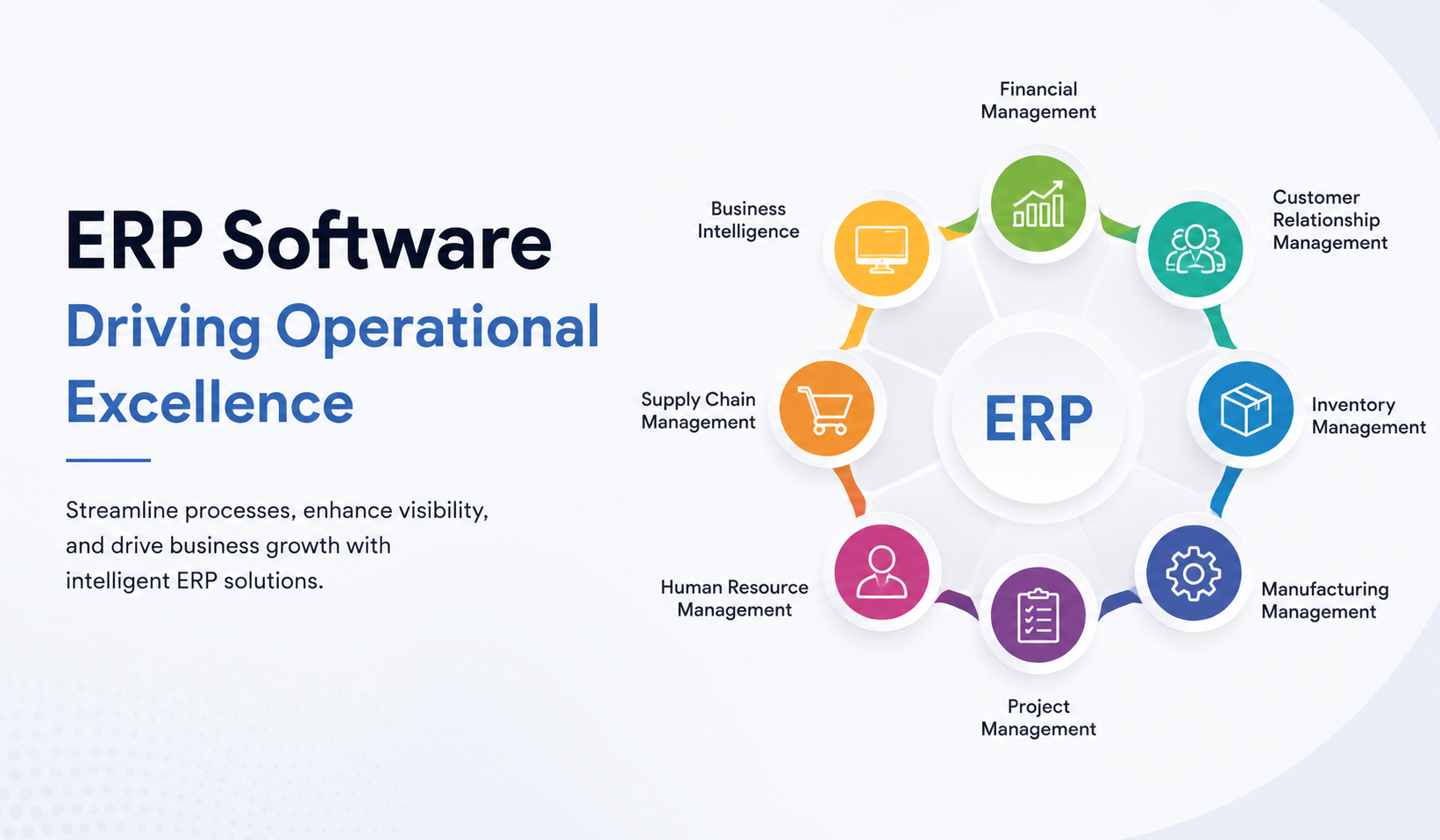
Every business wants smoother operations, faster decisions, and fewer headaches. Yet many organizations still juggle disconnected systems, scattered spreadsheets, and manual processes that quietly drain productivity. Operational excellence is not achieved through harder work alone—it comes from working smarter. ERP software brings essential business functions together under one roof, creating a connected environment where information flows seamlessly. We have observed that companies often spend years fixing symptoms while ignoring the root cause. An ERP system addresses that root cause by providing structure, visibility, and efficiency across the entire organization.
Understanding Operational Excellence in Modern Business
Operational excellence is the ongoing pursuit of better performance through efficiency, consistency, and continuous improvement. Businesses today face increasing customer expectations, growing competition, and more complex workflows than ever before. Delivering quality products or services requires every department to work in harmony. That sounds simple in theory (and wonderfully optimistic in practice), but disconnected systems often create barriers. Operational excellence focuses on eliminating those barriers. By standardizing processes, improving communication, and enabling better resource utilization, organizations create a foundation that supports long-term growth and sustainable success.
How ERP Software Eliminates Data Silos
Data silos are one of the most common obstacles to operational efficiency. Sales teams may maintain one set of records, finance another, and operations yet another. The result is confusion, duplication, and inconsistent reporting. ERP software creates a centralized repository where departments access the same information in real time. Instead of debating whose spreadsheet contains the correct numbers, teams can focus on solving business challenges. Improved collaboration becomes possible because everyone works from a shared source of truth. The organization gains greater transparency, accuracy, and confidence in everyday decision-making.
Streamlining Business Processes Through Automation
Manual processes consume valuable time and increase the likelihood of human error. Tasks such as invoice approvals, inventory updates, employee onboarding, and reporting can quickly become bottlenecks. ERP software automates these repetitive activities, allowing teams to focus on higher-value work. We once observed a company that proudly maintained dozens of interconnected spreadsheets—until nobody could explain how they all worked. Automation replaced that maze with structured workflows and measurable outcomes. By reducing manual intervention, ERP systems accelerate operations, improve consistency, and help organizations maintain productivity even as business demands increase.
Enhancing Visibility Across Departments
Business leaders cannot improve what they cannot see. Visibility is essential for identifying inefficiencies, monitoring performance, and responding to changing conditions. ERP software provides comprehensive dashboards and reporting tools that offer real-time insights across departments. Finance, sales, procurement, and operations gain access to critical information without waiting for separate reports. This shared visibility strengthens coordination and accountability. Problems become easier to identify before they escalate into larger issues. Organizations benefit from faster responses, better planning, and a clearer understanding of how every function contributes to overall business performance.
Improving Decision-Making with Accurate Business Intelligence
Successful decisions depend on accurate information. Unfortunately, many organizations still rely on outdated reports or fragmented data when evaluating opportunities and risks. ERP software consolidates information from across the business and transforms it into actionable insights. Leaders can monitor performance metrics, analyze trends, and forecast future outcomes with greater confidence. Instead of relying on assumptions, teams make decisions supported by real-time intelligence. Better visibility into operations helps organizations identify opportunities, reduce inefficiencies, and allocate resources more effectively. Data-driven decision-making becomes a practical reality rather than a corporate buzzword.
Increasing Productivity Without Increasing Complexity
Growth often introduces additional processes, responsibilities, and challenges. Without the right systems in place, complexity can quickly overwhelm productivity. ERP software simplifies operations by standardizing workflows and reducing administrative burdens. Employees spend less time searching for information and more time completing meaningful tasks. Collaboration improves because everyone follows consistent processes and accesses the same data. Productivity gains occur naturally without creating unnecessary layers of management or bureaucracy. Operational excellence thrives when businesses remove friction from everyday activities and enable teams to focus on delivering value rather than managing inefficiencies.
Supporting Scalability and Business Growth
Business growth is exciting—but it can also expose weaknesses in existing processes. Systems that worked for a small organization may struggle to support larger teams, additional locations, or increased transaction volumes. ERP software provides the scalability required to manage expansion effectively. A reliable custom ERP software development company can create solutions that evolve alongside business needs rather than forcing organizations to adapt to rigid software limitations. Scalable ERP systems help companies maintain efficiency, consistency, and control throughout periods of growth while supporting future operational requirements.
Strengthening Compliance and Risk Management
Regulatory requirements continue to grow across industries, making compliance a critical business concern. ERP software helps organizations maintain accurate records, track transactions, and establish clear audit trails. Access controls ensure sensitive information remains protected while authorized users retain necessary visibility. Automated documentation reduces the likelihood of compliance gaps and reporting errors. Risk management also improves because organizations gain better oversight of operational activities. Rather than scrambling to gather information during audits, businesses can access comprehensive records through a centralized system, improving accountability and reducing potential liabilities.
Why Custom ERP Solutions Deliver Greater Operational Excellence
Every business operates differently, which explains why generic software often creates limitations. Custom ERP solutions are designed around specific workflows, goals, and operational requirements. Instead of forcing employees to adapt to predefined processes, customized systems support existing business practices while improving efficiency. Experienced ERP developers can integrate essential tools, automate unique workflows, and create functionality tailored to organizational needs. This flexibility helps businesses maximize technology investments while maintaining operational alignment. Customization transforms ERP software from a management tool into a strategic asset that drives measurable performance improvements.
Common Signs Your Business Needs an ERP System
Certain operational challenges often signal the need for ERP implementation. Frequent data entry, delayed reporting, inconsistent information, and excessive spreadsheet usage are common indicators. Communication breakdowns between departments can also reveal underlying process issues. As organizations grow, these problems typically become more pronounced and costly. ERP software addresses these challenges by creating standardized processes and centralized data management. Businesses that recognize these warning signs early can prevent operational inefficiencies from limiting future growth. Identifying the need for ERP is often the first step toward achieving greater organizational effectiveness.
The Financial Impact of ERP-Driven Operational Excellence
Operational improvements often translate directly into financial benefits. ERP software reduces waste, improves resource utilization, and streamlines business processes that affect profitability. Faster workflows lower operational costs while improved accuracy reduces costly mistakes. Enhanced visibility enables better budgeting, forecasting, and investment decisions. Customer satisfaction may also improve due to more consistent service delivery and faster response times. Although ERP implementation requires investment, the long-term returns frequently justify the effort. Organizations that achieve operational excellence often discover that efficiency gains create opportunities for sustained revenue growth and stronger financial performance.
Future Trends Shaping ERP Technology
ERP technology continues to evolve alongside changing business requirements. Artificial intelligence is enhancing predictive analytics and decision-making capabilities. Cloud-based platforms offer greater flexibility, accessibility, and scalability. Mobile functionality supports increasingly distributed workforces, allowing employees to access critical information from virtually anywhere. Advanced automation further reduces manual workloads and improves operational efficiency. Integration with emerging technologies creates new opportunities for innovation and growth. Businesses that embrace these developments position themselves to remain competitive in rapidly changing markets. The future of ERP is increasingly intelligent, connected, and responsive to organizational needs.
Conclusion
Operational excellence is not achieved through isolated improvements or temporary fixes. It requires a connected strategy that aligns people, processes, and technology. ERP software serves as a powerful foundation for that strategy by improving visibility, streamlining workflows, and supporting data-driven decisions. Organizations that invest in the right ERP solution gain the tools needed to operate more efficiently and adapt more effectively to change. The lesson remains surprisingly simple: businesses rarely struggle because they have too much information—they struggle because that information is scattered. ERP brings everything together, and operational excellence follows.
FAQs
What is ERP software?
ERP software is a system that integrates and manages core business processes through a single platform.
How does ERP improve efficiency?
It automates workflows, reduces manual work, and provides real-time business data.
Why choose a custom ERP solution?
Custom ERP solutions are tailored to specific business needs and processes.
Can ERP software reduce costs?
Yes, it helps lower costs by improving productivity and minimizing operational errors.
What industries use ERP software?
Manufacturing, healthcare, retail, logistics, finance, and many other industries use ERP systems.
How do ERP developers help businesses?
They build, customize, and optimize ERP solutions to match organizational goals.
Is ERP suitable for growing businesses?
Yes, ERP software scales with business growth and supports expanding operations.
What is the main benefit of ERP software?
The biggest benefit is improved visibility and control across all business functions.

 English
 Arabic
 French
 Portuguese
 Deutsch
 Turkish
 Dutch
Dutch
 Italiano
 Russian
 Romaian
 Portuguese (Brazil)
 Greek
Greek