


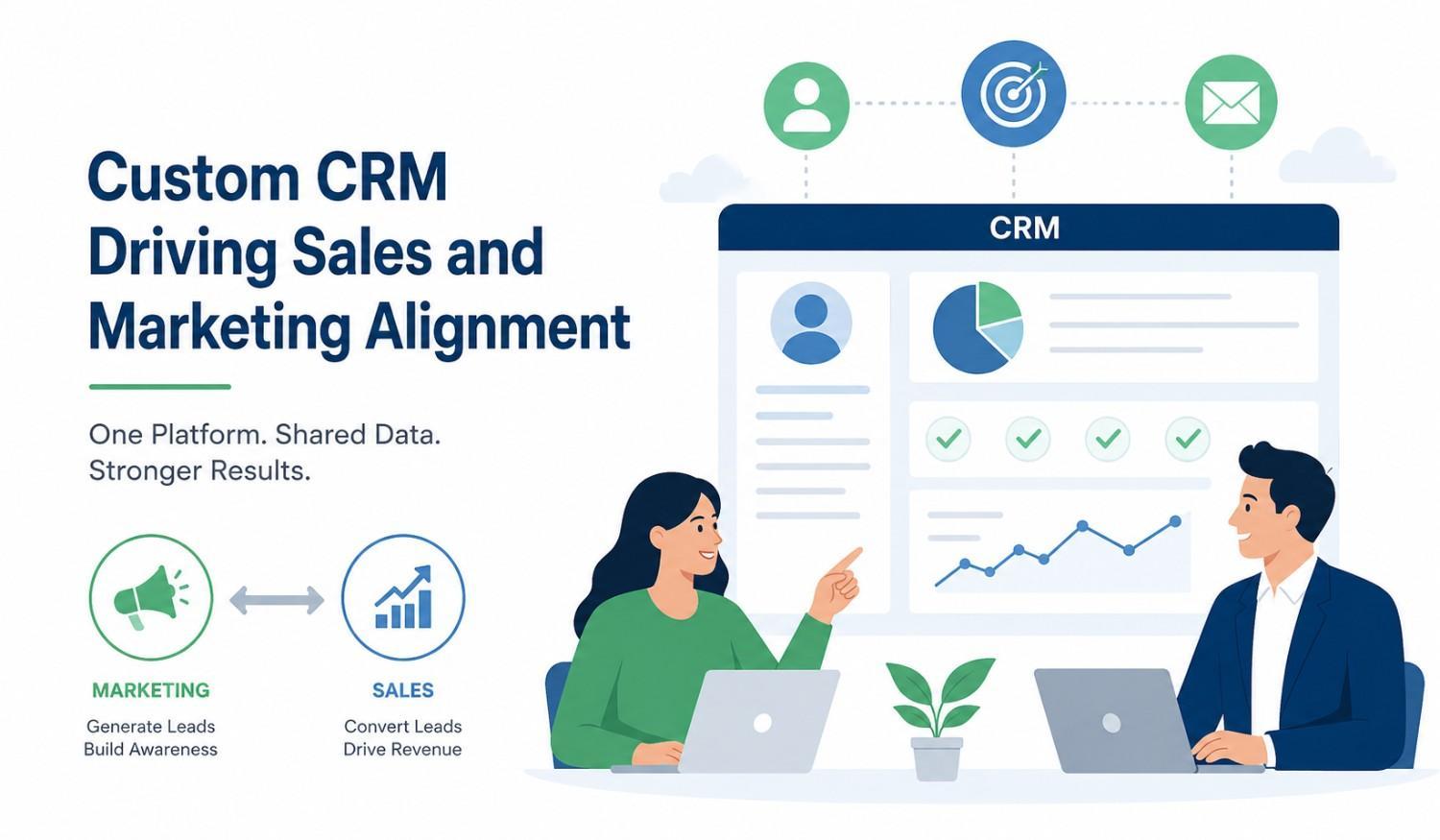
Sales and marketing teams often share the same destination but somehow end up using different maps. Marketing celebrates lead volume, sales focuses on revenue, and somewhere in between, valuable opportunities occasionally disappear into a black hole of spreadsheets, emails, and forgotten follow-ups. Sound familiar? We have seen businesses invest heavily in customer acquisition only to discover that internal disconnects were quietly slowing growth. That is where tailored CRM solutions enter the picture. By creating a shared view of customers, activities, and goals, businesses can finally replace guesswork with collaboration—and perhaps retire a few spreadsheets while they are at it.
Why Sales and Marketing Misalignment Continues to Challenge Businesses
Many organizations assume sales and marketing naturally work together because both contribute to growth. Reality tends to be a little messier. Marketing may generate hundreds of leads while sales questions their quality. Sales may close deals without sharing customer insights that could improve future campaigns. Different tools, disconnected reporting, and conflicting priorities often create frustration on both sides. The result is slower decision-making and missed revenue opportunities. Without a structured system connecting teams, alignment becomes less of a strategy and more of a hopeful suggestion discussed during meetings.
Different Goals, Different Metrics
Marketing departments are frequently measured by campaign performance, website traffic, engagement rates, and lead generation. Sales teams, meanwhile, live in a world of quotas, conversions, and revenue targets. Neither approach is wrong, but they can create competing priorities. Marketing may focus on generating more leads, while sales prefers fewer but highly qualified prospects. Without a shared framework, each team can feel the other is missing the point. A properly configured CRM creates transparency around common objectives, ensuring both departments work toward measurable business outcomes instead of separate scoreboards.
Data Silos Create Communication Gaps
Customer information often lives in multiple locations. Marketing platforms hold campaign engagement data. Sales systems track conversations and opportunities. Customer service applications contain support histories. The problem is not a lack of information—it is having too much information trapped in too many places. Teams end up making decisions based on incomplete pictures of customer behavior. Miscommunication becomes inevitable. When data silos persist, collaboration slows and customer experiences suffer. Bringing information together into one accessible platform helps eliminate confusion and encourages smarter conversations backed by reliable insights.
The Customer Often Gets Caught in the Middle
Customers rarely care which department owns a particular interaction. They simply expect consistent communication and timely responses. Unfortunately, when sales and marketing operate independently, customers may receive conflicting messages, duplicate outreach, or delayed follow-ups. Nothing damages confidence quite like being asked the same question three times by three different people. These disconnects can make businesses appear less organized than they actually are. Strong alignment supported by integrated CRM technology helps create a smoother customer journey, ensuring every interaction feels connected rather than completely accidental.
How Custom CRM Software Creates a Single Source of Truth
One of the biggest advantages of custom CRM software is its ability to centralize critical business information. Instead of relying on scattered systems, organizations gain a unified environment where sales and marketing teams access the same customer records, engagement history, and performance metrics. This shared visibility reduces misunderstandings and improves decision-making across departments. Everyone works from the same information rather than debating whose spreadsheet is most accurate. In many businesses, that alone can feel like a small miracle. Better visibility ultimately leads to better collaboration and stronger customer relationships.
Centralized Customer Information
Customers leave digital footprints everywhere—website visits, email clicks, inquiries, purchases, and support requests. When this information is stored across multiple platforms, important context often gets lost. A centralized CRM gathers these interactions into a single customer profile, giving teams a complete picture of each relationship. Marketing can see what interests prospects, while sales gains visibility into previous engagements and preferences. Rather than operating with fragmented information, both departments work with the same facts. The result is more personalized communication and a significantly improved customer experience.
Real-Time Data Accessibility
Business opportunities rarely wait for weekly status meetings. Teams need access to current information when making decisions. Real-time CRM updates ensure that customer activities, lead movements, and sales interactions are immediately visible across departments. Marketing can adjust campaigns based on live feedback, while sales representatives gain instant awareness of prospect engagement. This reduces delays and improves responsiveness throughout the customer journey. Faster access to information also increases accountability because everyone can see what actions have been taken and what tasks still require attention.
Eliminating Spreadsheet Chaos
Most growing businesses eventually encounter a folder containing files with names like “Final_Report_v7_Actually_Final.xlsx.” That moment usually signals a need for better systems. Spreadsheets are useful tools, but they were never designed to manage complex customer relationships across multiple teams. Version conflicts, duplicate entries, and outdated information quickly become common problems. A custom CRM eliminates much of this chaos by providing a centralized environment for managing data and workflows. Instead of hunting for information, employees can focus on serving customers and driving growth.
Improving Lead Management Through Better Alignment
Lead management is often where alignment succeeds or fails. Marketing works hard to attract prospects, while sales depends on receiving leads that are genuinely ready for conversations. Without clear processes, leads may be ignored, misclassified, or transferred too late. A tailored CRM solution creates structure around lead qualification, distribution, and tracking. Both departments gain visibility into the entire lifecycle, making it easier to identify bottlenecks and improve conversion rates. Better lead management not only increases efficiency but also ensures valuable opportunities receive the attention they deserve.
Standardizing Lead Qualification
One team's “hot lead” can be another team's “not yet.” This difference in perspective often causes friction between departments. A custom CRM helps establish consistent lead qualification criteria through shared scoring models and agreed-upon definitions. Marketing-qualified leads and sales-qualified leads become clearly distinguished, reducing confusion and improving handoff efficiency. Instead of relying on subjective opinions, both teams use the same standards to evaluate prospects. This consistency improves trust, strengthens collaboration, and helps sales focus on opportunities with the greatest potential for conversion.
Automated Lead Routing
Even the best-qualified lead can lose value if it sits untouched in a queue for days. Custom CRM platforms help eliminate delays through automated lead routing. Leads can be assigned based on territory, industry, product interest, availability, or any rule that fits the business. Sales representatives receive opportunities faster, and prospects receive quicker responses. Everyone wins. Automation also removes manual errors that often occur when leads are transferred between departments. Faster handoffs mean businesses can engage interested prospects while their attention—and buying intent—are still at their highest levels.
Visibility Into Lead Status
One common frustration for marketers is not knowing what happens after a lead reaches the sales team. Was the lead contacted? Did a conversation happen? Was an opportunity created? A CRM provides complete visibility into each stage of the sales process. Marketing teams can monitor outcomes, identify patterns, and better understand which campaigns generate valuable opportunities. Sales gains transparency as well, reducing unnecessary status requests and reporting meetings. Shared visibility creates accountability and encourages both departments to focus on improving overall results rather than assigning blame.
Enabling Smarter Marketing Campaign Decisions
Marketing performs best when decisions are supported by accurate customer and revenue data. Unfortunately, many businesses still evaluate campaigns using surface-level metrics such as clicks and impressions. While useful, those numbers tell only part of the story. A CRM bridges the gap between marketing activity and business outcomes. Teams can see how leads progress through the funnel and identify which initiatives contribute to actual revenue. This deeper understanding helps organizations invest resources more effectively while continuously improving campaign performance and customer engagement strategies.
Connecting Campaign Data to Revenue Outcomes
Marketing teams often celebrate campaign success based on engagement metrics, but executives usually care about revenue. A CRM helps connect those two worlds. By tracking customer journeys from initial interaction to closed sale, businesses gain a clear understanding of campaign effectiveness. Teams can identify which channels generate the highest-quality leads and which strategies deserve additional investment. This level of visibility removes much of the guesswork from marketing planning. Instead of relying on assumptions, organizations can make decisions based on measurable outcomes and verified customer behavior.
Building More Personalized Customer Journeys
Modern customers expect communication that feels relevant to their needs and interests. Generic messaging rarely produces meaningful engagement. CRM systems support personalization by collecting behavioral data and organizing customer information into actionable segments. Marketing teams can create targeted campaigns while sales representatives tailor conversations based on customer history and preferences. This coordinated approach improves engagement throughout the buying process. Customers feel understood rather than treated like anonymous contacts in a database. Better experiences naturally increase trust, conversion rates, and long-term customer loyalty.
Continuous Feedback Loops
Successful alignment depends on communication flowing in both directions. Sales teams interact directly with prospects and customers, making them valuable sources of market intelligence. Marketing teams generate engagement insights that can improve sales conversations. A CRM creates a structured environment where this information can be shared efficiently. Feedback becomes part of the process rather than an occasional discussion during meetings. Over time, these continuous feedback loops help refine messaging, improve targeting, and strengthen overall business performance. Small improvements accumulate into meaningful competitive advantages.
Helping Sales Teams Focus on High-Value Opportunities
Sales professionals generate the most value when they spend time building relationships and closing deals—not updating spreadsheets or searching for information. Custom CRM systems streamline administrative work while providing better visibility into opportunities. By automating routine processes and organizing customer data effectively, businesses enable sales teams to focus their energy where it matters most. Productivity improves, response times decrease, and pipeline management becomes more predictable. In a competitive marketplace, helping sales representatives prioritize high-value activities can have a significant impact on revenue growth.
Prioritizing Leads With Intelligent Workflows
Not every lead deserves the same level of attention. Intelligent CRM workflows help sales teams identify prospects most likely to convert. Factors such as engagement history, demographics, buying behavior, and qualification scores can be used to prioritize opportunities automatically. Representatives spend less time chasing unlikely prospects and more time engaging qualified buyers. This improves efficiency without sacrificing customer experience. Better prioritization also creates more accurate forecasting because teams gain clearer visibility into which opportunities are most likely to move forward through the pipeline.
Automating Administrative Tasks
Administrative work is necessary, but it should not consume the majority of a salesperson’s day. CRM automation reduces repetitive tasks such as scheduling follow-ups, updating records, sending reminders, and generating reports. These seemingly small efficiencies add up quickly. When employees spend less time managing paperwork and more time interacting with prospects, productivity naturally improves. Automation also ensures important tasks are not forgotten during busy periods. Consistency becomes easier to maintain, helping businesses deliver reliable customer experiences while reducing operational bottlenecks.
Better Pipeline Visibility
Forecasting becomes difficult when information is incomplete or outdated. A CRM provides real-time visibility into sales pipelines, helping managers monitor progress and identify potential issues early. Opportunities can be tracked through every stage, creating a clearer understanding of future revenue potential. Sales leaders gain access to accurate performance metrics, while marketing teams better understand conversion trends. Improved visibility supports smarter planning and resource allocation across departments. Rather than reacting to surprises, organizations can make proactive decisions based on reliable data and measurable activity.
Custom CRM Integrations That Strengthen Team Collaboration
Technology should connect departments, not create additional barriers between them. Unfortunately, many businesses rely on disconnected systems that make collaboration more difficult than necessary. Custom CRM integrations help unify essential tools, ensuring information flows seamlessly throughout the organization. Whether connecting marketing platforms, communication channels, or operational systems, integration creates a more complete view of customer interactions. Employees spend less time switching between applications and more time acting on insights. The result is greater efficiency, improved communication, and a stronger customer experience.
Connecting Marketing Automation Platforms
Marketing automation platforms generate valuable engagement data, but that information becomes even more useful when integrated with CRM systems. Email interactions, campaign responses, website behavior, and lead nurturing activities can automatically update customer profiles. Sales representatives gain immediate visibility into prospect interests and engagement history. Marketing teams can monitor how leads progress after entering the sales process. This seamless connection eliminates manual data transfers while providing richer insights into customer behavior. Better visibility enables smarter decisions across both departments.
Integrating Communication Channels
Customers communicate through multiple channels, including email, phone calls, chat applications, and support portals. Without integration, important conversations can become fragmented across different systems. A custom CRM brings these interactions together, creating a unified communication history. Teams gain full visibility into customer relationships regardless of how conversations occur. This prevents duplicate outreach and improves response quality. Customers appreciate dealing with businesses that remember previous interactions rather than forcing them to repeat information every time they make contact.
Bringing Business Systems Together
Sales and marketing are only part of the customer journey. Finance, operations, customer service, and inventory management often play important roles as well. Integrating CRM software with ERP platforms, analytics tools, and eCommerce systems creates a more complete business ecosystem. Information moves freely between departments, reducing manual work and improving accuracy. Decision-makers gain broader visibility into operations and customer relationships. When systems communicate effectively, businesses can respond more quickly to opportunities while maintaining consistency throughout the customer experience.
Why Off-the-Shelf CRM Platforms Often Fall Short
Off-the-shelf CRM solutions offer convenience, but convenience does not always equal effectiveness. Many businesses discover that generic platforms require them to adapt their processes to the software rather than the other way around. Workarounds become common, adoption decreases, and productivity suffers. While standard solutions can be useful for basic requirements, growing organizations often need greater flexibility. Tailored CRM systems provide the ability to align technology with actual business operations, creating a solution that supports growth instead of limiting it.
Generic Workflows Rarely Match Real Processes
Every business develops unique sales cycles, approval processes, and customer engagement strategies. Generic CRM workflows are designed to serve broad audiences, which means they rarely align perfectly with specific operational requirements. Employees often create manual workarounds to compensate for these limitations. Over time, those workarounds introduce inefficiencies and inconsistencies. A customized solution reflects actual business processes from the beginning, reducing friction and improving usability. Teams spend less time adapting to software and more time focusing on customers and business objectives.
Feature Overload Creates Adoption Problems
Many CRM platforms attempt to solve every possible problem for every possible industry. The result is often a system filled with features that employees never use. Complex interfaces can overwhelm users and reduce adoption rates. When employees avoid using a CRM, data quality declines and visibility suffers. Custom solutions focus on relevant functionality rather than unnecessary complexity. Users gain access to tools that support their responsibilities without navigating countless menus and options. Simplicity often drives stronger adoption and better long-term results.
Scalability Concerns
Business requirements evolve as organizations grow. New products, additional locations, larger teams, and changing customer expectations can expose limitations in standard CRM platforms. Scalability becomes a critical consideration. Custom systems can be designed with future growth in mind, making it easier to expand functionality when needed. Instead of replacing software every few years, businesses can adapt existing solutions to support changing requirements. This flexibility protects technology investments while ensuring systems remain aligned with strategic goals.
The Role of a Custom CRM Software Development Company in Business Growth
A custom CRM software development company helps organizations build systems that support specific operational requirements rather than forcing teams into predefined structures. The goal is not simply to develop software—it is to create a platform that improves efficiency, visibility, and customer engagement. Through careful planning and collaboration, businesses gain solutions tailored to their workflows and growth objectives. The result is technology that supports long-term success while helping sales and marketing teams operate with greater alignment and confidence.
Designing Around Existing Processes
Successful CRM implementation begins with understanding how a business actually operates. Customized development focuses on existing workflows, customer journeys, and operational requirements. Instead of redesigning processes to fit software limitations, the platform is built around real business needs. This approach reduces disruption and increases adoption because employees can continue working in familiar ways. A solution that reflects established processes naturally feels more intuitive, making it easier for teams to embrace and use consistently.
Creating Scalable CRM Architectures
Growth should be exciting, not something that exposes technology limitations. Scalable CRM architecture allows businesses to expand users, integrations, workflows, and reporting capabilities without rebuilding systems from scratch. Flexibility becomes a built-in advantage rather than an afterthought. As customer expectations evolve and business requirements change, the CRM can adapt accordingly. This future-focused approach helps organizations avoid costly migrations while maintaining operational efficiency and visibility across departments.
Delivering Better User Adoption
Even the most advanced CRM platform provides little value if employees avoid using it. Adoption depends on usability, relevance, and simplicity. Custom development prioritizes user experiences tailored to specific roles and responsibilities. Employees access the information and tools they need without unnecessary complexity. Training becomes easier, resistance decreases, and data quality improves. Strong adoption ensures businesses receive maximum value from their CRM investment while supporting better collaboration between departments.
Conclusion
Sales and marketing alignment is not achieved through good intentions alone. It requires shared visibility, consistent processes, and reliable information. Custom CRM solutions provide the foundation for that alignment by connecting teams, automating workflows, and centralizing customer data. We have observed businesses transform collaboration simply by replacing disconnected systems with a unified platform. Interestingly, the loudest complaint often becomes silence—because teams finally stop arguing about whose spreadsheet is correct. When technology supports teamwork, customer experiences improve, opportunities move faster, and growth becomes far more predictable.
FAQs
1. How does custom CRM software improve sales and marketing alignment?
Custom CRM software centralizes customer information, improves communication, automates workflows, and provides shared visibility into lead and customer activity.
2. Why is a custom CRM better than a standard CRM?
A custom CRM is designed around specific business processes, making it more flexible, scalable, and relevant to organizational needs.
3. Can CRM software improve lead conversion rates?
Yes. Better lead qualification, automated routing, and improved visibility help businesses respond faster and engage prospects more effectively.
4. How do CRM integrations support collaboration?
Integrations connect communication tools, marketing platforms, and operational systems, ensuring information flows seamlessly across departments.
5. What industries benefit from custom CRM solutions?
Industries including healthcare, finance, manufacturing, real estate, professional services, and eCommerce commonly benefit from tailored CRM platforms.
6. How long does CRM development take?
Timelines vary depending on complexity, features, integrations, and business requirements, but most projects range from several weeks to several months.
7. What role do CRM software developers play in implementation?
CRM software developers design workflows, integrations, automation features, reporting systems, and user experiences tailored to business goals.
8. What should businesses consider before investing in CRM software?
Businesses should evaluate operational requirements, scalability needs, integration requirements, reporting expectations, and user adoption goals before development begins.

 English
 Arabic
 French
 Spanish
 Portuguese
 Deutsch
 Turkish
 Dutch
Dutch
 Italiano
 Romaian
 Portuguese (Brazil)
 Greek
Greek