


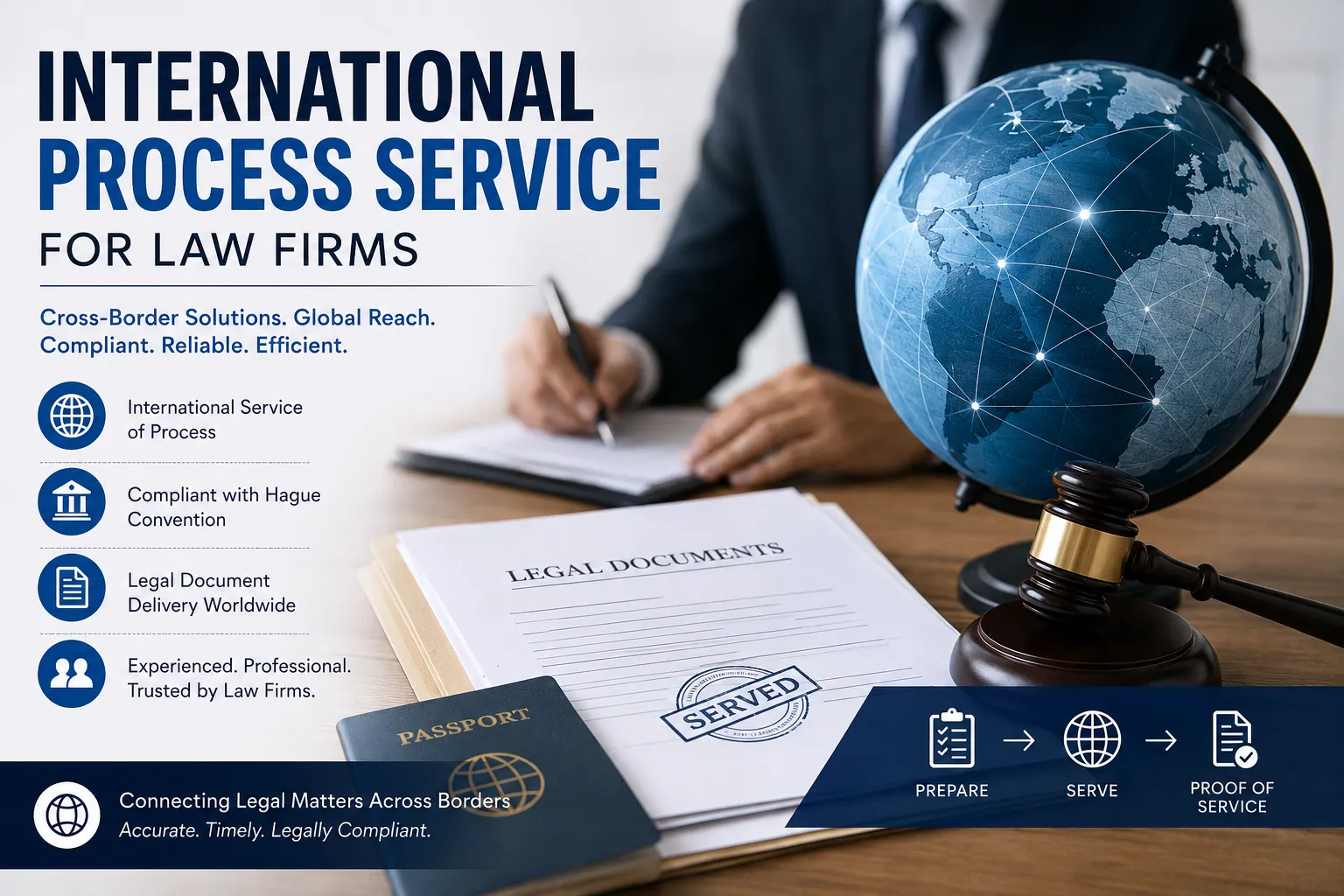
International legal disputes are becoming increasingly common as companies expand into new markets, contracts involve overseas parties, and individuals relocate across national borders. While filing a lawsuit may be straightforward, serving legal documents internationally often presents a unique set of procedural and legal challenges.
Unlike domestic service, international process service requires compliance with international agreements, foreign legal systems, and country-specific regulations. A minor procedural error—such as choosing an incorrect service method or failing to meet translation requirements—can delay litigation, increase legal costs, and even result in the court rejecting the service.
For law firms managing cross-border litigation, understanding the international service process is essential. This guide explains how international service of process for law firms works, the common obstacles attorneys encounter, and practical strategies to complete service efficiently while maintaining legal compliance.
What Is International Process Service?
International process service is the formal delivery of legal documents to an individual, business, or organisation located outside the country where legal proceedings have been filed.
Its primary purpose is to ensure the receiving party is properly notified of the legal action and given an opportunity to respond before the court continues with the case.
Documents commonly served internationally include:
- Summons and complaints
- Commercial litigation documents
- Contract dispute notices
- Arbitration papers
- Family law documents
- Probate filings
- Intellectual property claims
- Corporate litigation notices
- Business dispute documents
- Court orders
Because every country has its own procedural rules, international document delivery requires much greater attention than domestic service.
Why International Service Is Different
Many legal professionals assume international service is simply an overseas version of domestic process serving. In reality, the legal requirements are considerably more complex.
Several factors contribute to this complexity:
Different Legal Systems
Each country has its own judicial procedures governing the service of legal documents.
Some jurisdictions allow private process servers, while others require service through government authorities or designated judicial agencies.
International Treaties
Many countries participate in international agreements that regulate how legal documents must be delivered.
Ignoring these agreements can invalidate the service process.
Language Requirements
Several jurisdictions require certified translations before documents can be accepted.
Submitting incomplete or inaccurate translations often results in avoidable delays.
Local Court Procedures
Certain countries require additional forms, authentication, or supporting documentation before service may proceed.
Understanding these local rules before beginning the assignment saves valuable time.
Understanding the Hague Service Convention
One of the most significant international agreements affecting cross-border litigation is the Hague Service Convention.
The Convention provides a recognised framework for serving judicial and extrajudicial documents between participating countries while protecting the due process rights of all parties.
However, membership in the Convention does not create identical procedures worldwide.
Each participating country may establish its own requirements relating to:
- Accepted service methods
- Translation standards
- Required documentation
- Processing authorities
- Objections to specific delivery methods
- Local filing procedures
For this reason, legal professionals should review the destination country's requirements before initiating service.
Common Challenges Law Firms Face
Cross-border legal matters often involve procedural issues that are rarely encountered in domestic litigation.
Outdated Address Information
International assignments frequently fail because the defendant's address is incomplete or no longer accurate.
Address verification before initiating service can significantly improve success rates.
Corporate Structure Complexity
Serving multinational corporations often requires identifying the correct legal entity or authorised representative.
Incorrect corporate information may delay proceedings.
Time-Sensitive Court Deadlines
International service generally requires more time than domestic assignments due to document review, government processing, translations, and international coordination.
Beginning the process early reduces the likelihood of missed deadlines.
Country-Specific Restrictions
Certain jurisdictions prohibit direct service through private providers and instead require documents to pass through official government channels.
Selecting the correct procedure from the outset helps avoid unnecessary repetition.
How Professional International Process Service Supports Law Firms
An experienced international process service provider offers far more than document delivery.
Professional litigation support often includes:
- Country-specific procedural guidance
- International document coordination
- Hague Convention assistance
- Translation management
- Address verification
- Recipient research
- Status reporting
- Proof of service documentation
- Cross-border litigation support
These services reduce administrative burdens while improving procedural accuracy.
Best Practices Before Starting International Service
Successful international service begins long before documents are sent overseas.
Verify Recipient Information
Confirm the legal name, current address, company registration details, and any available contact information.
Accurate information improves service efficiency.
Research Local Legal Requirements
Every country follows different legal procedures.
Understanding local regulations before submitting documents helps prevent delays.
Prepare Complete Documentation
Review all court papers carefully to ensure supporting documents, exhibits, translations, and filing requirements are complete.
Missing paperwork frequently causes service delays.
Build Extra Time into Your Litigation Schedule
International assignments often require additional processing time.
Planning ahead helps protect important court deadlines.
Technology Has Improved International Litigation Support
Modern process serving companies increasingly use secure technology to improve efficiency and communication.
Many providers now offer:
- Secure online document submission
- Electronic case tracking
- Digital status updates
- Secure client portals
- Online proof of service delivery
- Centralised case management
These systems allow attorneys to monitor international assignments without relying on manual updates.
Choosing the Right International Process Service Provider
Selecting the right provider can have a significant impact on both compliance and efficiency.
When evaluating a provider, consider whether they offer:
International Experience
Providers with extensive global experience understand the procedural differences between jurisdictions.
Strong Communication
Regular updates allow legal teams to monitor progress and manage client expectations.
Reliable Documentation
Accurate proof of service is essential for court filings and procedural compliance.
Comprehensive Litigation Support
Additional services such as document retrieval, translation coordination, address verification, and legal courier services create greater efficiency throughout the litigation process.
Frequently Asked Questions
Is international process service required for every overseas lawsuit?
Yes. When a defendant is located outside the jurisdiction where the lawsuit is filed, legal notice generally must be served according to the applicable international and local legal procedures.
Does every country follow the Hague Service Convention?
No. Some countries participate in the Convention, while others follow different legal procedures for serving foreign judicial documents.
Can a law firm handle international service without professional assistance?
While possible in some situations, international service involves complex procedural requirements. Working with experienced professionals helps reduce errors and improves compliance.
Why is proof of service important?
Proof of service demonstrates that legal documents were delivered according to applicable legal requirements and allows the court to proceed with confidence.
Final Thoughts
International litigation demands precision, preparation, and a clear understanding of cross-border legal procedures. Every jurisdiction has unique requirements, and overlooking even a small procedural detail can delay a case or create unnecessary legal challenges.
Professional International Process Service provides law firms with the expertise needed to navigate international regulations, coordinate document delivery, manage country-specific requirements, and prepare reliable proof of service. By partnering with an experienced provider of international service of process for law firms, legal professionals can minimise delays, improve procedural compliance, and focus on achieving successful outcomes for their clients.

 English
 Arabic
 French
 Spanish
 Portuguese
 Deutsch
 Turkish
 Dutch
Dutch
 Russian
 Romaian
 Portuguese (Brazil)
 Greek
Greek