


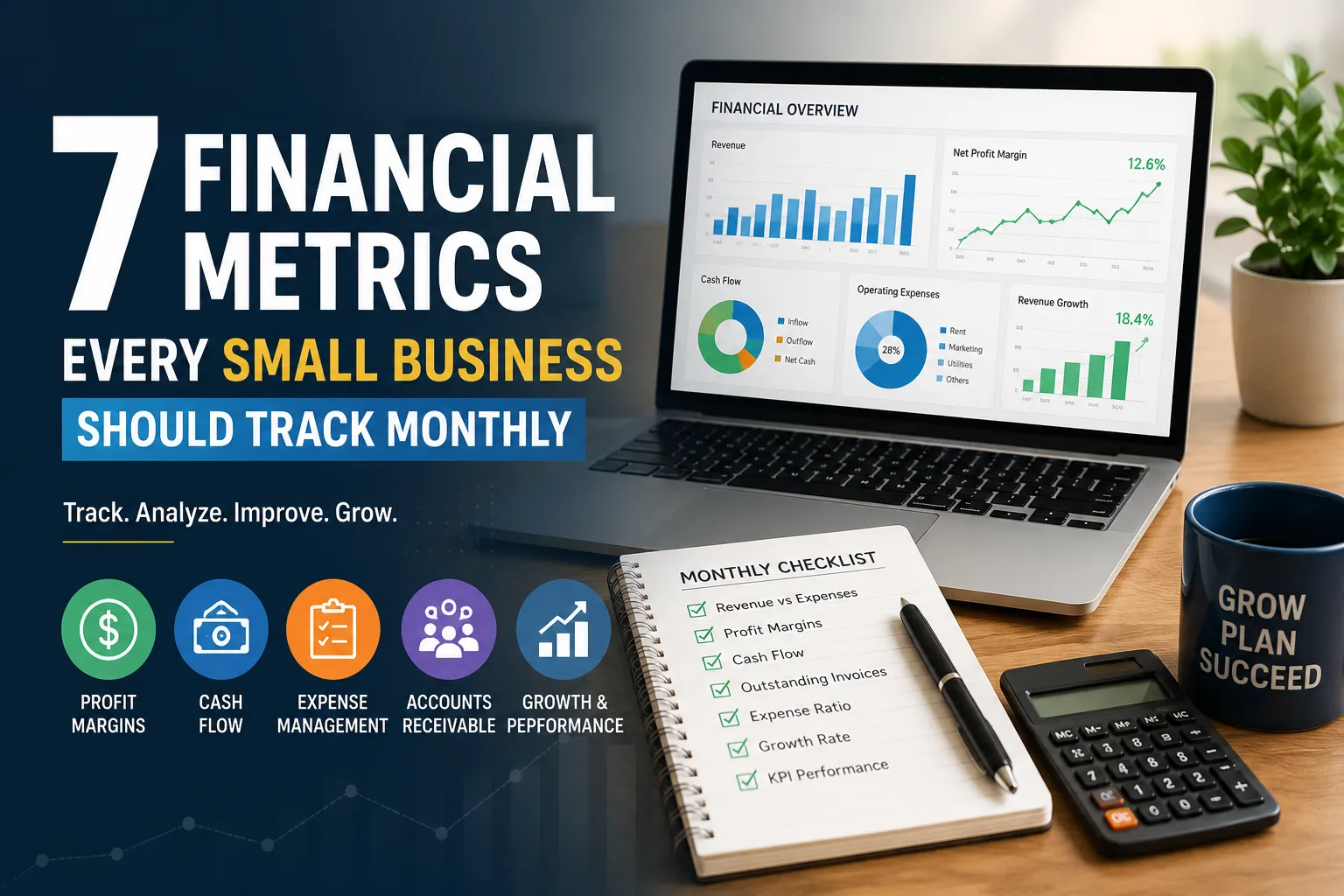
Running a successful small business requires more than offering quality products or services. Long-term success depends on understanding your company's financial health and using accurate data to make informed decisions. Many business owners focus only on sales revenue, but revenue alone does not tell the complete financial story.
Tracking the right financial metrics allows you to identify strengths, uncover hidden problems, manage expenses, improve profitability, and prepare for future growth. Whether you operate a retail store, service business, consulting firm, or online business, monitoring financial performance regularly helps reduce risk and improve overall business stability.
In this guide, you'll learn the most important financial metrics every small business should review, why they matter, and how they help you make better financial decisions.
Why Financial Metrics Matter for Small Businesses
Financial metrics transform accounting data into meaningful insights. Instead of relying on assumptions, business owners can make decisions based on measurable performance.
Monitoring financial metrics helps businesses:
- Improve cash flow management
- Increase profit margins
- Control operating expenses
- Identify unnecessary spending
- Plan future investments
- Make informed hiring decisions
- Monitor business growth
- Improve budgeting accuracy
- Reduce financial risks
- Prepare for tax planning
Businesses that consistently review financial reports are often better prepared to respond to changing market conditions and unexpected expenses.
1. Revenue Growth
Revenue growth measures how much your business income increases over a specific period. Rather than looking at one month's sales, compare monthly, quarterly, or annual performance to identify long-term trends.
Steady revenue growth generally indicates increasing customer demand, stronger marketing performance, or successful business expansion. However, revenue should always be evaluated alongside expenses because higher sales do not automatically mean higher profits.
When reviewing revenue growth, consider factors such as:
- Seasonal trends
- Customer demand
- Pricing changes
- Marketing campaign performance
- New products or services
Tracking revenue over time provides valuable insights into whether your business strategy is producing sustainable growth.
2. Gross Profit Margin
Gross profit margin measures how much money remains after covering the direct costs of delivering products or services.
This metric helps determine whether your pricing strategy is generating sufficient profit before operating expenses are considered.
A healthy gross profit margin indicates that your business is producing revenue efficiently while maintaining reasonable production or service costs.
If gross profit margins begin declining, possible causes may include:
- Rising supplier costs
- Increased labour expenses
- Pricing that is too low
- Inventory waste
- Production inefficiencies
Regular monitoring allows businesses to adjust pricing or reduce direct costs before profitability declines.
3. Net Profit Margin
Net profit margin represents the percentage of revenue remaining after all business expenses, including operating costs, taxes, interest, and other expenses, have been deducted.
Many businesses generate strong sales while struggling to produce healthy profits because operating expenses continue to increase.
Reviewing net profit margin helps answer important questions such as:
- Is the business truly profitable?
- Are expenses growing faster than revenue?
- Are pricing strategies effective?
- Is cost management improving?
Improving net profit often requires a combination of better expense control, improved operational efficiency, and strategic pricing adjustments.
4. Cash Flow
Cash flow is one of the most critical financial metrics for every small business.
Even profitable companies can experience financial difficulties if cash does not arrive when needed to pay suppliers, employees, rent, or other operating expenses.
Positive cash flow means more money is entering the business than leaving it during a given period.
Business owners should regularly monitor:
- Cash received from customers
- Outstanding invoices
- Upcoming supplier payments
- Payroll obligations
- Tax payments
- Loan repayments
Maintaining healthy cash flow reduces financial stress and allows businesses to respond quickly to new opportunities.
Consistent cash flow forecasting also helps prevent unexpected shortages that could disrupt daily operations.
5. Operating Expenses
Operating expenses include the everyday costs required to run a business.
These commonly include:
- Employee salaries
- Office rent
- Utilities
- Marketing expenses
- Insurance
- Software subscriptions
- Professional services
- Administrative costs
Tracking operating expenses helps identify spending patterns that may reduce profitability over time.
Business owners should compare monthly operating expenses against revenue to ensure costs remain under control.
Regular expense analysis often reveals opportunities to negotiate vendor contracts, eliminate unused subscriptions, automate repetitive tasks, or improve operational efficiency.
6. Current Ratio
The current ratio measures a business's ability to pay its short-term financial obligations using current assets.
Current Assets Generally Include:
- Cash
- Accounts receivable
- Inventory
- Short-term investments
Current Liabilities Include:
- Accounts payable
- Payroll obligations
- Taxes payable
- Short-term loans
A healthy current ratio provides confidence that the business can meet immediate financial commitments without experiencing liquidity problems.
Although the ideal ratio varies by industry, monitoring this metric helps identify potential cash management issues before they become serious financial concerns.
7. Accounts Receivable Turnover
Accounts receivable turnover measures how quickly customers pay outstanding invoices.
Slow customer payments can create cash flow challenges, even when sales remain strong.
A low turnover ratio may indicate:
- Ineffective collection processes
- Poor payment terms
- High customer credit risk
- Delayed invoicing
Improving invoice collection can significantly strengthen working capital.
Businesses can encourage faster payments by:
- Sending invoices promptly
- Offering multiple payment options
- Setting clear payment deadlines
- Following up on overdue accounts
- Automating payment reminders
Efficient accounts receivable management supports healthier cash flow and reduces reliance on external financing.
8. Break-Even Point
Every business should understand its break-even point.
The break-even point represents the level of sales required to cover all fixed and variable expenses before generating profit.
Knowing this figure helps business owners make informed decisions regarding:
- Pricing strategies
- Sales targets
- Cost reduction initiatives
- Business expansion
- Hiring decisions
It also provides valuable insight during periods of economic uncertainty, allowing businesses to understand how changes in sales volume affect profitability.
A lower break-even point generally provides greater financial flexibility and reduces overall business risk.
9. Working Capital
Working capital measures the funds available to support your business's day-to-day operations. It is calculated by subtracting current liabilities from current assets.
Healthy working capital allows a business to:
- Pay suppliers on time
- Cover payroll without delays
- Purchase inventory when needed
- Handle unexpected expenses
- Invest in growth opportunities
Negative working capital may indicate that the business is relying too heavily on short-term borrowing or struggling with cash management. Monitoring this metric monthly helps ensure your business maintains enough liquidity to operate smoothly.
10. Customer Acquisition Cost (CAC)
Customer Acquisition Cost (CAC) measures how much your business spends to gain a new customer.
This includes expenses such as:
- Advertising
- Digital marketing
- Sales commissions
- Marketing software
- Promotional campaigns
Understanding CAC helps determine whether your marketing efforts are cost-effective. If acquiring customers costs more than the revenue they generate, your business may need to optimise its marketing strategy.
Reducing acquisition costs while maintaining customer quality can significantly improve profitability over time.
11. Customer Lifetime Value (CLV)
Customer Lifetime Value estimates the total revenue a customer is expected to generate throughout their relationship with your business.
A higher customer lifetime value often indicates:
- Strong customer satisfaction
- Effective customer retention
- Repeat purchases
- Long-term loyalty
Comparing Customer Lifetime Value with Customer Acquisition Cost provides valuable insight into marketing performance. Ideally, the lifetime value should substantially exceed the cost of acquiring each customer.
Businesses that invest in customer relationships often experience more stable revenue and lower marketing costs over time.
12. Inventory Turnover
For businesses that sell physical products, inventory turnover is an essential metric.
It measures how efficiently inventory is sold and replaced during a specific period.
Low inventory turnover may suggest:
- Overstocking
- Weak customer demand
- Ineffective purchasing
- Obsolete inventory
High inventory turnover generally indicates efficient stock management and healthy sales performance.
Regular inventory analysis helps reduce storage costs, minimise waste, and improve cash flow.
13. Debt-to-Equity Ratio
The debt-to-equity ratio compares business debt with owner equity.
This metric helps evaluate financial risk and long-term stability.
A high debt ratio may indicate that a business relies heavily on borrowed funds, increasing interest costs and financial obligations.
Monitoring this ratio helps business owners:
- Make informed borrowing decisions
- Improve financial planning
- Maintain lender confidence
- Support sustainable business growth
Maintaining a balanced capital structure can strengthen overall financial resilience.
14. Budget Variance
Budget variance compares actual financial results with planned budgets.
Regularly reviewing budget variance allows businesses to identify where spending or revenue differs from expectations.
Examples include:
- Marketing costs exceeding budget
- Payroll expenses increasing unexpectedly
- Lower-than-expected sales revenue
- Reduced operating costs through efficiency improvements
Analysing these differences enables business owners to make timely adjustments and improve future budgeting accuracy.
How Often Should Small Businesses Review Financial Metrics?
Financial data becomes more valuable when reviewed consistently rather than only at year-end or during tax season.
A practical review schedule includes:
Weekly
- Cash balances
- Sales performance
- Outstanding invoices
Monthly
- Profit and loss statement
- Cash flow statement
- Gross profit margin
- Net profit margin
- Operating expenses
- Working capital
- Budget performance
Quarterly
- Revenue growth
- Customer acquisition cost
- Customer lifetime value
- Debt ratios
- Inventory turnover
- Financial forecasting
Annually
- Overall business performance
- Long-term financial goals
- Strategic planning
- Tax planning opportunities
- Business expansion decisions
Regular financial reviews allow business owners to identify trends early instead of reacting after problems become costly.
Tips for Improving Your Financial Performance
Simply tracking financial metrics is not enough. The information should guide business decisions that improve profitability and long-term success.
Consider these best practices:
- Maintain accurate bookkeeping throughout the year.
- Reconcile bank accounts every month.
- Review financial reports before making major business decisions.
- Monitor expenses regularly to identify unnecessary spending.
- Improve invoice collection processes.
- Build and maintain a cash reserve for unexpected costs.
- Update budgets as business conditions change.
- Use accounting software to automate reporting.
- Work with experienced accounting professionals for financial guidance.
- Compare performance with previous months and industry benchmarks.
Consistent financial management creates a stronger foundation for sustainable growth and better decision-making.
Common Mistakes Small Business Owners Should Avoid
Many businesses collect financial data but fail to use it effectively.
Some common mistakes include:
- Focusing only on revenue while ignoring profitability.
- Reviewing financial reports only during tax season.
- Mixing personal and business finances.
- Ignoring cash flow until problems arise.
- Delaying bank and account reconciliations.
- Failing to monitor outstanding customer invoices.
- Not updating financial forecasts regularly.
- Making decisions based on assumptions instead of financial reports.
Avoiding these mistakes helps improve financial stability and supports smarter business planning.
Conclusion
Understanding and reviewing the key financial metrics for small business success is essential for making informed decisions, improving profitability, and supporting sustainable growth. While revenue is an important indicator, it represents only one part of your company's financial performance. Metrics such as cash flow, gross profit margin, net profit margin, working capital, operating expenses, customer acquisition cost, and budget variance provide a more complete picture of your business's financial health.
By reviewing these metrics regularly, small business owners can identify potential issues early, control costs, strengthen cash flow, and make confident strategic decisions. Accurate bookkeeping, timely financial reporting, and consistent performance monitoring create the foundation for long-term success in an increasingly competitive business environment.
Whether your goal is increasing profits, improving operational efficiency, or preparing for future expansion, monitoring the right financial metrics will help your business stay financially healthy and ready for new opportunities.

 English
 Arabic
 French
 Spanish
 Portuguese
 Deutsch
 Turkish
 Dutch
Dutch
 Russian
 Romaian
 Portuguese (Brazil)
 Greek
Greek