


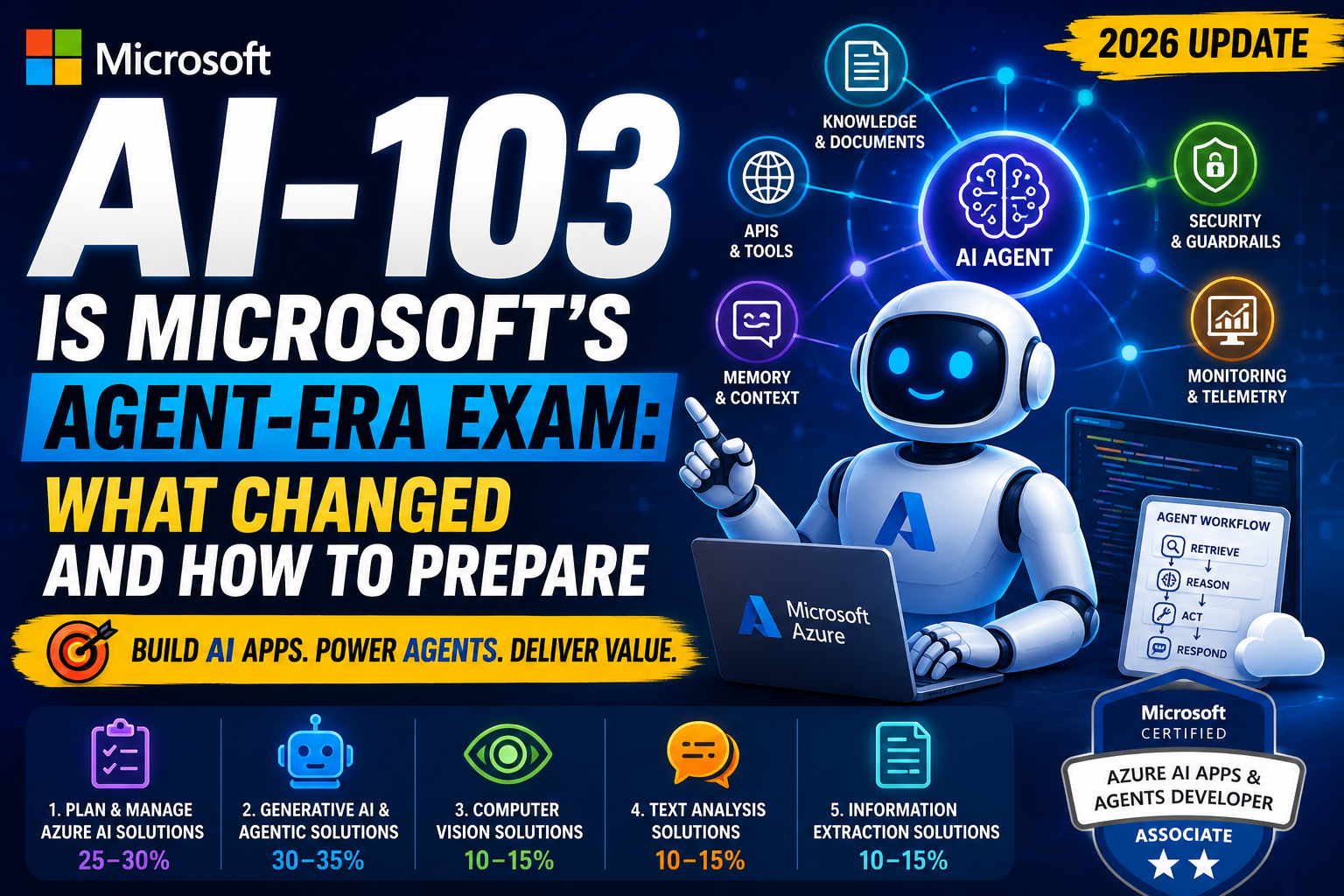
Microsoft’s AI-103 exam signals a major change in the way Azure AI skills are being assessed. Instead of testing whether candidates can simply identify individual Azure AI services, the exam focuses on building complete AI applications and agents that can work with data, tools, users, security controls, and production systems.
Passing AI-103 earns the Microsoft Certified: Azure AI Apps and Agents Developer Associate credential. Microsoft classifies it as an intermediate certification for AI engineers and developers who design, develop, manage, and deploy AI solutions through Microsoft Foundry. Candidates are expected to have Python development experience and a working understanding of generative AI and Azure services.
The Real AI-103 Update: Agents Are Now Central
The most important change is the exam’s focus on agentic AI.
Earlier Azure AI learning paths often separated language, vision, search, and machine learning services into individual topics. AI-103 examines how these technologies operate together within a working application.
Candidates may need to decide how an AI agent should access company information, call APIs, retain conversation context, use tools, retrieve documents, handle unsafe requests, and send activity data to a monitoring system.
The official skills outline currently used for AI-103 took effect on April 16, 2026. It gives 30–35% of the exam to generative AI and agentic solutions. Another 25–30% covers planning and managing Azure AI solutions. More than half of the exam therefore deals with architecture, agents, deployment, security, monitoring, model selection, and operational decisions.
What Is Covered on the AI-103 Exam?
The Microsoft AI-103 exam has five main skill areas.
1. Planning and Managing Azure AI Solutions — 25–30%
Candidates must know how to select suitable Microsoft Foundry services, models, retrieval methods, deployment options, and infrastructure.
This section also covers managed identities, private networking, access policies, quotas, scaling, rate limits, cost management, content moderation, safety filters, guardrails, trace logging, and responsible AI controls.
The questions are likely to test decisions rather than definitions. Candidates should understand why one model, search method, security control, or deployment option is better for a specific business requirement.
2. Generative AI and Agentic Solutions — 30–35%
This is the largest AI-103 exam domain.
It includes model deployment, prompt design, retrieval-augmented generation, function calling, conversation memory, agent tools, multi-agent orchestration, workflow controls, application evaluation, tracing, latency analysis, and safety monitoring.
Candidates should also understand how agents connect with APIs, search indexes, knowledge stores, custom functions, and approval processes. Microsoft’s outline includes both autonomous and semiautonomous workflows, which means governance is just as important as agent capability.
3. Computer Vision Solutions — 10–15%
This section covers image and video generation, image editing, multimodal understanding, visual question answering, object identification, image descriptions, video analysis, and accessibility-focused alt text.
It also includes visual safety controls, such as detecting inappropriate content, embedded prompt injection, prohibited symbols, and policy violations.
4. Text Analysis Solutions — 10–15%
Candidates should understand entity extraction, summarization, sentiment detection, translation, structured JSON output, speech-to-text, text-to-speech, and audio-based AI interactions.
The exam is not limited to older text-analysis APIs. It also measures how language models and Microsoft Foundry tools can support business-specific tasks such as compliance summaries and structured information extraction.
5. Information Extraction Solutions — 10–15%
This domain covers document ingestion, OCR, semantic search, hybrid search, vector search, indexing, document structure, field extraction, retrieval pipelines, and grounding.
Candidates should understand how unstructured content—including documents, images, audio, and video—can be processed and made available to AI applications or agent tools.
Who Should Take AI-103?
AI-103 is suitable for Python developers, Azure AI engineers, software engineers, cloud developers, and technical professionals building generative AI applications.
It is not designed as a beginner-level introduction to artificial intelligence. A candidate who has only used public chatbots but has no experience with Python, APIs, Azure resources, or application deployment may find the exam difficult.
Microsoft’s official audience profile expects familiarity with Python, APIs, SDKs, generative AI, Microsoft Foundry, and Azure services.
Microsoft’s Official AI-103 Training Course
Microsoft provides the four-day AI-103T00-A: Develop AI Apps and Agents on Azure course.
The training covers generative AI applications, AI agents, knowledge connections, agent tools, multimodal capabilities, and complex-content understanding. Candidates can follow instructor-led training or use the connected self-directed learning paths.
The exam itself provides 120 minutes and is offered through Pearson VUE. Microsoft states that a score of 700 or higher is required to pass. Exam pricing depends on the country or region where the assessment is taken.
Prepare for Success Through Understanding, Not Memorization
Start with Microsoft Learn and the official AI-103 skills outline. Then build a small Azure project that combines a Foundry model, a Python application, an Azure AI Search index, a document collection, and an agent that uses at least one external tool.
Add authentication, logging, evaluation, safety filters, and monitoring. These steps help connect separate exam objectives into one practical system.
After completing hands-on labs, use practice questions to test your decision-making and find weak topics. The DumpsGate AI-103 certification resource can support this stage with exam-style preparation materials. It should be combined with Microsoft documentation, practical development, and official training rather than used as a replacement for them.
Microsoft’s official Practice Assessment is currently unavailable, though candidates can use the exam sandbox to become familiar with the testing interface.
Why AI-103 Matters in 2026
AI-103 reflects the direction of real Azure AI work. Organizations are moving beyond isolated model demonstrations toward secure, observable, data-connected agents that can complete useful tasks.
The exam therefore rewards candidates who understand the full application lifecycle: choosing models, grounding outputs, connecting tools, controlling access, evaluating responses, monitoring behavior, and improving systems after deployment.
The best way to approach AI-103 is not to treat it as a vocabulary test. Prepare as a developer who may be asked to build and operate a real Azure AI application. That approach matches both the current exam blueprint and the skills Microsoft intends the certification to validate.
More Browsing:

 Arabic
 French
 Spanish
 Portuguese
 Deutsch
 Turkish
 Dutch
Dutch
 Italiano
 Russian
 Romaian
 Portuguese (Brazil)
 Greek
Greek