


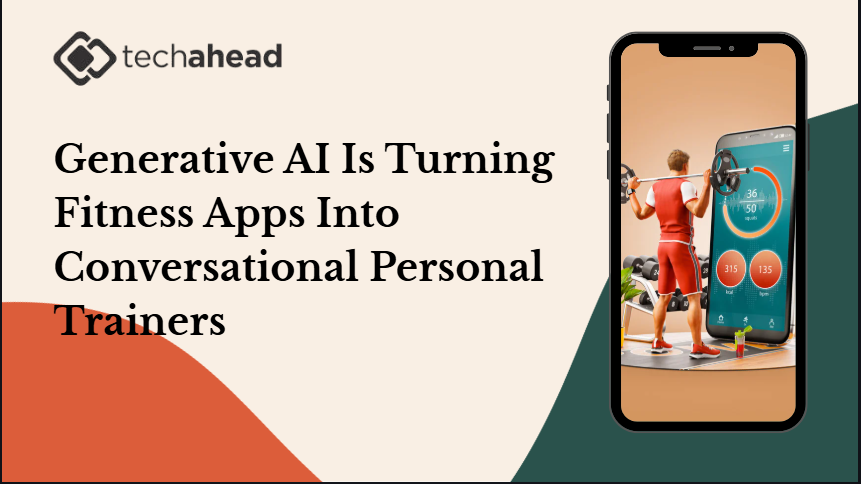
The traditional fitness application asks users to interact with menus.
Choose a workout.
Select a goal.
Enter your weight.
Log your repetitions.
Review your progress.
But humans do not naturally think in menus. They ask questions.
"Why am I so tired today?"
"Can I replace this exercise?"
"What should I train tomorrow?"
"Why have I stopped progressing?"
"Can you make this workout shorter?"
Generative AI is changing fitness software by making those conversations possible.
For an AI development company, this creates opportunities to build intelligent conversational systems that understand context rather than simply respond to isolated commands. For a Fitness development company, it offers a chance to transform the fitness application from a digital logbook into an interactive coaching environment.
The Chatbot Was Only the Beginning
Early fitness chatbots were relatively simple.
Users entered a question, and the system searched a predefined knowledge base or generated a basic response.
Modern generative AI can operate differently.
Large language models can interpret natural language, maintain conversational context, summarize information, and generate personalized responses.
But the most useful fitness applications will not rely on a general-purpose model alone.
They will connect the model to structured user data.
For example, a conversational system could combine:
- Workout history
- User goals
- Exercise preferences
- Available equipment
- Previous feedback
- Scheduling constraints
- Wearable information
The AI can then generate responses based on a richer context.
Retrieval-Augmented Generation Makes Fitness AI More Reliable
One of the most important technical approaches for enterprise-grade generative AI is Retrieval-Augmented Generation, or RAG.
Instead of expecting the language model to know everything, the application retrieves relevant information from approved sources and provides it to the model as context.
In fitness technology, that knowledge layer could include:
- Exercise libraries
- Training methodologies
- Product-specific guidelines
- Coach-created content
- Approved educational materials
- User-specific training information
The model then generates a response based on retrieved information.
This architecture can reduce reliance on unsupported model knowledge, although it does not eliminate hallucination or guarantee correctness.
An AI development company building a serious fitness assistant should therefore combine RAG with validation, guardrails, monitoring, and human review where appropriate.
Personalization Goes Beyond Workout Plans
A conversational AI coach can personalize more than exercise selection.
Consider a user who says:
"I only have 25 minutes today and my legs are still sore."
A rigid fitness application might show the day's scheduled workout.
A conversational system could potentially understand both constraints and modify the recommendation.
The user does not have to navigate multiple menus.
They simply explain their situation.
This is an important interface shift.
Natural language becomes the control layer.
AI Can Reduce the Friction of Fitness
Fitness adherence often fails because of friction.
Users forget what to do.
They do not know how to adjust a workout.
They become overwhelmed by progress data.
They lose motivation after missing several sessions.
AI can potentially reduce some of that friction.
Instead of forcing the user to search through a library of exercises, the system can recommend a smaller set.
Instead of requiring users to interpret several charts, the application can summarize meaningful changes.
Instead of sending generic reminders, it can make communication more contextual.
The technology becomes useful when it reduces cognitive effort.
Multimodal AI Makes Fitness More Interactive
The next stage is not just text.
Modern AI systems increasingly work across multiple modalities, including text, images, audio, and video.
That creates interesting possibilities for fitness.
A user could show the application an exercise and ask:
"Is this the movement you meant?"
Or speak naturally during a workout.
Or use a camera-based system to receive visual feedback.
The interface could combine voice, vision, and conversational reasoning.
This creates a much more natural coaching experience.
However, multimodal AI introduces additional engineering complexity. Each modality can fail differently, and developers must evaluate the complete system rather than assuming that a strong language model automatically produces a safe or accurate product.
Voice AI Could Make Fitness Hands-Free
Fitness is one of the rare application categories where users frequently cannot—or should not—look at their phones.
During a workout, touching the screen can be inconvenient.
Voice interfaces therefore have strong potential.
Users could say:
"Start the next set."
"How many repetitions?"
"Move to the next exercise."
"Make the workout easier."
"Play the recovery timer."
This turns voice into an operational interface.
For a Fitness development company, voice AI can therefore be more than a novelty. It can solve a genuine usability problem.
Agentic AI Takes the Conversation Further
Generative AI answers questions.
Agentic AI can potentially perform tasks.
This distinction matters.
Imagine a fitness assistant that does not simply tell a user what workout to perform but can:
- Review recent activity
- Select an appropriate session
- Add it to the schedule
- Start the workout
- Track completion
- Analyze results
- Modify future sessions
The AI becomes part of the application workflow.
Research into agentic AI increasingly focuses on systems capable of perception, reasoning, planning, and action across complex environments.
Fitness is a natural environment for this concept because training itself is an iterative process.
Guardrails Matter More Than Clever Prompts
The more autonomy an AI system receives, the more important safety becomes.
A fitness assistant should distinguish between general wellness guidance and medical advice.
For example, if a user describes severe symptoms or an injury, the system should not confidently diagnose the problem.
Instead, it should recognize the limits of its role and encourage appropriate professional evaluation when necessary.
Responsible AI frameworks are becoming increasingly relevant to production AI systems. NIST's AI RMF provides organizations with a structured approach for managing AI risks, while its Generative AI Profile addresses risks specific to generative systems.
This means safety cannot simply be added as a disclaimer at the bottom of the application.
It needs to influence the model architecture, user experience, escalation rules, testing, and monitoring.
Data Privacy Will Shape Consumer Trust
Conversational fitness assistants can accumulate enormous amounts of personal information.
Users may reveal:
- Physical limitations
- Daily routines
- Sleep patterns
- Goals
- Eating habits
- Emotional states
- Training history
That information deserves careful protection.
A Fitness development company should use strong authentication, encryption, permission controls, data minimization, and clear privacy policies.
Users should understand what information is being collected and why.
The most intelligent fitness assistant in the world will fail if people do not trust it.
How Companies Can Build Better AI Fitness Products
The strongest products will probably not begin with "Let's add ChatGPT."
They will begin with a specific user problem.
For example:
Problem: Users abandon personalized programs because plans are too rigid.
AI opportunity: Build a conversational adaptation system.
Or:
Problem: Users do not understand their wearable data.
AI opportunity: Create an AI interpretation layer.
Or:
Problem: Trainers spend too much time answering repetitive questions.
AI opportunity: Build an AI assistant that handles routine interactions while escalating complex cases.
This problem-first approach makes AI commercially useful.
The Future Fitness Interface May Feel Less Like an App
The most interesting consequence of generative AI may be invisible.
Instead of users opening an application and navigating through features, they may increasingly interact with an intelligent layer that coordinates those features.
The application still exists.
But the interface becomes conversational.
The user expresses an intention, and the system determines which capabilities are needed.
That is a fundamental change in software design.
Conclusion: The Personal Trainer Is Becoming a Software Interface
Generative AI will not eliminate human trainers.
Instead, it can augment coaching by handling information, personalization, scheduling, routine communication, and analysis.
For an AI development company, the opportunity lies in creating reliable intelligence around real-world user data.
For a Fitness development company, the opportunity is to make software feel less mechanical and more responsive.
The future fitness app may not ask users to learn how the application works.
It may simply understand what the user wants to accomplish—and help them get there.

 English
 Arabic
 French
 Spanish
 Portuguese
 Deutsch
 Turkish
 Dutch
 Italiano
 Russian
 Romaian
 Greek