


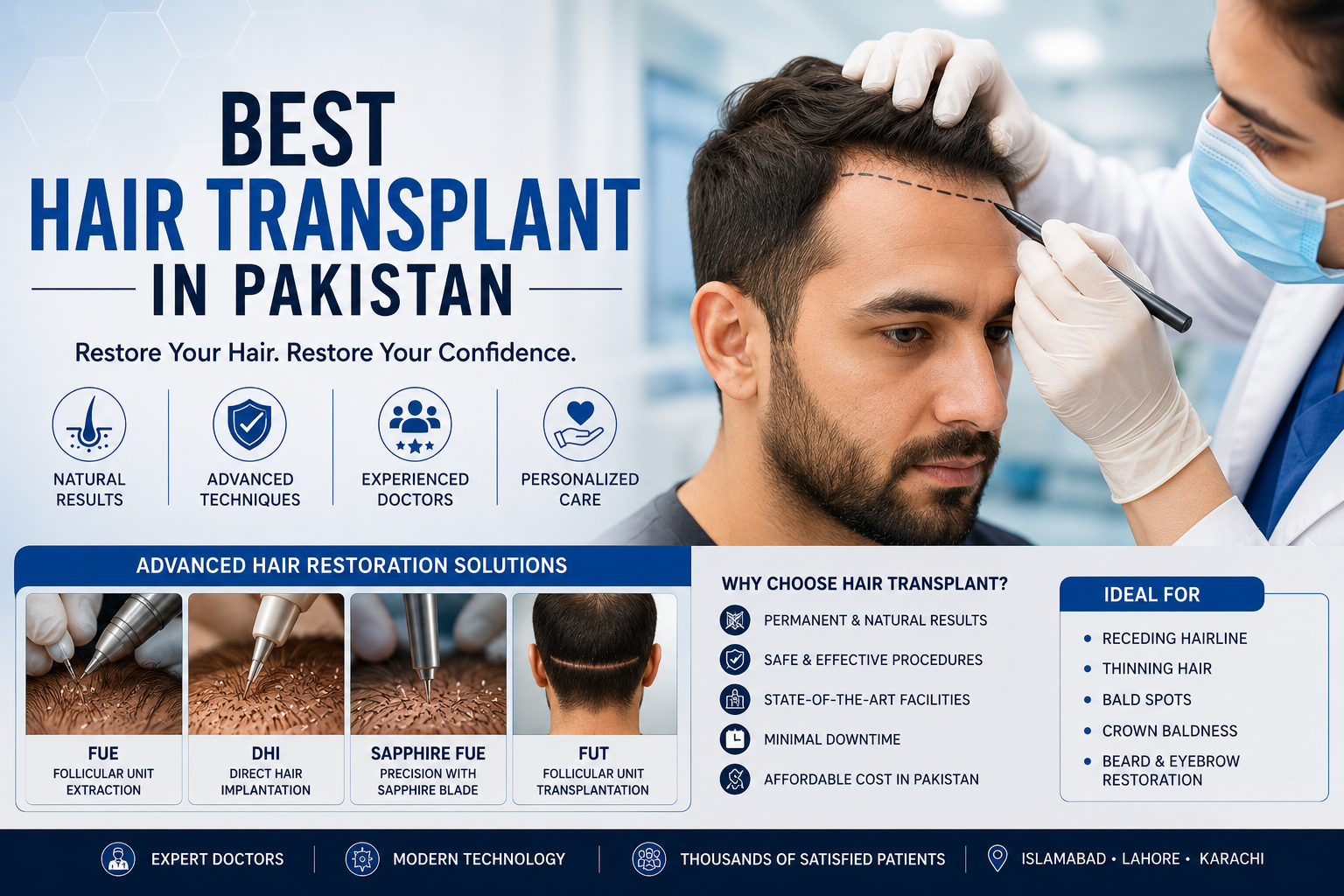
Hair loss can affect more than appearance. For many men and women, thinning hair, a receding hairline, or advanced baldness can influence confidence, professional appearance, and social comfort. With modern hair restoration techniques, hair transplantation has become a practical option for people who want to restore lost hair and achieve a more natural-looking appearance.
Pakistan has developed into an increasingly popular destination for hair restoration because patients can access experienced medical professionals, modern transplantation techniques, and comparatively affordable treatment options. However, choosing the best hair transplant in Pakistan should not be based only on price or advertising. The quality of the final result depends on several factors, including diagnosis, donor-hair assessment, hairline planning, graft extraction, graft handling, implantation technique, medical supervision, and aftercare.
For patients considering treatment in Pakistan, Extent Hair Transplant International provides hair restoration services in Islamabad, Lahore, and Karachi, with treatment plans designed according to the patient's hair-loss pattern, donor supply, facial characteristics, and restoration goals.
The International Society of Hair Restoration Surgery (ISHRS) emphasizes that hair transplantation is surgery and recommends that patients carefully investigate the training, qualifications, experience, and role of the physician responsible for their treatment.
What Makes a Hair Transplant the Best?
There is no single procedure that is automatically the "best" for every patient. A successful hair transplant is one that is appropriately planned for the individual patient's condition.
Two patients may have similar-looking baldness but require completely different treatment strategies. One may need approximately 2,000 grafts to rebuild the frontal hairline, while another may require a larger session to address the frontal scalp, mid-scalp, and crown.
The best hair transplant therefore involves:
- Proper diagnosis of the cause of hair loss
- Detailed examination of the donor area
- Realistic planning of graft requirements
- Natural hairline design
- Appropriate selection of FUE, FUT, DHI, or another suitable approach
- Careful extraction of follicular units
- Proper graft preservation and preparation
- Accurate placement and direction of grafts
- Protection of the donor area
- Appropriate post-operative care
- Long-term planning for progressive hair loss
The ISHRS similarly advises prospective patients to research their options and make sure a properly trained and licensed physician is responsible for the medical aspects of treatment.
Hair Transplant in Pakistan
Hair transplantation in Pakistan has progressed considerably over the years. Clinics in major cities such as Islamabad, Lahore, and Karachi now offer procedures including FUE, FUT, DHI, Sapphire FUE and other implantation approaches.
A hair transplant generally involves moving follicular units from a donor region—usually the back and sides of the scalp—to areas affected by hair loss. The transplanted follicles can subsequently grow hair in the recipient area.
FUE and FUT are primarily different approaches to harvesting donor follicles. In FUE, individual follicular units are extracted using a small punch. FUT involves removing a strip of scalp tissue and dissecting it into individual follicular units.
DHI is commonly used to describe an implantation approach using an implanter device. In practical terms, DHI and FUE are not necessarily competing concepts because FUE generally refers to the extraction method, while DHI describes a particular implantation technique.
Why Islamabad, Lahore and Karachi Are Popular for Hair Restoration
Patients looking for the best hair transplant in Pakistan commonly consider three major cities: Islamabad, Lahore, and Karachi.
Each city has established medical infrastructure and offers access to cosmetic and hair restoration services.
Hair Transplant in Islamabad
Islamabad is an important destination for patients from northern Pakistan and international visitors. Its healthcare environment, accessibility, and concentration of specialist clinics make it a popular location for cosmetic procedures.
Patients travelling from cities such as Rawalpindi, Peshawar, Abbottabad, and other northern regions may find Islamabad convenient for consultation and treatment.
Hair Transplant in Lahore
Lahore is one of Pakistan's largest healthcare and commercial centres. Patients from Punjab and surrounding regions frequently travel to Lahore for specialist medical and cosmetic procedures.
A major advantage for patients is the availability of different treatment options, allowing them to compare doctors, facilities, techniques, and treatment plans.
Hair Transplant in Karachi
Karachi is Pakistan's largest metropolitan city and serves patients from Sindh, Balochistan, and other parts of the country. It also attracts overseas Pakistanis who combine medical treatment with family visits.
For international patients, the availability of airports, accommodation, transportation, and medical facilities can make Karachi a practical destination.
Understanding Hair Loss Before Choosing a Hair Transplant
Before undergoing surgery, it is important to understand why the hair is falling out.
The most common cause of male pattern hair loss is androgenetic alopecia. However, hair loss can also result from:
- Nutritional deficiencies
- Thyroid disorders
- Certain medications
- Severe stress
- Illness
- Scalp conditions
- Autoimmune disorders
- Hormonal changes
- Traction
- Previous surgery or trauma
A transplant does not necessarily treat the underlying cause of every type of hair loss.
For example, if someone has an active scalp disease or a temporary form of shedding, transplantation may not be the first treatment recommended.
This is why proper consultation should come before deciding how many grafts to transplant.
Who Is a Good Candidate for Hair Transplantation?
The ideal candidate generally has a stable donor area and sufficient healthy follicles to achieve the desired coverage.
Important considerations include:
1. Donor Hair Density
The donor area needs to contain sufficient hair follicles. If the donor supply is limited, aggressive extraction may compromise the appearance of the donor region.
2. Pattern of Hair Loss
The surgeon should evaluate the current pattern and consider possible future progression.
3. Age
Age alone does not determine eligibility. However, younger patients with rapidly progressing hair loss may require particularly careful long-term planning.
4. Expectations
A transplant should improve coverage and appearance, but it cannot necessarily recreate the density of teenage hair.
5. General Health
The patient should disclose relevant medical conditions, medications, allergies, previous procedures, and other factors that may affect surgery.
FUE Hair Transplant
Follicular Unit Excision (FUE) is one of the most widely discussed hair transplantation techniques.
During FUE, follicular units are individually extracted from the donor region using a small punch. These grafts are then prepared and implanted into recipient areas.
One major advantage of FUE is that it avoids the linear donor scar associated with traditional strip harvesting. However, it is inaccurate to describe FUE as completely "scarless." The ISHRS specifically notes that FUE produces small scars and that all hair transplantation surgery involves some degree of tissue injury.
Advantages of FUE
- Individual follicular extraction
- No linear strip scar
- Suitable for many hair-loss patterns
- Can provide natural-looking results when properly performed
- Usually allows shorter hairstyles than traditional FUT
- Useful for scalp, beard, and other selected restoration procedures
Important Consideration
FUE requires careful donor management. Excessive harvesting can lead to visible donor thinning.
The goal should not simply be to extract the maximum number of grafts. The goal should be to extract an appropriate number while protecting the long-term donor supply.
FUT Hair Transplant
Follicular Unit Transplantation (FUT) uses a strip of tissue from the donor area. The strip is then dissected into follicular unit grafts before implantation.
FUT can be useful in selected patients, particularly where a large number of grafts may be required and the patient's anatomy and preferences make strip harvesting appropriate.
The principal disadvantage is the linear scar created in the donor region.
Modern hair restoration planning should therefore consider the patient's hairstyle, donor characteristics, graft requirements, previous surgery, and long-term objectives before selecting FUT.
DHI Hair Transplant
Direct Hair Implantation (DHI) is frequently discussed as an advanced implantation approach.
DHI generally uses a specialized implanter device to place grafts into the recipient area. The exact surgical strategy varies according to the patient's condition and the medical team's approach.
DHI can be particularly useful when the treatment plan calls for controlled placement of individual grafts, including attention to angle, direction, and density.
However, the term "DHI" should not be treated as a guarantee of superior results.
A skilled team using an appropriate FUE-based implantation strategy can also achieve excellent natural-looking results.
Recent clinical explanations likewise emphasize that neither FUE nor DHI is universally superior; patient characteristics, goals, hair quality, and surgeon experience all influence technique selection.
Sapphire FUE
Sapphire FUE is a term used by many clinics to describe the use of sapphire blades for recipient-site creation.
Patients should understand that a particular instrument does not automatically guarantee a better outcome.
What matters more is how the overall procedure is planned and performed.
Factors such as:
- Hairline design
- Recipient-site direction
- Graft handling
- Extraction technique
- Donor preservation
- Density planning
- Physician experience
can have a greater impact on the final appearance.
The ISHRS also cautions patients about marketing terminology that may make techniques sound dramatically different even when the underlying surgical principles are similar.
Finding the best hair transplant in Pakistan is not simply about selecting the clinic with the most attractive advertisement or the lowest price.
The most important considerations are the quality of medical assessment, surgeon involvement, realistic planning, donor management, hairline design, graft handling, implantation technique, patient safety, and long-term follow-up.
FUE, FUT, DHI, and other techniques can have a place in modern hair restoration. The right method depends on the patient's hair-loss pattern, donor supply, hair characteristics, desired outcome, and medical assessment.
For patients considering treatment in Pakistan, Islamabad, Lahore, and Karachi offer access to established medical facilities and hair restoration services. Extent Hair Transplant International provides consultation and hair restoration treatment planning for patients seeking natural-looking hair restoration.
A good transplant should not simply add hair. It should restore the appearance of the hairline and density in a way that fits the patient's facial structure and long-term goals.
Most importantly, patients should take time to investigate the physician, understand the proposed treatment, examine genuine before-and-after cases, ask who will perform each part of the surgery, and receive realistic information about benefits, limitations, costs, recovery, and future hair loss.
The ISHRS recommends that patients become well informed before proceeding and make sure a properly trained and licensed physician is responsible for the relevant medical and surgical aspects of treatment.
The best hair transplant is ultimately not the one with the biggest promise—it is the one that is medically appropriate, carefully planned, skillfully performed, and designed around the individual patient.

 Arabic
 French
 Spanish
 Portuguese
 Deutsch
 Turkish
 Dutch
 Italiano
 Russian
 Romaian
 Portuguese (Brazil)
 Greek