


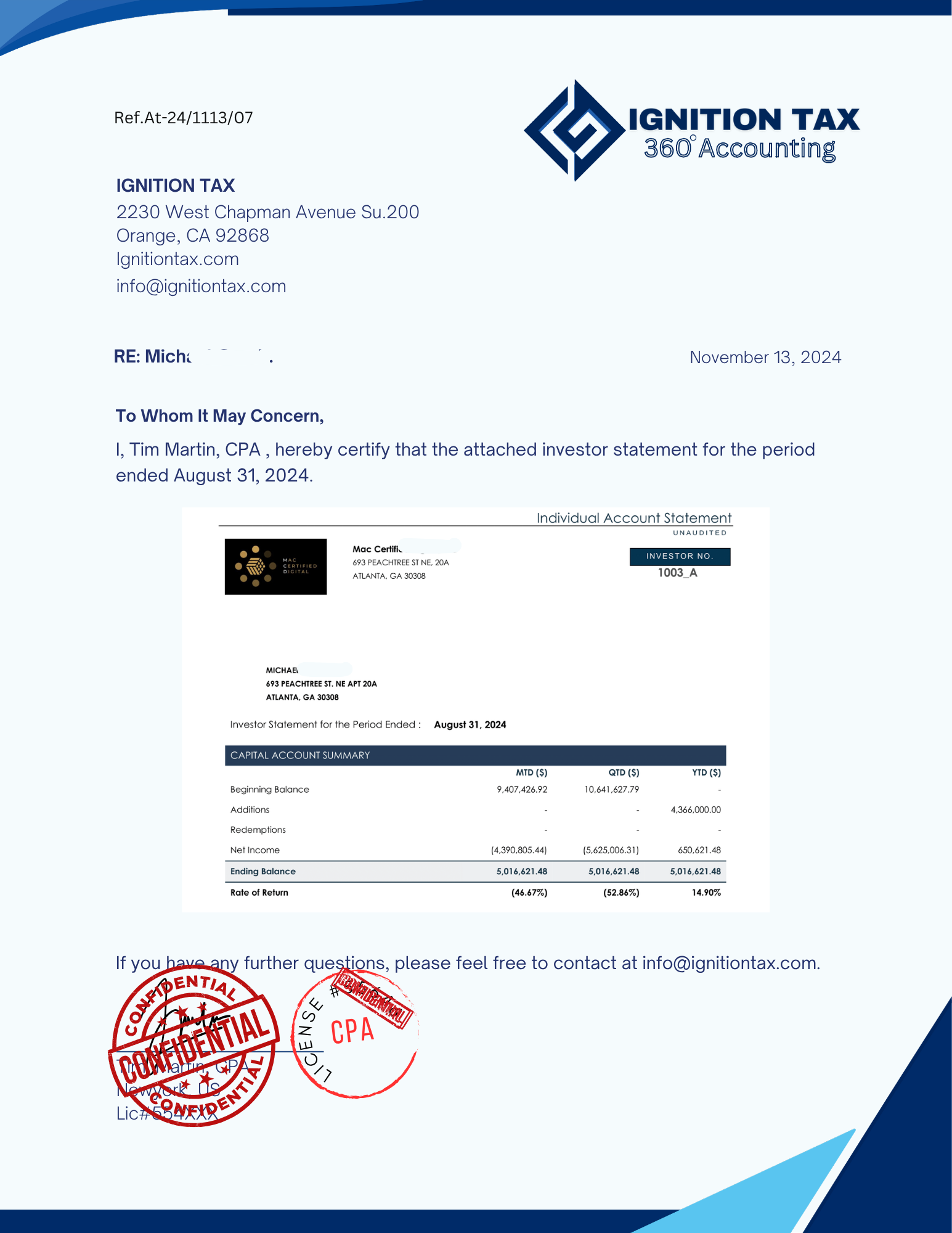
A CPA comfort letter and a CPA letter can refer to the same type of third-party verification document. "CPA letter" is a broad term, while "comfort letter" is commonly used for a letter in which a CPA provides specific information about a client to an outside party.
The name alone does not determine what the document must contain. The recipient's requirements and the CPA's professional judgment determine the appropriate content.
For example, a mortgage lender might ask for a "CPA letter" confirming self-employment, while another organization might call a similar document a "CPA comfort letter."
What Is a CPA Comfort Letter?
A CPA comfort letter is a written statement prepared by a Certified Public Accountant for an authorized third party.
The letter may verify specific information about an individual or business, depending on the purpose of the request.
Possible information includes:
-
Self-employment status
-
Business ownership
-
Business name and entity type
-
CPA-client relationship
-
Tax preparation history
-
Specific financial information
-
Business activity
-
Relevant dates or tax years
The CPA should only provide information that can be appropriately supported by available records and the scope of the professional relationship.
What Is a CPA Letter?
"CPA letter" is a general term rather than the name of one standardized document.
A CPA letter can describe many types of letters prepared by a Certified Public Accountant for a client or third party. The contents depend on the reason the letter is being requested.
For example, a CPA letter might be requested to verify:
-
Self-employment
-
Business ownership
-
Income or financial information
-
Tax-related information
-
A professional relationship
-
Other specific facts supported by the CPA
This means that a CPA comfort letter can be considered one type of CPA letter.
Why Are the Terms Used Interchangeably?
The terminology is not always consistent among lenders, CPAs, businesses, and service providers.
A requesting organization may use "CPA letter," while a CPA or service provider may refer to the document as a "CPA comfort letter" or "CPA verification letter."
The important question is not which label is used. The important question is:
What information does the recipient need the CPA to verify?
The American Institute of CPAs discusses third-party verification requests and notes that the term "comfort letter" may be used informally for certain requests involving loans and refinancing.
CPA Comfort Letter vs. CPA Letter: Quick Comparison
| Feature | CPA Comfort Letter | CPA Letter |
| Meaning | Usually a third-party verification letter | Broad term for letters prepared by a CPA |
| Standard format | No universal format | No universal format |
| Common purpose | Verification for lenders or other third parties | Depends on the specific request |
| May verify self-employment | Yes, when appropriate | Yes, when appropriate |
| May verify business ownership | Yes, when requested and supportable | Yes, when requested and supportable |
| Who determines content? | CPA and requesting organization | CPA and requesting organization |
| Automatically accepted by lenders? | No | No |
The two terms may describe substantially the same document. The recipient's written requirements are more important than the title printed at the top of the letter.
When Might You Need a CPA Comfort Letter?
A third party may request a CPA letter when it wants professional verification of information that is not fully addressed by other documentation.
Common situations include:
Mortgage applications
Some mortgage lenders may request CPA verification from self-employed borrowers or borrowers with business interests.
The exact requirements depend on the lender, loan program, and borrower's circumstances.
Business loans
A bank or financial institution may request additional information about a business's ownership, financial condition, or tax history.
Business ownership verification
A CPA may be asked to verify an individual's ownership interest in a business when the CPA has appropriate supporting records.
Rental applications
Some landlords or property managers may request additional documentation from self-employed applicants.
Other financial transactions
Investors, financial institutions, or other third parties may request CPA verification for a specific transaction or business relationship.
What Information Does a CPA Letter Include?
There is no universal template. The contents should match the purpose of the request.
A letter may include:
-
Client's full name
-
Business name
-
CPA or accounting firm's information
-
Description of the CPA-client relationship
-
Self-employment status
-
Business ownership information
-
Business entity type
-
Specific financial information
-
Relevant dates
-
Tax years, when relevant
-
Purpose of the letter
-
Limitations on the information provided
-
CPA signature and contact information
A CPA should not include information simply because a third party requests it. The CPA must determine whether the statement is accurate, supportable, and appropriate.
Is a CPA Letter the Same as a Tax Transcript?
No. A CPA letter and an IRS tax transcript are different documents.
An IRS tax transcript is issued by the Internal Revenue Service and provides tax return or tax account information, depending on the transcript type.
A CPA letter is prepared by a CPA and addresses specific information the CPA is able to verify.
A lender may request one, the other, or both. One document should not automatically be assumed to replace the other.
Is a CPA Comfort Letter the Same as an Income Verification Letter?
Not necessarily.
An income verification letter specifically focuses on income information. A CPA comfort letter may address income, but it can also cover other facts such as business ownership, self-employment, or the CPA-client relationship.
If a lender asks for an income verification letter, ask whether it specifically requires a CPA to prepare the document.
Who Provides a CPA Comfort Letter?
A CPA comfort letter is generally prepared and signed by a Certified Public Accountant who has an appropriate professional relationship with the client and a reasonable basis for the information being provided.
The CPA determines what can appropriately be verified.
If you do not have an existing CPA, a CPA service provider may be able to assist, depending on the request and the information that can be properly supported.
Ignition Tax provides CPA letter services for individuals and businesses in the United States. Clients should provide the requesting organization's exact requirements so the appropriate type of letter can be determined.
How Do You Get a CPA Comfort Letter?
The process generally involves five steps:
1. Ask the recipient for its requirements
Find out exactly what information needs to be verified.
2. Give the requirements to the CPA
Provide the lender's form, instructions, or written request whenever possible.
3. Provide supporting records
The CPA may need tax returns, accounting records, business ownership information, or other documentation.
4. Complete authorization
If confidential information will be disclosed to a third party, the CPA may require written authorization.
5. Review and submit the completed letter
Check the information for accuracy and follow the recipient's instructions for delivery.
How Much Does a CPA Comfort Letter Cost?
There is no standard nationwide price.
The fee can depend on:
-
Complexity of the request
-
Number of businesses involved
-
Number of tax years
-
Records that must be reviewed
-
Turnaround requirements
-
Notarization
-
Additional accounting work
-
The CPA or service provider's pricing
Ask whether the quoted fee includes revisions, notarization, expedited service, and document review.
How Long Does a CPA Letter Take?
Turnaround varies by provider and the complexity of the request.
A straightforward letter may require less preparation than a request involving multiple businesses, detailed financial information, or additional record review.
To reduce delays, provide the complete request and supporting documentation when you first order the service.
What Are the Limitations of a CPA Comfort Letter?
A CPA letter does not guarantee a financial outcome.
For example, it generally should not be treated as a guarantee that:
-
A mortgage will be approved
-
A loan will be approved
-
Future income will continue
-
A business will remain profitable
-
A borrower will repay a loan
A CPA letter is also not automatically an audit, review, compilation, or other assurance engagement.
The AICPA advises CPAs to carefully consider the nature and wording of third-party verification requests.
What Should You Ask the Lender Before Ordering a CPA Letter?
If your letter is for a mortgage or loan, ask:
-
Is a CPA letter required?
-
What exactly must it verify?
-
Do you have a required form?
-
Is specific wording required?
-
Does it need to confirm self-employment?
-
Does it need to verify business ownership?
-
Does it need to include income information?
-
Is notarization required?
-
What is the submission deadline?
-
Can the letter replace any other document?
Give the answers to your CPA before the letter is prepared.
What Should You Ask the CPA?
You should also confirm:
-
What documents are required?
-
Can the CPA verify the requested information?
-
What will the service cost?
-
How long will preparation take?
-
Is authorization required?
-
Are revisions included?
-
Is notarization available?
-
How will the completed letter be delivered?
Clear communication at the beginning can prevent unnecessary revisions.
Common Mistakes to Avoid
Ordering the wrong type of letter
The title "CPA letter" does not tell you what information must be included.
Solution: Get the recipient's exact requirements first.
Assuming every lender uses the same requirements
Mortgage lenders and loan programs can have different documentation requirements.
Solution: Follow the specific instructions for your application.
Asking a CPA to guarantee future income
A CPA may verify certain historical or current information but should not be expected to guarantee future financial results.
Solution: Ask for factual verification that can be supported by records.
Assuming a CPA letter replaces tax documents
A CPA letter does not automatically replace tax returns, IRS transcripts, financial statements, or other documentation.
Solution: Ask the recipient which documents are required in addition to the letter.
Which One Do You Need?
In most cases, you should not choose between a "CPA comfort letter" and a "CPA letter" based only on the name.
Instead, identify what the requesting organization wants verified.
If the organization asks for a CPA letter, ask for its specific requirements. If it calls the document a CPA comfort letter, provide those instructions to the CPA.
The CPA can then determine the appropriate format and wording.
FAQs
Are a CPA comfort letter and a CPA letter the same thing?
Often, yes. "CPA letter" is a broad term, while "CPA comfort letter" commonly refers to a CPA's written verification for a third party. The exact meaning depends on the context and the recipient's requirements.
Is a CPA comfort letter a legal document?
It is a professional letter prepared by a CPA, but it is not a universal government form or standardized legal document. Its purpose and effect depend on the information requested and the organization receiving it.
Does a mortgage lender require a CPA comfort letter?
Not every lender requires one. Some lenders may request CPA verification depending on the borrower's circumstances, loan program, and underwriting requirements.
Can a CPA letter verify self-employment?
A CPA may be able to verify self-employment when the CPA has sufficient supporting information and the requested statement is appropriate. The lender determines whether that verification satisfies its requirements.
Can a CPA comfort letter verify business ownership?
It can, when the CPA has appropriate records and the requested ownership information can be supported. The letter should state only information the CPA can reasonably verify.
Is a CPA comfort letter the same as an audit?
No. A comfort letter is not automatically an audit or other assurance engagement. The scope of the CPA's work should match the statements made in the letter.
Can I use the same CPA letter for different lenders?
Not necessarily. Different lenders may request different information or wording. A letter prepared for one recipient may not satisfy another recipient's requirements.
How much does a CPA comfort letter cost?
There is no universal fee. The price depends on the provider, complexity, documentation review, turnaround time, and additional requirements such as notarization.
Can I get a CPA letter without having a regular CPA?
Possibly. A CPA service provider may be able to prepare a letter if the requested information can be appropriately verified. The provider should determine what can be supported before issuing the document.

 Arabic
 French
 Spanish
 Portuguese
 Deutsch
 Turkish
 Dutch
 Italiano
 Russian
 Romaian
 Portuguese (Brazil)
 Greek