


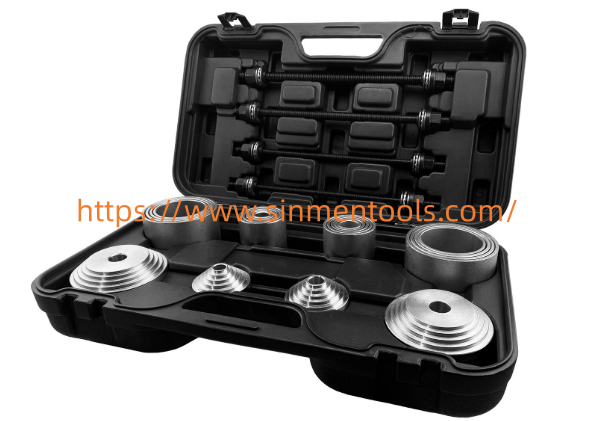
Bushings are used in many automotive assemblies to support movement, reduce friction, and help manage vibration between connected components. Replacing them can require controlled force and careful alignment, particularly when a worn part is fitted tightly within a housing. For technicians evaluating a Bushing Press Kit, the key considerations include the tool’s construction, the relationship between its adapters, and its suitability for the repair task. A thoughtfully designed kit can help make bushing removal and installation more organized while reducing the likelihood of damage caused by uneven pressure or improvised methods. Source
Material selection influences how the tool responds to repeated workshop use. Load-bearing parts are commonly made from steel because the material can provide the structural support needed during pressing operations. Threaded components, plates, sleeves, and adapters each perform distinct roles, so their material quality and surface condition should be considered as part of the complete assembly. A durable finish can help protect exposed surfaces from corrosion during storage and handling. Buyers should look for consistent manufacturing and well-finished contact areas rather than relying only on the appearance of the tool. The quality of individual components matters because the kit operates as a coordinated system.
Choosing a suitable kit begins with understanding the vehicle and the bushing being serviced. Automotive bushings differ in shape, location, housing arrangement, and material. A tool intended for one application may not suit another, so buyers should review the manufacturer’s compatibility guidance before selecting equipment. They should also consider whether the work will take place on the vehicle or on a removed component, and whether the workshop already has a suitable press. A kit with clearly identified adapters and application information can make selection easier for both technicians and purchasing teams. Source
The functional principle of a press kit is to apply force through compatible contact pieces so that a bushing can be moved into or out of its housing. Depending on the design, the assembly may use threaded rods, receiving sleeves, press plates, or other adapters. The receiving component supports the surrounding structure while the pressing element transfers force to the bushing. Correct alignment is important: if the tool begins at an angle, the bushing may enter unevenly or contact the housing in an unintended way. A suitable setup helps distribute force more evenly and allows the technician to maintain control throughout the operation. Source
User experience depends on how easily the kit can be prepared, positioned, and operated. Clearly organized components can reduce the time spent identifying the appropriate adapter, while a practical arrangement of parts can make the workflow easier to follow. Instructions should explain how the tool is assembled and identify the intended contact points. For workshops handling different vehicles, a well-organized kit can also support more consistent procedures between technicians. However, convenience should never replace safe working practices. Users should follow vehicle service information and tool instructions, wear appropriate protective equipment, and stop if the assembly appears misaligned or unstable.
Maintenance and inspection help preserve tool condition over time. Before use, technicians should examine threaded parts, plates, sleeves, and contact surfaces for visible damage or wear. Components should be cleaned after use and stored so that they remain organized and protected from unnecessary impact or moisture. Where lubrication is recommended for a threaded mechanism, it should be applied according to the manufacturer’s instructions. Damaged or distorted parts should not be used, since their condition may affect how force is transferred during pressing. These routine checks help workshops keep tools ready for service and identify issues before they interrupt a repair.
Design and appearance contribute to the practical organization of the equipment. A compact arrangement can make storage easier, while clearly differentiated adapters help users recognize the components needed for a particular task. A carrying case or organized storage system, when provided, can reduce the risk of misplaced parts and make the kit easier to transport between work areas. Smooth finishes and clearly marked components can also support straightforward handling and inspection. Still, visual presentation should be evaluated alongside structural quality, compatibility, and ease of operation. The most useful design is one that supports the repair process without adding unnecessary complexity.
Taizhou Xinming Technology Co., Ltd. develops automotive tools for maintenance and repair applications. Businesses evaluating bushing press equipment can discuss their intended service tasks, workshop requirements, component organization, and product expectations when considering suitable options. Reviewing application guidance and confirming compatibility before use can help technicians select equipment that fits their working methods. Further information about the company and its automotive tool range is available at https://www.sinmentools.com/.

 English
 Arabic
 French
 Spanish
 Portuguese
 Deutsch
 Turkish
 Dutch
 Italiano
 Romaian
 Portuguese (Brazil)
 Greek