


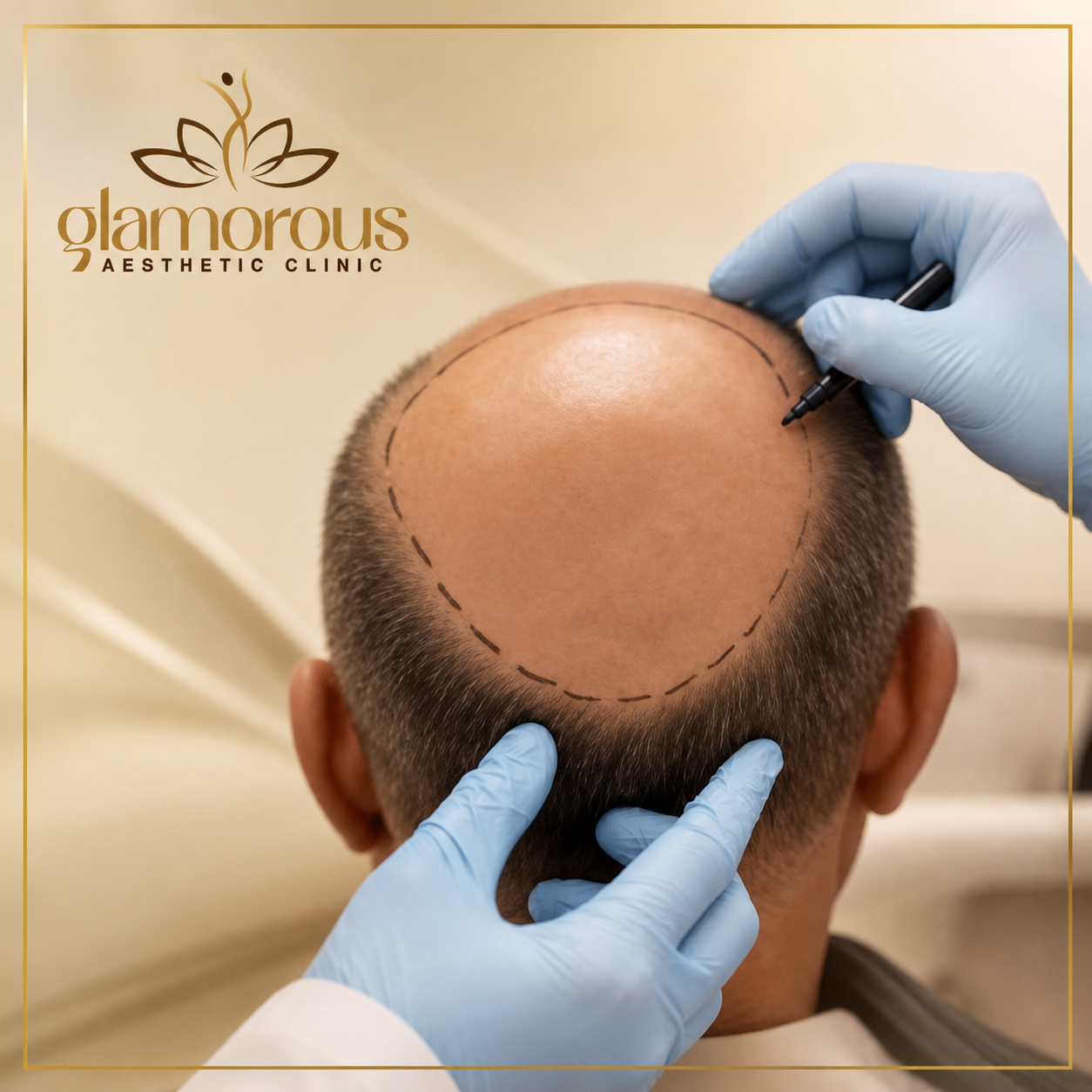
Hair restoration is as much about planning as it is about surgical skill. Two patients can receive the same number of grafts and walk away with very different results, depending on how those grafts are placed. Patients considering FUE Hair Transplant in Islamabad should understand that graft distribution is the single most important factor behind a natural, lasting outcome. At Glamorous, this process is treated as a carefully designed strategy rather than a routine step in the procedure.
What Graft Distribution Really Means?
Follicular Unit Extraction, commonly called FUE, involves harvesting individual follicular units from a donor area, usually the back and sides of the scalp, and implanting them into thinning or balding zones. Each follicular unit contains one to four hairs. Graft distribution is the plan that decides which units go where, how densely they are placed, and in what direction they point.A strong distribution plan respects a simple truth: the donor supply is limited. A person has only so many permanent hairs available, and those cannot be replenished. Spending them wisely is the foundation of every successful hair transplant.
Assessing the Donor Area First
Before any placement plan is drawn, the clinical team evaluates the donor area carefully. Hair density, hair caliber, curl, color contrast with the skin, and the overall laxity of the scalp all influence how many grafts can be safely harvested and how much coverage they can achieve.Thicker hair shafts and a slight wave tend to give better visual coverage than fine, straight hair. A patient with a moderate number of high-caliber grafts may achieve fuller looking results than someone with a larger count of fine grafts. This is why Glamorous does not rely on graft numbers alone when setting expectations. The quality and characteristics of the donor hair matter just as much as the quantity.Safe harvesting limits are also considered. Over-harvesting from one zone can leave the donor area looking sparse or patchy, so extraction is spread evenly across the safe donor region. This keeps the donor area looking natural after healing.
Designing the Hairline
The hairline is the most scrutinized feature of any transplant, and it receives the most careful attention in the distribution strategy. A natural hairline is never a straight, sharp line. It is slightly irregular, with soft transitions and tiny groupings of single hairs that mimic how hair grows naturally at the front of the scalp.At Glamorous, the hairline is designed in line with the patient’s facial proportions, age, and long-term hair loss pattern. A hairline that looks suitable for a twenty-five-year-old may appear unnatural on a forty-five-year-old and may also leave the patient with an awkward result as native hair continues to thin with time. The design therefore takes the future into account, not just the present.
Matching Graft Types to Zones
One of the key principles in graft distribution is matching graft type to the area being treated.
Single-hair grafts are placed along the very front of the hairline. Their fine, soft appearance creates a gentle edge that blends naturally with the forehead. Using thicker grafts here would create a harsh, artificial look.
Double and triple-hair grafts are placed behind the frontal edge, in the mid-scalp and crown areas. These multi-hair units provide density and volume, building the bulk of the coverage behind the delicate front line.
Mixed placement in transition zones helps avoid a visible border between the transplanted area and the native hair. Gradual changes in density make the result look continuous and age appropriately.This layered approach gives both a soft frame at the front and meaningful density where it is needed most.
Prioritizing Areas for Maximum Visual Impact
When donor supply is limited, not every thinning area can receive the same density. A good distribution strategy sets priorities based on what creates the greatest visual impact and what suits the patient’s goals.For most patients, the frontal third and the mid-scalp are the priority, because these areas frame the face and are seen most often. The crown, which tends to require a large number of grafts for relatively modest coverage, is addressed with careful judgment. In some cases it may be treated lightly or planned for a later session, so the donor supply is not exhausted too early.Patients with advanced hair loss are counseled honestly. Rather than promising complete coverage everywhere, the team explains what is realistically achievable and designs a plan that delivers a balanced, natural appearance with the grafts available.
Controlling Density and Angle
Density refers to how many grafts are placed in each square centimeter. Natural scalp hair density is high, but transplanting at the highest possible density can compromise blood supply to the healing tissue and reduce graft survival. Skilled planning aims for a density that looks full while keeping the grafts healthy.Angle and direction are equally important. Hair on the scalp grows in specific directions that vary between regions. Along the front it points forward and slightly downward, while at the crown it follows a swirling pattern. Each graft is implanted to match these natural patterns. When angles are wrong, even a dense result can look unnatural, so close attention is paid to placing every graft correctly.
Protecting Graft Survival
A distribution plan only works if the grafts survive. Throughout the procedure, extracted follicles are handled gently and stored in a suitable solution to protect them while they are out of the body. The time between extraction and implantation is kept as short as possible, and grafts are sorted by type so each is ready for its intended zone.Implantation itself is done with care to avoid crowding sites too tightly, which can strain the blood supply. Spacing the incisions thoughtfully supports healing and helps the transplanted hair grow in strongly.
Planning for the Long Term
Hair loss is usually progressive, so a transplant should be planned with the years ahead in mind. Placing grafts too aggressively at the front without considering future thinning can leave a patient with an isolated patch of hair that looks odd as native hair recedes further.At Glamorous, the strategy considers how the patient’s pattern may evolve. Where appropriate, medical therapies that help preserve existing hair may be discussed alongside surgery, so the transplanted area and the native hair stay in harmony. This forward-looking approach protects both the result and the remaining donor supply.
What Patients Can Expect?
Following the procedure, the transplanted area goes through a normal recovery cycle. Small scabs form and fall off within the first couple of weeks, and the transplanted hairs shed before new growth begins a few months later. Visible improvement typically builds gradually, with a more complete result appearing around the one-year mark. Following the aftercare guidance, avoiding strenuous activity early on, and attending follow-up visits all support a smooth recovery.Because every scalp is different, individual results vary. A transparent consultation, where the plan is explained clearly and questions are answered openly, helps patients begin with realistic and confident expectations.
Choosing the Right Clinic
When comparing options for FUE Hair Transplant in Islamabad, patients should look beyond price and advertised graft counts. Useful questions include who designs the hairline, how the team decides graft placement, how donor supply is protected, and whether past results are shown honestly. A clinic that can explain its distribution strategy in clear terms is far more likely to deliver a result that looks natural and holds up over time.
Conclusion
Graft distribution is the quiet foundation behind every successful hair transplant. By evaluating the donor area carefully, designing a natural hairline, matching graft types to the right zones, controlling density and angle, and planning for the long term, Glamorous approaches FUE as a precise and personalized process. The goal is not simply to add hair, but to place each graft where it will create the most natural and lasting improvement. For anyone exploring FUE Hair Transplant in Islamabad, a clinic that treats graft distribution as a strategy rather than a formality offers the best chance of a confident, natural-looking outcome.

 Arabic
 French
 Spanish
 Portuguese
 Deutsch
 Turkish
 Dutch
 Italiano
 Russian
 Romaian
 Portuguese (Brazil)
 Greek