


Introduction
Starting a business in the UK is an exciting opportunity, but managing its finances can quickly become challenging. From registering your company and maintaining financial records to handling tax obligations and managing cash flow, there are several financial responsibilities that startup founders must consider.
In the early stages, many entrepreneurs attempt to manage their accounts themselves to reduce expenses. While this may work initially, financial responsibilities often become more complicated as the business grows.
Knowing when to hire an accountant for startups in the UK can make a significant difference. A professional accountant can help you maintain accurate financial records, understand tax obligations, avoid costly mistakes and make informed business decisions.
But how do you know when your startup needs professional accounting support?
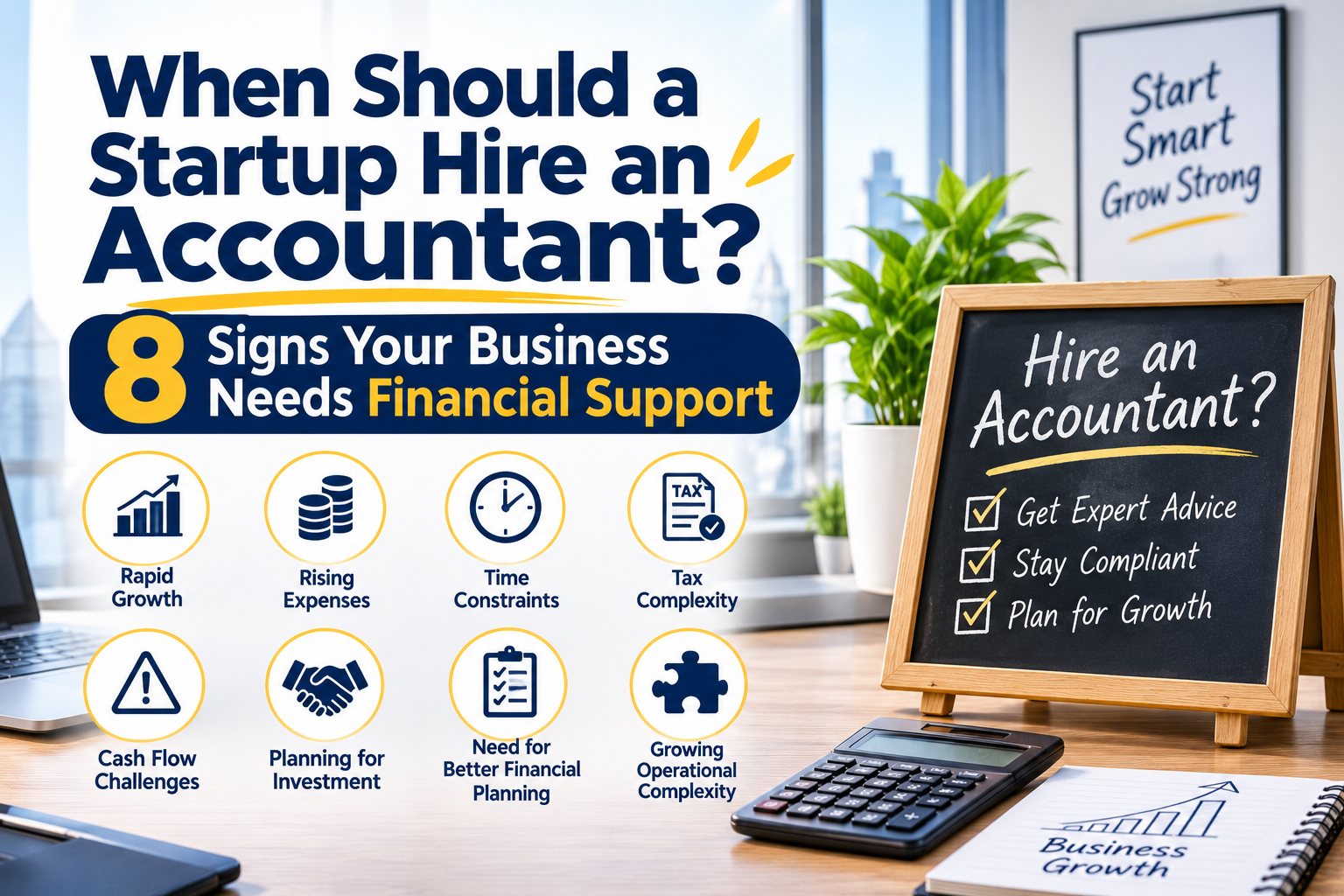
Here are eight important signs that it may be time to work with an accountant.
1. You Are Spending Too Much Time Managing Financial Records
As a startup founder, your time is valuable. You need to focus on developing products, attracting customers, building relationships and growing your business.
However, bookkeeping and financial administration can take up a considerable amount of time.
If you regularly spend hours recording transactions, organising invoices, reconciling bank statements and updating spreadsheets, it may be time to seek professional support.
A startup accountant can help with:
-
Recording daily financial transactions.
-
Organising invoices and receipts.
-
Reconciling business bank accounts.
-
Monitoring income and expenses.
-
Maintaining accurate financial records.
Outsourcing these responsibilities allows you to focus on business development while ensuring your financial information remains organised.
2. You Are Unsure About Your Tax Obligations
Understanding UK tax requirements can be difficult, particularly for first-time business owners.
Depending on your business structure and activities, you may need to deal with Corporation Tax, VAT, PAYE, National Insurance and other tax responsibilities.
Missing deadlines or submitting incorrect information can lead to penalties and unnecessary financial pressure.
An accountant can help your startup understand its tax responsibilities, including:
-
Corporation Tax registration and returns.
-
VAT registration and VAT returns.
-
PAYE and payroll reporting.
-
Allowable business expenses.
-
Relevant tax reliefs and allowances.
-
Important HMRC deadlines.
Professional tax support helps you stay informed about your obligations and plan for upcoming payments.
3. Your Business Cash Flow Is Becoming Difficult to Manage
Cash flow is one of the biggest financial challenges facing startups.
Even if your business is generating revenue, delayed customer payments, unexpected expenses and high operating costs can create cash shortages.
For example, your startup may have several outstanding customer invoices but still need to pay employees, suppliers and monthly business expenses.
An accountant can help you understand your financial position through:
-
Cash flow statements.
-
Cash flow forecasting.
-
Budget preparation.
-
Expense monitoring.
-
Financial performance analysis.
With better financial visibility, you can identify potential cash shortages and plan ahead.
This is particularly important for startups preparing to hire employees, invest in equipment or expand their operations.
4. You Are Planning to Hire Employees
Hiring your first employee is an important milestone for any startup. However, becoming an employer also introduces additional financial and administrative responsibilities.
UK employers generally need to operate PAYE, report payroll information to HMRC and manage applicable National Insurance and workplace pension obligations.
These responsibilities can become complicated if you have limited experience with payroll administration.
A startup accountant can support you with:
-
Setting up payroll systems.
-
Calculating employee salaries.
-
Managing PAYE deductions.
-
Preparing payslips.
-
Submitting payroll information to HMRC.
-
Supporting workplace pension administration.
Getting professional support can help you establish an organised payroll process as your team grows.
5. You Are Struggling to Understand Your Business Profitability
Generating sales does not necessarily mean your startup is profitable.
You need to understand how much money remains after accounting for operating expenses, salaries, supplier payments and other business costs.
Without accurate financial reports, it can be difficult to determine whether your business model is sustainable.
A professional accountant can prepare management accounts and financial reports that show:
-
Monthly income and expenditure.
-
Gross and net profit margins.
-
Operating expenses.
-
Business performance trends.
-
Budget performance.
-
Financial forecasts.
These insights help startup founders identify areas where costs can be reduced and opportunities where additional investment may be worthwhile.
6. Your Business Is Approaching the VAT Registration Threshold
VAT registration is another important consideration for growing UK startups.
The compulsory VAT registration threshold is currently £90,000 in taxable turnover over a rolling 12-month period.
Businesses must monitor their taxable turnover and register when the relevant registration conditions are met. They may also choose to register voluntarily in certain circumstances.
If your startup is experiencing rapid growth, monitoring turnover becomes increasingly important.
An accountant can help you:
-
Monitor taxable turnover.
-
Determine when VAT registration is required.
-
Complete VAT registration.
-
Prepare VAT returns.
-
Understand VAT schemes.
-
Maintain appropriate VAT records.
Professional guidance can help you avoid registration mistakes and manage your VAT responsibilities more effectively.
7. You Are Preparing to Secure Investment or Business Funding
Many startups require external funding to develop products, expand operations or enter new markets.
Whether you are approaching angel investors, venture capital firms, banks or other funding providers, having organised financial information is important.
Potential investors and lenders may want to review your financial position, revenue forecasts, operating expenses and growth projections.
An accountant can help prepare:
-
Financial statements.
-
Cash flow forecasts.
-
Business budgets.
-
Profitability reports.
-
Financial projections.
-
Supporting accounting information.
Reliable financial reporting can make it easier to explain your startup's financial performance and demonstrate how additional funding could support future growth.
8. Your Business Is Growing and Accounting Requirements Are Becoming More Complex
One of the clearest signs that your startup needs an accountant is when your financial responsibilities begin increasing faster than you can manage them.
For example, your business may now have:
-
Multiple revenue streams.
-
More employees.
-
Higher transaction volumes.
-
Additional suppliers.
-
International customers.
-
Increased tax and reporting responsibilities.
What Accounting Services Does a UK Startup Actually Need?
The accounting requirements of a startup depend on its business structure, size, activities and stage of development.
However, most startups can benefit from some combination of the following services.
| Accounting service | How it helps startups |
|---|---|
| Bookkeeping | Keeps financial transactions organised and accurate. |
| Annual accounts | Supports statutory financial reporting requirements. |
| Corporation Tax | Helps calculate and report company tax liabilities. |
| VAT accounting | Supports VAT registration, calculations and returns. |
| Payroll management | Helps manage employee salaries and PAYE reporting. |
| Management accounts | Provides insights into business performance. |
| Cash flow forecasting | Helps anticipate future financial requirements. |
| Cloud accounting | Makes financial records easier to access and manage. |
Startups do not necessarily need every service from day one. The right combination should reflect their current requirements and future plans.
Is It Better to Hire an In-House Accountant or Outsource Startup Accounting?
Many startups face the decision of hiring an employee to manage their accounts or outsourcing accounting responsibilities to a professional firm.
Both approaches have advantages, depending on the size and complexity of the business.
| Factor | In-house accountant | Outsourced accountant |
|---|---|---|
| Cost | Salary and employment-related costs | Service fees based on agreed requirements |
| Availability | Dedicated internal resource | Support according to service agreement |
| Expertise | Depends on the employee's experience | Access to a wider range of accounting expertise |
| Scalability | May require additional recruitment | Services can often adapt as the business grows |
| Administration | Managed internally | Accounting responsibilities delegated externally |
Knowing when to hire an accountant is an important part of building a successful startup. While founders may initially manage their finances independently, increasing transactions, tax responsibilities, payroll requirements and cash flow challenges can make professional support increasingly valuable.
An experienced accountant for startups in the UK can help you maintain accurate financial records, manage tax obligations, monitor business performance and prepare for future growth.
If your startup is spending too much time on financial administration or struggling to understand its financial position, it may be the right time to seek professional accounting support.
At Lanop, businesses can access accounting services designed to support their financial management requirements. From bookkeeping and annual accounts to payroll, tax support and management accounting, professional assistance can help startups establish a more organised approach to their finances.

 Arabic
 French
 Spanish
 Portuguese
 Deutsch
 Turkish
 Dutch
 Italiano
 Russian
 Romaian
 Portuguese (Brazil)
 Greek