


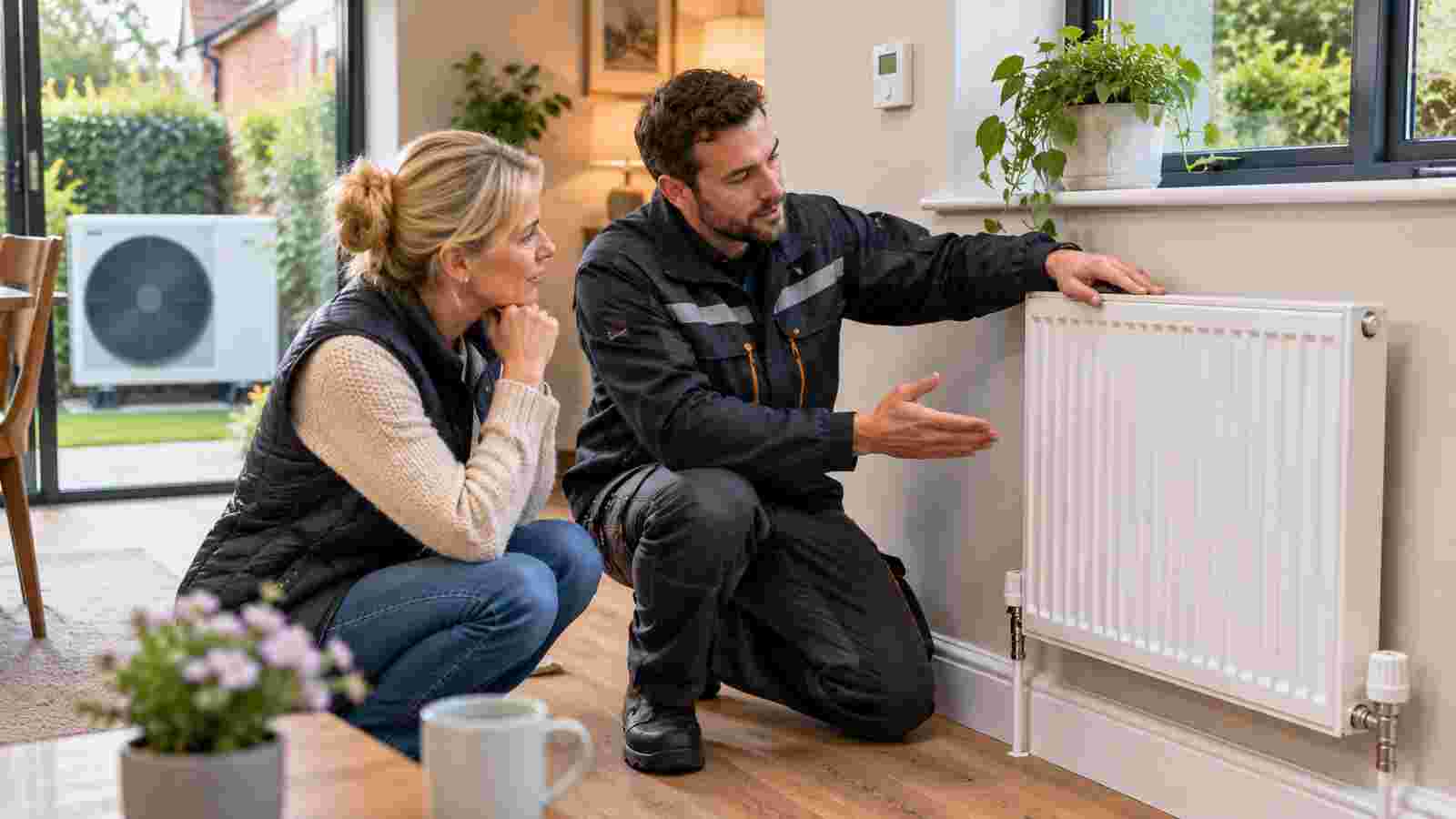
If you're thinking about switching from a gas or oil boiler to a heat pump, one practical question may come before everything else: will your existing radiators still work? The Boiler Upgrade Scheme can help with eligible installation costs, but it doesn't remove the need for a correctly designed heating system.
The answer is not always “replace every radiator.” Many homes can reuse some or all of their current equipment. The right decision depends on the building's heat loss, room sizes, radiator output and the temperature at which the new system will operate.
Why Radiators Matter With Heat Pumps
A conventional boiler often sends relatively hot water around the heating circuit. A heat pump is typically most efficient when it delivers heat at a lower water temperature. At those temperatures, a small radiator may release less warmth into the room, even when the system is working correctly.
That is why an installer should calculate room-by-room heat demand before specifying equipment. A larger or more effective radiator may be needed in some rooms, while existing radiators elsewhere may be entirely adequate. Underfloor heating can also be suitable, but it is not compulsory for a heat pump.
What Should the Installer Check?
A thorough assessment should cover the property's insulation, draughts, window performance, floor area and desired indoor temperatures. The installer should then consider radiator size, pipework, heating controls and hot-water requirements.
Ask to see the proposed design assumptions. If your living room needs more heat than its current radiator can supply at the chosen flow temperature, the installer should explain the options and their costs. Potential changes could include a larger radiator, a double-panel model or other suitable heat emitter.
Does the Government Grant Pay for Radiators?
The Boiler Upgrade Scheme is an upfront grant towards an eligible heating installation, rather than a separate fixed payment for each radiator. An installer may include necessary associated work within the overall quotation. The important thing is to ask for a clear breakdown rather than assuming every home improvement is covered for free.
As of November 2026, a qualifying air-to-water or ground source heat pump generally receives a £7,500 grant. Eligible off-gas-grid properties replacing oil or LPG heating may receive £9,000 towards qualifying systems until 31 March 2027. The installer shows the appropriate grant deduction on the quotation and invoice.
Can Insulation Reduce the Need for Bigger Radiators?
Sometimes. Reducing heat loss can lower the amount of heat a room requires, which may make it easier to use existing radiators. Loft insulation, draught-proofing and other suitable measures can also improve comfort.
However, you should not assume an insulation improvement automatically removes the need for radiator changes. Have the installer assess the building as it will actually be used and decide whether proposed insulation work should happen before the final system design.
An EPC is no longer a mandatory prerequisite for new BUS applications from 28 April 2026, but the heating survey and technical design still matter.
Questions Worth Asking Before You Sign
Ask which radiators will stay, which will change and why. Request the proposed flow temperature and a realistic explanation of how the system will heat the house on colder days. Confirm whether the price includes any pipework, radiator valves, hot-water-cylinder changes and system commissioning.
If you are researching the boiler upgrade scheme, Berks Insulation's guide provides an introduction to the programme before you arrange a detailed assessment with an MCS-certified installer.
Frequently Asked Questions
Must I install underfloor heating to qualify?
No. Suitable radiators can work with a properly designed heat pump.
Can I replace only some radiators?
Yes, where the heat-loss assessment shows that some existing radiators are adequate and others need upgrading.
Will larger radiators guarantee cheaper heating bills?
No. Operating costs depend on the whole system, the building and the electricity tariff. Good design can help efficiency, but bills are not guaranteed.
Final Thoughts
Do not let the possibility of radiator changes discourage you from exploring the scheme. Focus on getting a transparent, room-by-room system design and an itemised quote. That will tell you whether radiator replacements are really needed and what your total project could cost.

 English
 Arabic
 French
 Spanish
 Portuguese
 Deutsch
 Turkish
 Italiano
 Russian
 Romaian
 Portuguese (Brazil)
 Greek