


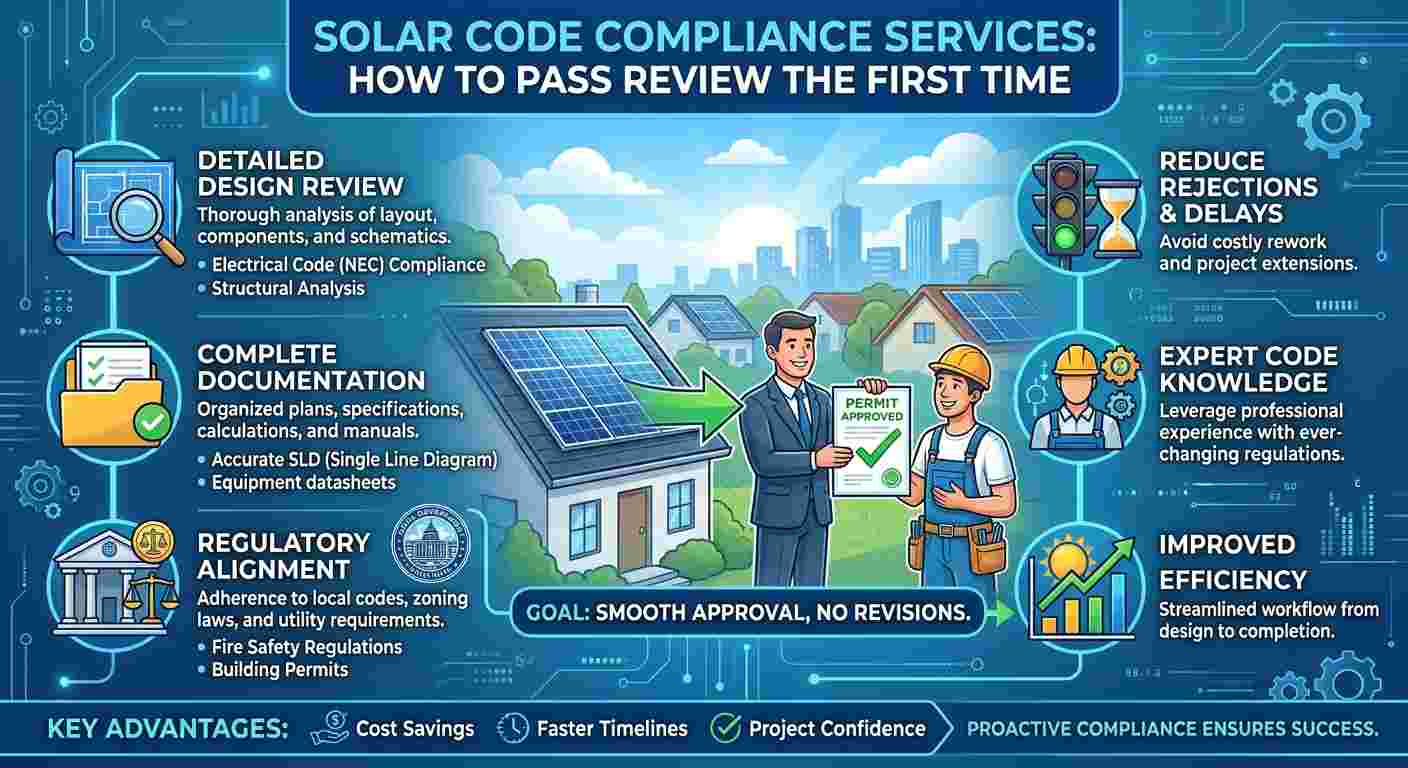
A plan reviewer opens your solar submission and spends maybe twenty minutes with it. In that window, they check whether the wiring is protected correctly, whether firefighters can walk the roof, whether the labels match the rulebook, and whether the numbers agree from sheet to sheet. Miss one item and the file goes back with a correction notice. Miss three and the project loses a month.
Codes are not the enemy. They are a shared safety standard, and every installer works under them. The real trouble is that codes change, local offices amend them, and a drawing that passed last year may not pass today. This guide explains what code compliance covers for solar, which standards matter most, how to build compliance into your workflow, and when outside help makes sense. It comes from the team at PTOEdge, who prepare and track solar documentation for contractors every week.
If you would like an expert check before you submit, our solar code compliance services can catch problems while they are still cheap to fix. Have a package ready for review? Book a Compliance Review and we will take a look.
What Are Solar Code Compliance Services?
Solar code compliance services are the technical checks and documentation work that confirm a photovoltaic system design follows the building, electrical, and fire rules that apply to a specific site. The work happens before submission, when changes are easy, rather than after a rejection, when they cost time and goodwill.
In practice, compliance work answers three questions. First, which codes and editions has the local jurisdiction adopted, including its own amendments? Second, does the design meet those requirements in every detail, from conductor sizing to roof pathways? Third, do the drawings clearly show that compliance, in a form a reviewer can verify quickly?
The third question matters more than many installers realize. A design can be perfectly safe and still get rejected because the proof is missing. Reviewers cannot approve what they cannot see. A good compliance process makes the evidence obvious: the right labels, the right notes, the right calculations, and consistent equipment details throughout the set.
Compliance also covers more than the first permit. Systems must be installed as designed, inspected against the approved plans, and documented for the utility. Treating compliance as a continuous thread, not a single gate, prevents surprises at every stage.
Types of Codes and Standards That Affect Solar Projects
Solar projects touch several rulebooks at once. Knowing which one governs each part of the design helps you anticipate review comments.
Electrical Code Requirements
The National Electrical Code, adopted in different editions across jurisdictions, is the main reference for solar wiring. It addresses conductor sizing, overcurrent protection, grounding, disconnects, arc-fault protection, and rapid shutdown. Interconnection rules, including limits on how much solar can connect to a busbar, appear here as well. Always confirm which edition the local office has adopted, since requirements shift between cycles.
Building and Structural Code Requirements
Building codes govern how a system attaches to a roof or the ground and whether the structure can carry the extra load. Wind uplift, snow, seismic forces, and attachment spacing all fall under this area. Engineers commonly reference load standards when evaluating these items.
Fire Code Requirements
Fire rules focus on firefighter safety. They typically set roof access pathways, setbacks from ridges and edges, and clear zones around openings. Rapid shutdown and labeling also support emergency response. Requirements vary, and some jurisdictions apply stricter local versions.
Product Listing and Equipment Standards
Modules, inverters, racking, and batteries must carry the proper listings for their use. Reviewers often compare the equipment on your drawings with data sheets and listing marks. Using unlisted or mismatched components is a frequent cause of rejection.
Local Amendments and Utility Rules
Cities, counties, and utilities add their own requirements on top of model codes. These might include special labels, additional disconnects, particular diagram formats, or specific interconnection forms. Local amendments are where many out-of-town contractors get caught.
Zoning and Appearance Standards
Ground-mounted systems, historic districts, and some neighborhoods carry height, setback, and screening limits that sit outside the technical codes but still need approval.
Benefits of Professional Code Compliance Review
A compliance check takes time, but it returns more than it costs. These are the gains contractors notice most.
Fewer rejections and resubmissions. Every correction notice adds days. Catching issues beforehand keeps applications moving and protects your schedule.
Safer installations. Codes exist because failures have happened. Correct protection devices, grounding, labeling, and access pathways reduce risk for occupants, crews, and firefighters.
Lower rework costs. Fixing a drawing costs almost nothing. Fixing a finished installation after a failed inspection can cost a lot. Compliance review pushes problems to the cheapest stage.
Better inspection results. Inspectors compare the finished system with approved plans and code. Systems designed with compliance in mind pass more often on the first visit.
Stronger reputation with plan reviewers. Offices notice which companies send clean, consistent packages. Over time, that reputation can make reviews smoother.
More credible proposals. When your team knows what the codes require, it can quote realistic scope and timelines. Pairing that knowledge with data-backed solar sales proposals helps customers trust that the price will not change after signing.
Reduced liability. Documented code review shows that your company took reasonable care. If questions arise later, you have a record of due diligence.
Key Compliance Areas and Factors to Check
Most corrections cluster in a handful of areas. Focus your review on these.
Conductor Sizing and Overcurrent Protection
Wire gauges, breaker ratings, and fuse sizes must agree with the system's maximum currents and the applicable correction factors. Calculation sheets should match the single line diagram exactly.
Rapid Shutdown
Most jurisdictions require a method to quickly reduce voltage on rooftop conductors during an emergency. The design should name the equipment that performs this function, show the initiation device, and include the required labels.
Point of Interconnection
Where the solar system connects to the building's electrical service affects safety and approval. Busbar ratings, main breaker sizes, and any planned service upgrades must be shown clearly, because this is a favorite area for reviewer questions.
Grounding and Bonding
Show how modules, racking, and equipment connect to the grounding system. Missing or vague grounding details lead to quick correction notices.
Labels and Placards
Warning labels, disconnect markings, and directory placards must have the right wording and placement. Many offices ask for label examples or a placard sheet with the application.
Roof Access and Setbacks
Pathways, ridge setbacks, and clearances should be dimensioned on the layout. Do not leave reviewers to measure the drawing themselves.
Structural Attachment
Show the mounting hardware, spacing, and fastener details, and confirm they match the racking manufacturer's instructions. Where a sealed structural review is needed, plan for sealed solar engineering documents early so engineering does not become a late-stage bottleneck.
Equipment Consistency
Module counts, inverter models, and ratings must agree between the layout, the diagram, the equipment schedule, and the data sheets. Inconsistency is the single most common reason a reviewer loses confidence in a package.
How Does a Code Compliance Review Work?
A thorough review follows a repeatable sequence. You can use this as a checklist for your own team or as a benchmark for outside providers.
Step 1: Identify the governing codes. Find the authority having jurisdiction and confirm the adopted code editions and local amendments. Read the office's solar checklist, and note anything unusual.
Step 2: Collect project data. Gather site photos, roof or land details, the main panel information, utility details, and equipment choices. Gaps here lead to assumptions, and assumptions lead to corrections.
Step 3: Review the design against requirements. Check layout, setbacks, structural details, electrical calculations, protection devices, and labeling against each applicable rule. An automated solar design workflow can reduce manual errors by keeping equipment data and layouts synchronized.
Step 4: Cross-check every sheet. Compare equipment names, counts, and ratings across all pages and attachments. Fix mismatches before anything leaves your office.
Step 5: Prepare supporting documents. Assemble data sheets, calculation sheets, label examples, and any required forms. Make sure file names and sheet numbers are clear.
Step 6: Submit and monitor. Send the package according to local instructions, record the date, and check in regularly. Reviews that stall in a queue are easy to miss.
Step 7: Respond to comments precisely. When the reviewer asks for changes, answer each item directly, update every affected sheet, and explain the revision. Sloppy responses lengthen the cycle.
Step 8: Prepare for inspection. Make sure the installed system, labels, and equipment match the approved set. Give the crew a copy of the final drawings for the site visit.
Step 9: Finish with utility approval. After inspection passes, the project still needs approval to connect. Planning for grid connection approval guidance from the start prevents a long wait after installation is complete.
Applications and Real-World Uses
Code compliance support helps in many situations beyond a single rooftop permit.
Residential installers scaling up. Growing companies often lose consistency as volume rises. Standard compliance checklists help new staff produce reliable packages.
Commercial and industrial projects. Larger systems involve more equipment, more review layers, and more room for error. A pre-submission review is inexpensive insurance.
Contractors entering new jurisdictions. Every office has quirks. Compliance services help out-of-area installers learn local expectations without paying for mistakes.
Battery storage and EV charging additions. These upgrades bring extra safety and placement rules that differ from standard solar. Early review prevents redesigns.
Projects after a rejection. When a package comes back with a long list of comments, an outside review can sort priorities and prevent a second failure.
Drawing standardization. Companies that want repeatable quality use compliance reviews to build templates that already include required notes and labels. Starting from code-checked solar plan sets makes every new job easier.
Due diligence for financing. Lenders and investors sometimes ask whether a project follows applicable codes. A documented review provides a clear answer.
Why Choose PTOEdge for Solar Code Compliance Services?
Contractors have enough to manage without memorizing every local amendment. That is where PTOEdge adds value. We review designs and documents with the reviewer's perspective in mind, then help you submit and track applications through approval.
Because PTOEdge handles design documentation, engineering coordination, permitting, and final utility steps, we see how a small drawing detail early on affects the outcome weeks later. That connected view helps us catch issues that single-task vendors can miss.
Here is what clients tell us they value:
- Reviewer-focused checks that look for the same issues plan examiners flag.
- Clear, actionable feedback instead of vague warnings.
- Consistent documents across projects and team members.
- Responsive support when comments arrive and deadlines are tight.
- End-to-end coordination from compliance review to utility approval.
Our approach is simple: fewer surprises, fewer resubmissions, and more projects starting on schedule. At PTOEdge, we judge our work by how rarely our clients hear the words "please revise and resubmit."
Conclusion
Code compliance is not a paperwork exercise. It is the discipline that keeps solar systems safe, approvals predictable, and customers confident. Confirm the governing codes, check the high-risk areas, keep every sheet consistent, and plan for engineering and utility steps from the beginning. Do that, and corrections become the exception.
Remember that a compliant design is only useful when the evidence is easy to read. Build your drawings so the reviewer can verify every requirement without hunting.
If you want a second set of expert eyes before your next submission, Get Your Plans Checked and let our team help you move from draft to approval with confidence.
Frequently Asked Questions (FAQs)
1. What does solar code compliance actually cover?
It covers electrical, structural, and fire safety requirements for a solar system, along with product listings and local amendments. It also includes making sure drawings show that compliance clearly enough for a reviewer to verify.
2. Which code edition applies to my project?
It depends on what the local authority has adopted, along with any amendments. Check the jurisdiction's website or ask the building office directly, and record the answer for your project file.
3. What are the most common reasons solar plans are rejected?
Common causes include inconsistent equipment details, missing or incorrect labels, unclear interconnection information, and incomplete roof access or setback details. A careful cross-check before submission prevents many of these.
4. Can a compliant design still fail inspection?
Yes. If the installed system differs from the approved plans, or labels and equipment are missing, the inspector may fail it. Giving your crew the final drawings and a pre-inspection checklist helps avoid this.
5. How early should I start a compliance review?
As early as possible, ideally before the design is finalized. Changes are cheapest on paper, and early review also reveals whether engineering or special utility steps will be needed.

 English
 Arabic
 French
 Spanish
 Deutsch
 Turkish
 Dutch
 Italiano
 Russian
 Romaian
 Portuguese (Brazil)
 Greek