


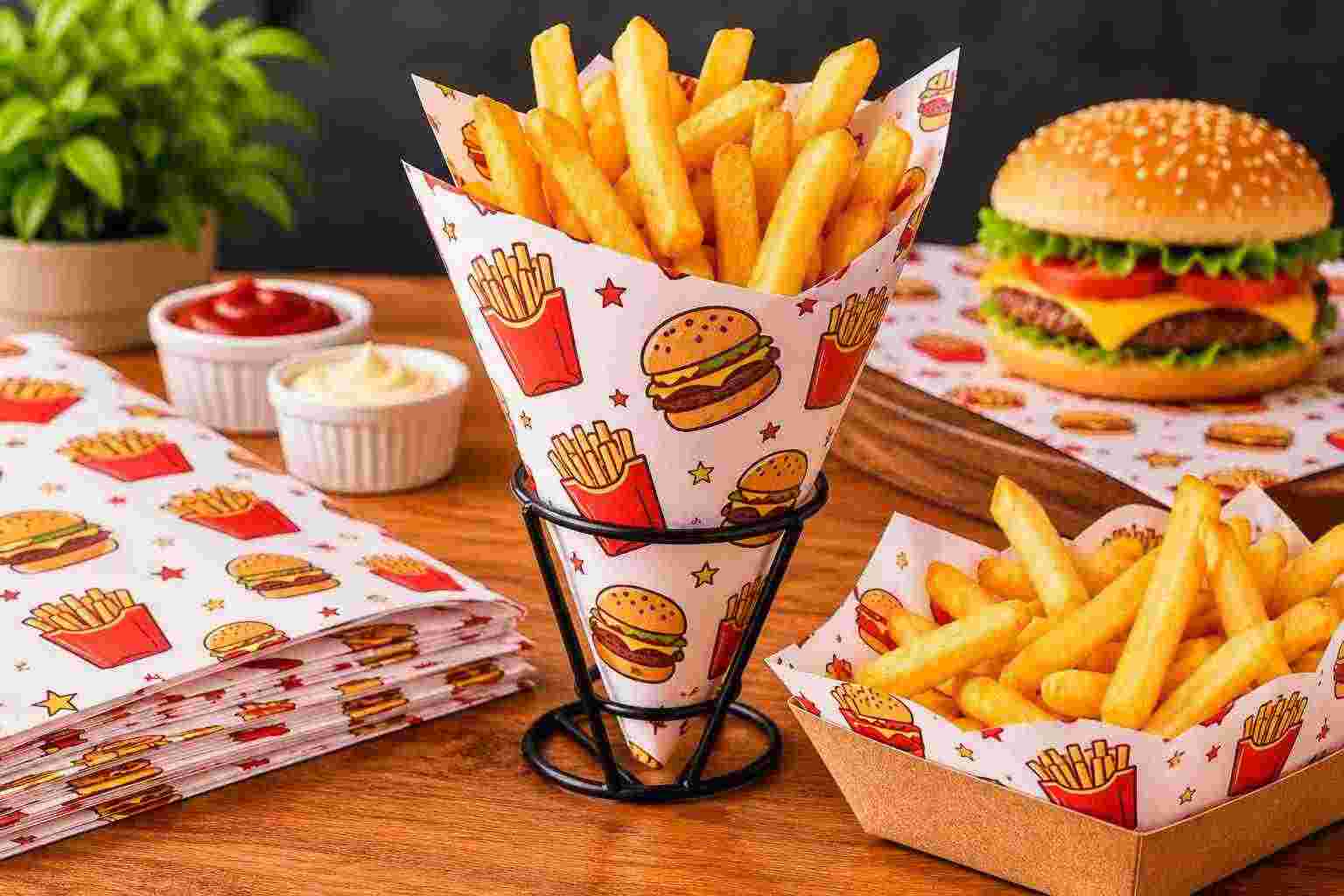
Custom French fry paper keeps grease in the wrapper, keeps fries hot and crisp on the way to the customer, and puts your logo in every hand that reaches for an order. The right paper depends on your coating, your paper weight, and what else you fry. Here’s how to choose. You can see the full specs on the Custom Fry Paper page at Print On Papers.
What Is Custom Fry Paper?
Custom fry paper is a grease-resistant food wrap made for fries and other fried foods, printed with your own logo or pattern. It’s built for foods that would soak through standard paper within minutes, such as French fries, fried chicken, onion rings, fish and chips, and burgers.
Print On Papers makes it on bleached white kraft or natural brown kraft. You can order flat sheets or rolls, in sizes and shapes that match your baskets, trays, or wraps.
Why Does Fried Food Need Its Own Paper?
Fried food puts heat, oil, and steam on the paper at the same time. Plain paper goes soft and translucent, the wrapper tears, and the customer ends up with greasy hands before the first bite.
A good fry paper handles three things:
- Grease: It blocks oil so the paper doesn’t soak through
- Moisture: It keeps steam from turning crisp food soggy
- Heat: It holds warmth through the counter, the bag, and the trip home
Print On Papers lists grease resistance at KIT Level 6 or higher, which is an industry rating for how well paper resists oil. It also lists up to 30 minutes of heat retention at serving temperature.
Which Coating Should You Choose?
Pick the coating based on how oily and hot your food is. Print On Papers offers three.
| Coating | What it does | Best for |
|---|---|---|
| PE (polyethylene) | Strong grease and moisture barrier, microwave and air fryer safe up to 425°F | Standard fries, fried chicken, most QSR and food truck use |
| Silicone | Adds non-stick performance, so food releases cleanly | Very oily food, or items that tend to stick |
| Wax (paraffin or soy-based) | Moisture and grease resistance for lighter items | Onion rings, snacks, lighter fried foods |
PE is the most common choice across quick-service restaurants and food trucks. Soy-based wax is biodegradable and compostable, which suits brands building a sustainability story.
What Paper Weight Do You Need?
Paper weight is measured in GSM, and a higher number means thicker paper. Fry paper comes in three grades.
| GSM | Best for |
|---|---|
| 35–40 | Fries, onion rings, and light snacks |
| 40–50 | Fried chicken and burgers |
| 50–60 | Fish and chips and heavily loaded wraps |
Most fry shops start in the middle. If you sell fish and chips or loaded, saucy portions, go to the heavy-duty grade.
Is Fry Paper Food Safe?
It should be, and you should ask for the paperwork. Print On Papers states that its fry paper meets FDA 21 CFR direct food-contact standards, is PFAS-free, and is FSC-certified.
PFAS matters more every year, since earlier fry papers often used fluorochemical coatings, and those chemicals are being phased out under US and EU rules. A growing number of US states also restrict PFAS in food packaging. Print On Papers uses fluorine-free, plant-based barrier coatings, so you avoid a switch later.
How Should You Design Branded Fry Paper?
Keep the design simple and bold, because food covers most of the sheet. A repeating logo or pattern looks good even when the paper is crumpled around fries. Choose colors with strong contrast against the paper so your name stays readable.
Print On Papers prints in full-color CMYK and offers Pantone matching for exact brand colors. The two print methods are flexographic for high-volume runs and digital for short runs and fine detail, both with soy-based and water-based food-safe inks. You get a flat digital proof first, a physical sample on request, and free design support if you only have a basic logo file.
Who Uses Custom Fry Paper?
Fry paper fits any business that serves fried food fast.
- Fast-casual restaurants and QSR chains wrapping fries, chicken, and burgers
- Fish and chip shops where the paper is part of the brand
- Food trucks serving fried items to go
- Delis, cafes, and diners lining baskets for counter and table service
- Caterers serving fried foods at events
A food truck in Los Angeles and a chippy-style shop in New York can use the same paper for the same reason: it keeps the food looking good until the last bite.
How Long Does It Take?
Plan on about 6–7 business days for printing and 4–5 business days for shipping, plus time to approve your proof. The quote form offers Standard (10–15 days) and Express (6–8 days) shipping, and shipping is free. The U.S. Small Business Administration notes that supplier lead times are a common pressure point for small businesses, so reorder before you run low.
How Much Does It Cost?
Pricing starts at $0.50 per unit, and the final price depends on paper weight, coating, size, number of print colors (1, 2, or 4), and quantity. Larger orders lower the cost per sheet. Ask for a full quote with every cost listed, and confirm the minimum quantity when you request it.
Frequently Asked Questions
How much does custom French fry paper cost?
Pricing starts at about $0.50 per unit. The final cost depends on paper weight, coating, size, colors, and quantity.
How do I order custom fry paper?
Fill out the quote form with your paper type, size, color options, and quantity, then upload your logo. You’ll get a digital proof to approve before printing starts.
What is the minimum order quantity?
Small food trucks and large restaurant groups can both order. Confirm the exact minimum for your size and coating when you request a quote.
How long does production and shipping take?
Plan on about 6–7 business days for printing and 4–5 business days for shipping. Express shipping is available.
Which coating is best for French fries?
PE coating is the most common choice for standard fry service, since it blocks grease and moisture well. Silicone suits very oily or sticky food, and wax suits lighter fried snacks.
Can fry paper go in the microwave or an air fryer?
Yes, the PE and silicone-coated versions are listed as safe up to 425°F. Check the details for your exact coating when you request a quote.
Conclusion
Custom French fry paper does a simple job well: keeping grease in, heat in, and your brand in front of every customer. Match the coating to your food, choose a weight that fits your heaviest orders, and check your proof before printing. A little planning means your paper arrives before you run out.

 English
 French
 Spanish
 Portuguese
 Deutsch
 Turkish
 Dutch
 Italiano
 Russian
 Romaian
 Portuguese (Brazil)
 Greek