


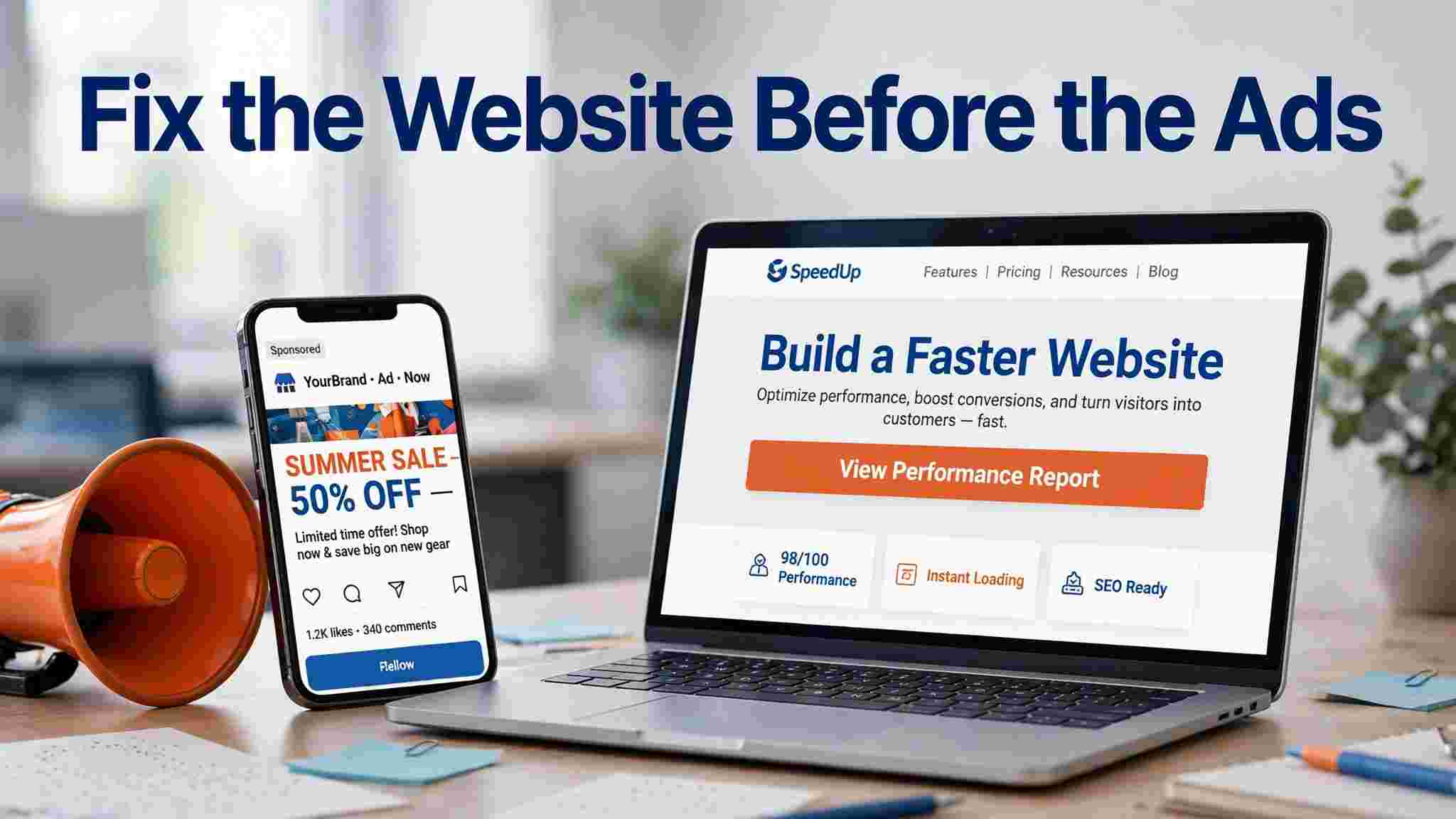
Imagine a founder who launches an online store and puts the whole first month budget into social ads. Clicks arrive, orders barely do. She blames the audience, rewrites the copy, and tries a new targeting setup three times. The real problem sits on the other side of the click. Smart brands treat web development services as the first line in the marketing budget, because ads only rent attention. The website decides whether that attention turns into revenue. At Web Dev Studioz, we meet this situation often, and it is almost always fixable without paying for more traffic.
Ads Rent Attention, Websites Keep It
What Happens After the Click
When someone taps your ad, they land on a page they know nothing about. They have maybe ten seconds of patience. If the page loads slowly, looks cramped on a phone, or hides the next step, they leave, and your money goes with them. The ad platform still charges you for that visit, whether or not anything came of it.
Why Extra Budget Rarely Fixes a Weak Page
Raising spend on a leaky page only makes the leak bigger. Many brands do exactly this because changing a budget takes a minute, while fixing a website feels like a project. But a larger budget pointed at a weak page simply buys more people who leave quickly.
The Math Behind Fixing the Site First
A Simple Illustration
These figures are made up to show the logic, not taken from a real client. Say a brand pays 2 dollars per click and buys 1,500 clicks a month, so the ad bill is 3,000 dollars. With a conversion rate of 1 percent, that brings 15 orders. If the average order is worth 60 dollars, revenue is 900 dollars, and the brand loses money on every campaign it runs.
Now suppose a rebuild lifts the conversion rate to 2 percent. The same 1,500 clicks produce 30 orders and 1,800 dollars. The ad bill did not move, yet revenue doubled. Getting the same result through ads alone would mean paying for about 3,000 clicks, which doubles the bill as well.
Why the Gains Keep Compounding
A better site lowers your cost per sale in every future campaign. It also helps organic search performance, email sign ups, and word of mouth referrals. Ad results stop the moment you stop paying, but improvements to the site keep working in the background long after the campaign ends.
What a Ready Website Looks Like Before the First Ad
Speed and Mobile Comfort
Most ad clicks come from phones. Pages should load in a couple of seconds on mobile data, text should be readable without zooming, and buttons should be easy to hit with a thumb. Heavy images and unused scripts are the usual culprits behind slow pages, and they are also the easiest problems to remove.
One Page, One Clear Goal
Landing pages work best when they ask for one thing. Good ui ux design services study how people scan a page, where attention drops, and which words earn trust, then shape the layout around a single action. Remove side links and competing offers, and conversions usually improve.
Proof That Builds Trust
Reviews, clear return policies, visible contact details, and real photos reduce doubt. First time visitors need these quickly because they have no history with your brand and nothing else to go on.
Picking a Platform That Fits the Campaign
Content Led Brands
If your plan includes articles, guides, and plenty of service pages, wordpress development services give you a flexible base that grows with your content. Keep plugins to a minimum, because clutter slows pages quickly.
Online Stores
For product sellers, Shopify keeps payments, inventory, and checkout together. Skilled shopify store design services shape the look of collection and product pages, while shopify development services handle apps, speed, and checkout flow. Used together, they turn a basic theme into a store that matches your ad creative.
Design Led and Simpler Builds
Brands that want tight control over visuals often pick webflow development services, since Webflow outputs clean code and custom layouts. Portfolio sites and small businesses may prefer squarespace website development, which gives a polished look with little maintenance. If easy editing matters most, wix development services can customize a template well beyond its defaults.
Common Mistakes Brands Make When Launching Campaigns
Sending Every Visitor to the Homepage
A homepage serves many audiences, so it rarely converts well for one specific ad. Send visitors to a page that matches the promise they just clicked on, using the same headline and the same offer.
Ignoring Conversion Tracking
Without tracking, you cannot tell which ads actually produce customers. Teams end up cutting good campaigns and keeping poor ones, simply because the data was never set up.
Skipping Tests on Real Devices
Desktop previews hide problems. A form that breaks on certain phones can quietly cost orders for weeks before anyone notices, and the ad platform will keep billing the whole time.
A Quick Checklist Before You Launch
Run through these steps before the campaign goes live.
- Open the landing page on a mid range phone and time the load.
- Complete the full purchase or enquiry process yourself.
- Check that the headline matches the promise in the ad.
- Install analytics and conversion tracking.
- Ask someone unfamiliar with your brand to find the main button in five seconds.
If any step feels clumsy, fix it first. It is far cheaper than paying for traffic that cannot convert.
Final Thoughts
Ads work like a loudspeaker. They make whatever you have louder, good or bad. Brands that invest in the site before the campaign pay less for every sale and learn faster from their data. Start with a quick audit of your landing page, then decide where the budget should go first. That order protects both your money and your reputation.

 English
 Arabic
 French
 Spanish
 Deutsch
 Turkish
 Dutch
 Italiano
 Russian
 Romaian
 Portuguese (Brazil)
 Greek