


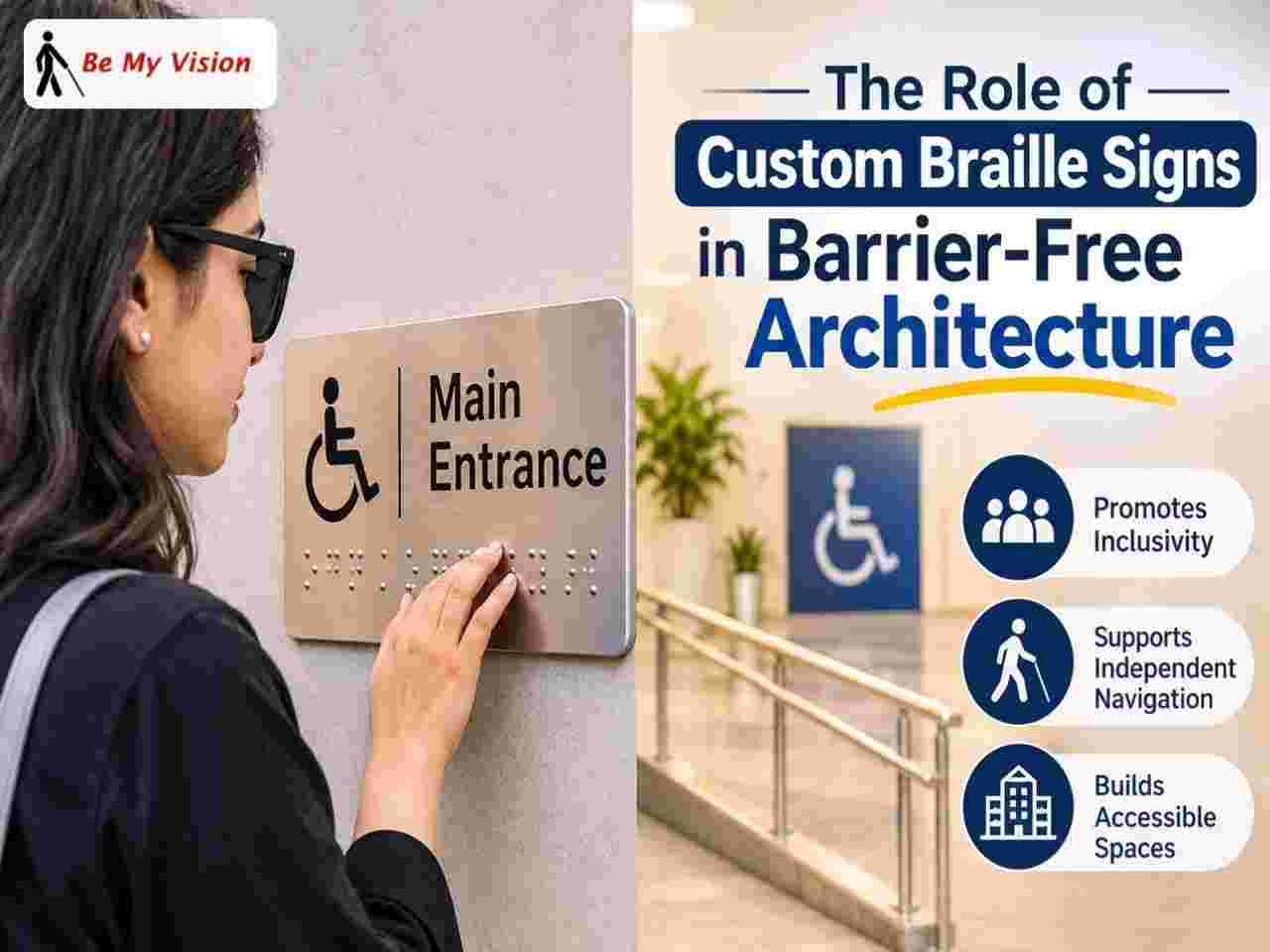
Walk into almost any modern public building and you will notice how much of it depends on sight. Room names, floor numbers, exits, restrooms: nearly everything is explained through printed signs. For a person who is blind or has low vision, that visual-only approach can turn a simple trip to a hospital, office, or hotel into a stressful guessing game.
Barrier-free architecture is not just about ramps and wide doors. It is about information, too. And one of the simplest, most overlooked ways to share that information is through well-planned Customized Braille Signage.
In this guide, we will look at why tactile signs matter, who benefits from them, what makes a good one, and how to plan a project that meets accessibility standards in different parts of the world.
What Barrier-Free Architecture Really Means
Barrier-free design (you may also hear it called universal design or inclusive design) is the idea that buildings should be usable by as many people as possible, without special workarounds. Think step-free entrances, elevators with audio announcements, handrails at the right height, and clear lighting.
But accessibility has layers. A person can enter a building through a perfect ramp and still feel completely lost once they are inside. Wayfinding, meaning how people figure out where they are and where to go, is the missing piece in many projects.
Why signage is often the weakest link
Most architects spend months perfecting floor plans, materials, and structure. Signage tends to arrive late in the process, sometimes as an afterthought, and the budget has often shrunk by then. The result? Generic signs, ordered from a catalogue, stuck wherever there happens to be space.
That approach fails everyone, but it fails people with visual impairments most of all.
Who Actually Benefits from Braille Signs?
Here is a common misunderstanding: that braille signs are only for a small group of people. In reality, the numbers are bigger than most of us assume. The World Health Organization estimates that at least 2.2 billion people worldwide live with some form of vision impairment. Not all of them read braille, of course. But for those who do, braille is a tool for independence, not a nice extra.
And the benefits spread wider than that:
- Blind and low-vision visitors who rely on touch to read room names, floor numbers, and restroom labels.
- Deafblind individuals, for whom tactile information is often essential.
- People in poor visibility conditions, such as during smoke-filled emergencies or power cuts, when tactile signs can still be found and read.
- Older adults whose eyesight is changing and who may find raised characters easier to confirm.
In other words, good tactile signage makes a building safer and calmer for nearly everyone.
Off-the-Shelf Signs vs. Customized Braille Signage
You might be wondering: why not just buy standard braille signs in bulk? Sometimes that works for a simple office. But most real buildings are not simple.
A university campus has hundreds of lecture halls and labs with unique names. A hotel might have a spa, a prayer room, and three conference suites. A metro station needs signs that match its architecture and its language requirements. Standard stock signs rarely fit these needs.
Customized Braille Signage gives designers control over the details that actually matter:
- Exact wording, including room names, department titles, and local terms
- Size, shape, and mounting style to suit walls, glass, or pillars
- Materials and finishes that match the building's look
- Multiple languages and braille codes, depending on the region
- Contrast levels and tactile graphics, such as arrows, pictograms, and floor maps
The point is not to make signs prettier (though they will be). The point is to make them useful in the exact place where they are installed.
Key Elements of a Well-Designed Braille Sign
A good tactile sign is a small piece of engineering. Every detail has a job. Let's walk through the main ones.
Braille dots and spacing
Braille is read by touch, so the dot height, base diameter, and spacing must be consistent. Most standards call for rounded dots, not sharp ones. Sharp dots can feel uncomfortable and wear down quickly under repeated touch. Grade 1 (letter-by-letter) and Grade 2 (contracted) braille each have their uses, and the right choice depends on local conventions.
Raised characters
Many tactile signs combine braille with raised print letters. This helps people who read large print by touch and also allows sighted staff to verify what the sign says. Letters should be sans-serif, uppercase, and raised at a modest height. Too high and they feel awkward; too low and they disappear under the fingertip.
Contrast and colour
Braille is for fingers, but plenty of people with low vision use the visual side of the sign too. A strong contrast between text and background is essential. Dark text on a light, non-glare surface is the safest bet. Avoid shiny finishes, because glare is a real problem for people with certain eye conditions.
Placement and height
A beautiful sign in the wrong spot is useless. Tactile signs are usually mounted beside the door on the latch side, at a height that is comfortable to reach for both standing and seated users. Many standards suggest placing the sign so its centre falls somewhere between roughly 1.2 and 1.5 metres from the floor. Always check your local rules for exact numbers.
Material choice
Acrylic, aluminium, brass, stainless steel, and photopolymer are all common. Each has trade-offs in cost, durability, and appearance. High-traffic areas such as hospitals and transport hubs need tougher materials, while a quiet boutique hotel can afford something more decorative.
Standards and Regulations Around the World
Because this article is for readers in many countries, here is a quick tour of the major frameworks. These are summaries, not legal advice, so please confirm the current rules where your project is located.
- United States: The Americans with Disabilities Act (ADA) Standards for Accessible Design set requirements for tactile characters, Grade 2 braille, sign location, and character proportions for permanent room and space identification.
- United Kingdom: Building Regulations (Approved Document M) and guidance such as BS 8300 shape accessible design, with additional guidance from organisations like RNIB on tactile signage.
- European Union: Requirements vary by member state, though the European Accessibility Act and standards such as EN 17210 encourage more consistent accessible built environments.
- Australia and New Zealand: The Disability (Access to Premises – Buildings) Standards and AS 1428.1 include detailed rules on tactile signs and braille.
- India: The Rights of Persons with Disabilities Act, 2016, along with the Harmonised Guidelines and Standards for Universal Accessibility, push for accessible public buildings, including tactile and braille information.
- Middle East, Asia, and Africa: Many countries are developing or updating accessibility codes, and international projects often follow ADA or ISO guidance as a reference point.
Here is the practical takeaway. Rules differ, but the goal is the same everywhere: a person who cannot see the sign should still be able to find and understand the information on it.
Language and Local Braille Codes
This is where customization becomes truly valuable. Braille is not a single universal language. English braille, Unified English Braille, Hindi-Bharati braille, Arabic braille, Japanese braille, and many others all follow different rules.
If you are designing a building in a multilingual region, or a global hotel chain that welcomes guests from everywhere, a single standard sign will not do. A custom approach lets you include the correct braille code for each language, and it helps you avoid awkward mistakes. (I have seen signs where the braille was literally translated by software with no proofreading. The result was gibberish. Always have a braille-literate reviewer check the final proof.)
Beyond Room Numbers: Creative Uses of Tactile Signs
Once you start thinking about touch as part of design, new ideas appear. Some of the most useful applications go well past the classic room-number plaque.
Tactile maps and floor plans
A raised map near the entrance of a museum, airport, or shopping centre can give a visitor a mental picture of the whole layout. These take careful design, since too much detail becomes noise under the fingers, but when done well they are remarkably empowering.
Handrail markers
Small braille plates on stair handrails can announce the floor level or the direction of travel. It is a quiet detail that people who use them often appreciate.
Emergency and exit information
Exit routes, assembly points, and fire equipment locations all benefit from tactile labels. In an emergency, clear information can make a real difference.
Lifts and control panels
Braille next to elevator buttons is probably the most familiar example, yet it is still missing in many older buildings. Retrofitting is usually cheap and fast.
Branding without compromise
Some building owners worry that accessible signs will clash with their brand. They do not have to. A thoughtful designer can match fonts, colours, and materials to the brand identity while staying fully compliant. That is one more reason to invest in Customized Braille Signage rather than settle for generic plates.
Read Also: Emergency Evacuation Chair: Features, Benefits & Uses
Common Mistakes to Avoid
After looking at many projects, a few errors keep showing up. Watch out for these:
- Treating signage as a last-minute purchase. Bring signage experts in during early design, not after construction.
- Skipping user testing. Invite blind and low-vision people to try the signs before final installation. Their feedback is gold.
- Mounting signs too high or on the wrong side of the door. Consistency matters, because people learn where to reach.
- Ignoring maintenance. Dirty, damaged, or peeling signs are hard to read. Plan for cleaning and replacement.
- Using unproofed braille. One wrong dot can change a word entirely.
- Relying only on braille. Combine tactile signs with good lighting, audio systems, and clear staff training for a complete experience.
How to Plan a Braille Signage Project Step by Step
If you are starting from scratch, here is a simple path that works for most buildings.
Step 1: Audit the space. Walk through the building as a visitor would. List every location that needs tactile information.
Step 2: Check the rules. Confirm the local accessibility codes and any international standards your client follows.
Step 3: Define the information hierarchy. Decide what needs a sign, what needs a map, and what can be handled by other means.
Step 4: Choose a trusted maker. Work with a signage supplier who understands braille, not just printing. Ask to see samples and past projects.
Step 5: Proof and test. Review every line of braille with a knowledgeable reader, then test a prototype on site.
Step 6: Install carefully. Follow mounting heights and positions exactly, and keep records for future maintenance.
The Business Case: It Is Not Just About Compliance
It is easy to see accessibility as a cost. I would invite you to see it differently. Inclusive buildings attract more visitors, protect owners from legal trouble, and build real goodwill in the community. A hotel that is genuinely welcoming to blind guests will earn loyalty and word-of-mouth praise that no advertising budget can buy.
There is also something deeper. When a person can read a sign with their own hands and move through a space without asking for help, they keep their independence and their dignity. That is hard to put a price on.
Conclusion
Barrier-free architecture succeeds when it removes obstacles of every kind, including the invisible ones. Custom braille signs are a small but powerful part of that effort. They turn a building from something people merely enter into something they can understand and navigate on their own terms.
If you are planning a new project or upgrading an existing one, start the signage conversation early, involve the people who will actually use the signs, and choose Customized Braille Signage that fits your space, your language, and your local standards. The investment is modest. The difference it makes is enormous.
Frequently Asked Questions (FAQs)
- What is Customized Braille Signage?
It is tactile signage designed specifically for a building or space, with tailored wording, size, materials, language, and layout, instead of a generic catalogue product. It still follows accessibility standards, but it adapts to the real needs of the site.
- Are braille signs legally required in every country?
Not in the same way everywhere. Countries such as the United States, the United Kingdom, and Australia have clear requirements for certain public buildings, while others are still developing their rules. Always check local building and accessibility codes before starting a project.
- Where should braille signs be placed in a building?
Usually beside the door on the latch side, at a reachable height for standing and seated users. Other good locations include lift panels, stair handrails, restrooms, emergency exits, and information points. Exact heights depend on local standards.
- What materials are best for tactile and braille signs?
Acrylic, aluminium, brass, stainless steel, and photopolymer are popular choices. The best option depends on the environment. High-traffic or outdoor areas need tougher materials, while indoor decorative spaces have more freedom.
- Can braille signs be made in multiple languages?
Yes. A good supplier can produce signs with several languages and the correct braille code for each. This is especially useful for airports, hotels, hospitals, and government buildings serving diverse communities.
- How do I make sure the braille on my signs is accurate?
Ask the supplier for a proof, then have a braille-literate reader review it. Avoid relying only on automatic software translation. Testing a sample on site with real users is even better.
- Do braille signs only help blind people?
No. They also support deafblind people, older adults, and anyone who cannot see clearly in low light or during emergencies. Tactile signs add safety and clarity for many different users.
- Can existing buildings be upgraded with braille signage?
Absolutely. Retrofitting is common and often straightforward. A site audit will show which areas need attention first, and signs can usually be installed without major construction.

 English
 French
 Spanish
 Portuguese
 Deutsch
 Turkish
 Dutch
 Italiano
 Russian
 Romaian
 Portuguese (Brazil)
 Greek