


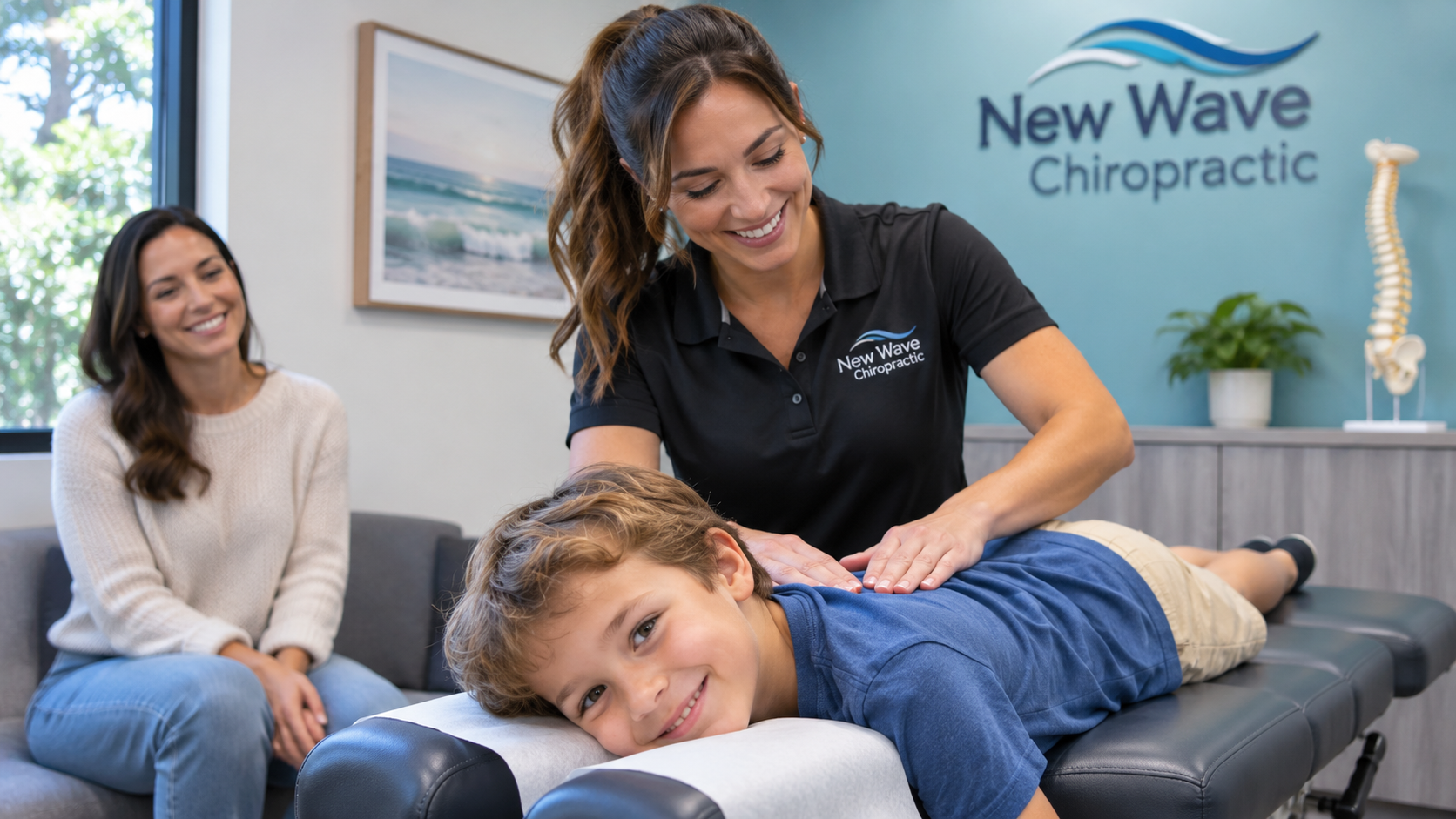
Pediatric chiropractic care in Carlsbad can be a reasonable choice for some children, mostly for musculoskeletal problems such as back pain, neck pain, posture concerns and minor sports strains. For many other childhood conditions that clinics list, including colic, ear infections, bedwetting and ADHD, the research is limited or inconclusive. Serious side effects appear to be rare, but good data on risk are thin, which is exactly why a careful exam and close contact with your pediatrician matter so much.
I wrote this post because parents deserve a straight answer. When you search for chiropractic care for kids, you tend to find two kinds of content: clinic pages that list dozens of conditions, and critics who dismiss the whole field. Neither helps a parent sitting at the kitchen table trying to decide whether to book an appointment for a baby who always turns her head to the left or a 12-year-old with a sore back.
So in this post I go through what pediatric chiropractic care is, what the research says condition by condition, what we know about safety and the questions I would ask any clinic before a first visit.
What pediatric chiropractic care involves
Pediatric chiropractic care is chiropractic care adapted for babies, children and teenagers. A licensed chiropractor takes a full history, examines posture, movement and the joints of the spine and limbs, and then uses gentle techniques if they are appropriate.
Techniques for children are very different from adult adjustments. With infants, chiropractors typically use light fingertip pressure. New Wave Chiropractic in Carlsbad describes the pressure as similar to checking the ripeness of a peach. With older children and teens, techniques are closer to adult care but still gentler, and often include soft tissue work, mobility exercises and posture advice.
You can read how New Wave Chiropractic describes its approach to pediatric chiropractic care in Carlsbad, including the age groups it sees, the reasons families visit and how care is adapted from infancy through the teen years.
Why honest evidence matters for parents
Children cannot always tell you what they feel, and they change fast. A baby who is fussy at six weeks may be settled at twelve weeks no matter what you do. A teen's back pain may ease as soon as a sports season ends. That makes it easy to credit any treatment for changes that would have happened anyway.
This is why research matters. Good studies compare children who receive a treatment with children who do not, so you can see whether the treatment made a real difference. When that kind of evidence is missing, it does not prove a treatment is useless. It means we do not know, and parents should weigh time, cost and any risk with that uncertainty in mind.
A 2025 review in Clinical Pediatrics summed up the situation well: research on chiropractic care in children shows limited data, a range of findings and often no definite conclusion. Keep that in mind as you read the condition-by-condition notes below.
Reading the research in plain words
You do not need a science degree to judge a health claim. A few simple questions help.
Was there a comparison group? A study that only tracks treated children cannot tell you whether they would have improved anyway.
Did parents know who was treated? When parents know their baby received care, their reports of crying or sleep can shift, even without any real change.
How many children were included? Small studies of a few dozen children can easily produce chance results.
Was it repeated? One promising study is a starting point. Several studies pointing the same way are far more convincing.
Who published it? Peer-reviewed journals with independent reviewers are more reliable than clinic websites or testimonials.
Applying these questions, most of the research on pediatric chiropractic care in Carlsbad and elsewhere for non-musculoskeletal conditions falls into the "small, early or uncontrolled" category. That is useful context, not a reason for alarm.
What the research says, condition by condition
I have grouped these from where chiropractic care fits most naturally to where the evidence is weakest.
Back pain and neck pain in older children and teens
This is where pediatric chiropractic care in Carlsbad fits most naturally. Back and neck pain become more common in adolescence, linked to growth spurts, sports, heavy backpacks and long hours on screens.
For adults, spinal manipulation has research support as one of several options for low back pain. For teens, the research is smaller, but some studies suggest that adding spinal manipulation to exercise may help with low back pain. Most good care plans for teens combine hands-on treatment with exercise and habit changes.
My take: A reasonable option for teens with back or neck pain once serious causes are ruled out, ideally as part of a plan that includes exercise.
Posture problems and "tech neck"
Many parents notice their kids slouching over phones and laptops. A chiropractor can assess posture, ease stiffness and teach exercises and habits.
There is little direct research on chiropractic care changing children's posture long term. The biggest changes usually come from daily habits: screen height, breaks, sleep, strength and activity.
My take: Useful for assessment, short-term relief of stiffness and coaching. Habits do the heavy lifting.
Minor sports injuries
Sprains, strains and overuse aches are common in young athletes. Chiropractors who work with athletes often use soft tissue work, joint mobilization and exercise, similar to sports physical therapy.
My take: Reasonable for minor strains and overuse aches once a fracture, growth plate injury or concussion has been ruled out by a medical provider.
Torticollis and head-turning preference in babies
Some babies have a tight neck muscle that makes them turn their head mostly one way. This can contribute to a flat spot on the head.
The standard first-line care is usually gentle stretching and positioning, often guided by a pediatrician or pediatric physical therapist. Some parents also see chiropractors for gentle manual care. Research specific to chiropractic care for torticollis is limited.
My take: Get a pediatrician's assessment first. Gentle manual care may be one part of a plan, alongside stretching and positioning.
Growing pains
Growing pains are aching pains in the legs, usually in the evening or at night, in otherwise healthy children. They tend to come and go and leave no lasting problems. Some families see chiropractors for comfort, often alongside gentle stretching and massage at home. There is little research specific to chiropractic care for growing pains.
My take: Fine to discuss, but see your pediatrician first if pain is in one leg only, present in the morning, linked to a limp, swelling, redness or fever, or getting worse.
Scoliosis
Scoliosis is a sideways curve of the spine, often noticed during growth spurts. Medical care for scoliosis usually involves monitoring, and sometimes bracing or surgery, depending on the size of the curve and how much growing a child has left. Chiropractors may help with comfort and mobility, but there is no strong evidence that adjustments correct a scoliosis curve.
My take: Diagnosis and monitoring belong with a pediatrician or orthopedic specialist. Chiropractic care can be a comfort measure alongside that care, never instead of it.
Reflux, constipation and sleep in babies
These are common reasons parents look for help, and they can be exhausting for the whole family. The research on chiropractic care for infant reflux, constipation and sleep problems is limited. Many of these issues improve with time, feeding changes or medical treatment.
My take: Start with your pediatrician, especially if your baby is not gaining weight, is vomiting forcefully or has blood in their stool.
Infant colic
Colic is long periods of inconsolable crying in an otherwise healthy baby. Chiropractors have long offered care for colic, and some small studies reported fewer crying hours. Systematic reviews, however, have not found convincing evidence that spinal manipulation alone changes how long colic lasts, and many studies had design weaknesses, such as parents knowing whether their baby was treated.
My take: Evidence is weak. If you choose to try it, keep your pediatrician involved, since crying can have medical causes such as reflux, milk protein allergy or infection.
Ear infections
A few small trials have looked at chiropractic care for ear infections in young children, with mixed and inconclusive results. Ear infections can need medical treatment, and a pediatrician should always assess a child with ear pain and fever.
My take: Not a reason to see a chiropractor. Ear infections belong with your pediatrician.
Bedwetting, ADHD, anxiety and other non-musculoskeletal conditions
The New Wave Chiropractic page, like many pediatric chiropractic pages, lists concerns such as ADHD, anxiety, sensory processing issues and bedwetting among the reasons families visit. For these conditions, the research on chiropractic care is very limited and of low quality. Children with these concerns need assessment and care from pediatricians, psychologists, occupational therapists and other specialists.
My take: If families also want chiropractic care for general comfort, that is their choice, but it should never replace evidence-based care for these conditions.
What we know about safety
Safety is where most parents' worries start, and it is worth looking at carefully.
Here is what the research shows:
- Serious problems appear rare. A 2015 review of published cases in the Journal of Manipulative and Physiological Therapeutics concluded that serious adverse events in infants and children receiving chiropractic, osteopathic, physiotherapy or manual medical therapy are rare.
- Hidden medical problems are a key factor. That same review found that an underlying condition was present in most of the cases where something went wrong. In other words, missing a medical problem is a big part of the risk.
- The true risk is not well measured. A 2020 rapid review on the safety of spinal manipulative therapy in children under 10, done for the College of Chiropractors of British Columbia, concluded that the risk of moderate and severe adverse events in this age group is unknown, and that it is unclear whether spinal manipulation increases risk compared with other treatments.
- Mild effects are more common. Temporary soreness, fussiness or stiffness after a visit can happen and usually settles within a day.
So the honest summary is that serious harm seems uncommon, but we do not have strong data to prove exactly how uncommon. That uncertainty is a good reason to choose gentle techniques, to make sure a careful exam always comes first and to keep your pediatrician involved.
How a careful clinic manages risk
When I look at a pediatric chiropractor, I focus less on the list of conditions they mention and more on how they protect children. A careful clinic will:
- Take a full history. Pregnancy and birth details, development, illnesses, medications and any concerns from your pediatrician.
- Examine before treating. Including simple neurological checks and a look for warning signs.
- Use age-appropriate force. Fingertip pressure for babies, gentle methods for young children and no high-force adjustments to infant necks.
- Avoid routine imaging. X-rays only when they would change the plan, given children's sensitivity to radiation.
- Refer quickly. Fever, poor feeding, unusual sleepiness, weakness, a limp after a fall or any unexplained symptom means a call to the pediatrician, not an adjustment.
- Keep parents present. A parent should be able to stay with the child for the whole visit.
- Set clear goals. A plan with check-ins and a clear point to stop if nothing is changing.
Red flags that need a pediatrician, not a chiropractor
Seek medical care, not a chiropractic visit, for any of the following:
- Fever in a baby under three months, or a high fever at any age
- Poor feeding, fewer wet diapers or signs of dehydration
- Vomiting that is forceful, green or bloody
- A baby or child who is unusually floppy, stiff, sleepy or hard to wake
- Back pain with fever, weight loss or pain that wakes your child at night
- Numbness, weakness, loss of balance, or bladder or bowel changes
- A limp or refusal to walk after a fall
- Head injury, especially with vomiting, confusion or a severe headache
- Ear pain with fever
Red flags in a chiropractic clinic
On the clinic side, these are the warning signs I would watch for:
- Promises to cure colic, ear infections, ADHD, autism or allergies
- Advice to skip vaccines, medications or your pediatrician's care
- Routine full-spine X-rays for every child
- Pressure to sign up for long prepaid care plans on the first visit
- Claims that every child needs regular adjustments to be healthy
- Discouraging questions or second opinions
A good clinic is comfortable with your questions and with the limits of what chiropractic care can do.
Questions to ask before your child's first visit
Bring these to your first appointment for pediatric chiropractic care in Carlsbad:
- What training do you have in pediatric care, and how many children do you see?
- How do you adapt your techniques for my child's age?
- What do you think chiropractic care can and cannot help with for my child's concern?
- What does the research say about that concern?
- When would you refer us to our pediatrician?
- Do you use X-rays for children, and when?
- How will we measure whether care is helping, and when would we stop?
- Can I stay with my child for the whole visit?
The answers matter, but so does the tone. You want a chiropractor who explains clearly, welcomes questions and talks about goals, not guarantees.
Where chiropractic care fits in a family's health plan
I think pediatric chiropractic care in Carlsbad works best when parents see it as one tool among many, not the center of their child's care. In a well-rounded plan:
- Your pediatrician leads on growth, development, illness, vaccines and overall health.
- Specialists such as pediatric physical therapists, occupational therapists or psychologists handle specific concerns.
- A chiropractor may help with musculoskeletal comfort, posture, minor sports strains and movement, working alongside everyone else.
- Daily habits such as play, sleep, nutrition and screen limits do most of the work.
Many families first meet a chiropractor during pregnancy. New Wave Chiropractic, for example, also offers prenatal chiropractic care for expecting moms, and some parents continue with the same office for their children after birth. That continuity can be helpful, as long as the same honest standards apply to every member of the family.
Time and cost to consider
Even when care is safe, it costs time and money. Chiropractic visits for children are often not covered by insurance, and a plan with several visits a week can add up quickly. Ask the clinic about fees up front, including the first exam, follow-up visits and any imaging. Ask whether your plan covers chiropractic care for children.
When you weigh pediatric chiropractic care in Carlsbad, set the cost against the strength of the evidence for your child's concern. For a teen with back pain from sports, a short course of care may be well worth it. For a concern with little research behind it, a brief trial with a clear stopping point is the sensible approach.
How to decide whether to try it
If you are still unsure, here is the simple decision process I would use:
- Name the concern. Is it musculoskeletal, such as back pain, neck stiffness or a head-turning preference? Or is it something else, such as colic, ear infections or behavior?
- Talk to your pediatrician. Rule out medical causes and ask their view.
- Check the evidence. For musculoskeletal concerns in older kids, chiropractic care is a more reasonable option. For other concerns, expect uncertain results.
- Choose carefully. Look for pediatric experience, gentle technique and honest communication.
- Set a time limit. Agree on a few weeks and a clear way to measure change.
- Review honestly. If there is no real improvement, stop or try another approach.
This process protects your child, your time and your budget, and it keeps the decision grounded in what you see rather than in promises.
A note for Carlsbad families
Carlsbad is an active place to raise kids. Surf lessons, youth soccer, gymnastics, cycling along the coast and long school days all put real demands on growing bodies. That is a big reason families look into pediatric chiropractic care in Carlsbad in the first place: they want their kids to stay active and comfortable.
That goal is a good one. My advice is to match it with the same standards you use for any other health decision. Ask for evidence, ask about safety, involve your pediatrician and keep a simple record of how your child is doing. Most families find that approach gives them confidence, whatever they decide.
My final thoughts
The honest picture of pediatric chiropractic care in Carlsbad is mixed. For back pain, neck pain, posture concerns and minor sports strains in older children and teens, it is a reasonable option, especially combined with exercise and good habits. For colic, ear infections, bedwetting, ADHD and many other conditions, the evidence is limited, and those concerns belong first with your pediatrician and specialists.
Serious harm appears rare, but the true risk is not well measured, so careful technique, a thorough exam and quick referral matter. Choose a chiropractor who is open about the evidence, uses gentle methods, keeps you in the room and works with your child's doctor. That is how you get the potential benefits while keeping your child safe.
Frequently Asked Questions
1. Is pediatric chiropractic care evidence-based?
It depends on the condition. For back and neck pain in older children and teens, there is some supporting research, mostly extended from adult studies. For many other conditions, including colic, ear infections, bedwetting and ADHD, research is limited, low quality or inconclusive. A 2025 review in Clinical Pediatrics described the overall data as limited, with often no definite conclusion.
2. Is chiropractic care safe for children?
Reviews of published cases suggest serious adverse events in children are rare, and many involved an underlying medical problem. However, a 2020 rapid review found the true risk of moderate and severe events in children under 10 is unknown. Gentle technique, a careful exam and close contact with your pediatrician help keep risk low.
3. Can chiropractic care treat colic?
Some small studies reported fewer crying hours, but systematic reviews have not found convincing evidence that spinal manipulation alone shortens colic. Many studies had design weaknesses. If you choose to try it, keep your pediatrician involved, since crying can have medical causes such as reflux, allergy or infection.
4. Should my child see a chiropractor for ear infections?
Ear infections should be assessed and treated by your pediatrician. Small trials on chiropractic care for ear infections have shown mixed and inconclusive results. Ear pain with fever, discharge from the ear or a child who seems unwell needs medical care first.
5. What are the side effects of chiropractic care for kids?
The most common side effects are mild and short-lived, such as soreness, stiffness or fussiness that settles within a day. Serious side effects appear rare. Call your pediatrician if your child develops a fever, weakness, numbness, unusual sleepiness or any symptom that worries you after a visit.
6. Do babies need chiropractic adjustments after birth?
There is no evidence that healthy babies need routine chiropractic adjustments after birth. Some parents choose a gentle check for concerns such as a head-turning preference. Talk to your pediatrician first, and choose a chiropractor with specific infant training who uses very light pressure.
7. Can chiropractic care help with ADHD or anxiety?
Research on chiropractic care for ADHD and anxiety is very limited and of low quality. Children with these concerns need assessment and care from pediatricians, psychologists and other specialists. Chiropractic care should never replace evidence-based treatment for these conditions.
8. Should children get X-rays at a chiropractor?
Routine X-rays are not recommended for children without a clear reason, because children are more sensitive to radiation. A careful chiropractor orders imaging only when the history or exam suggests it would change the plan, such as after significant trauma, and often refers to a medical provider for it.
9. How do I find a trustworthy pediatric chiropractor?
Look for specific pediatric training and experience, gentle age-appropriate technique, a thorough history and exam, and honest talk about the evidence. A trustworthy chiropractor welcomes your questions, keeps you in the room and coordinates with your pediatrician. Be cautious of anyone promising cures or pushing long prepaid plans.
10. When should I stop chiropractic care for my child?
Agree on a clear goal and time frame before starting, often a few weeks. If there is no meaningful improvement by then, stop and talk with your pediatrician about other options. Also stop and seek medical care if new symptoms appear, such as fever, weakness or unusual sleepiness.

 Arabic
 French
 Spanish
 Portuguese
 Deutsch
 Turkish
 Dutch
 Italiano
 Russian
 Romaian
 Portuguese (Brazil)
 Greek