


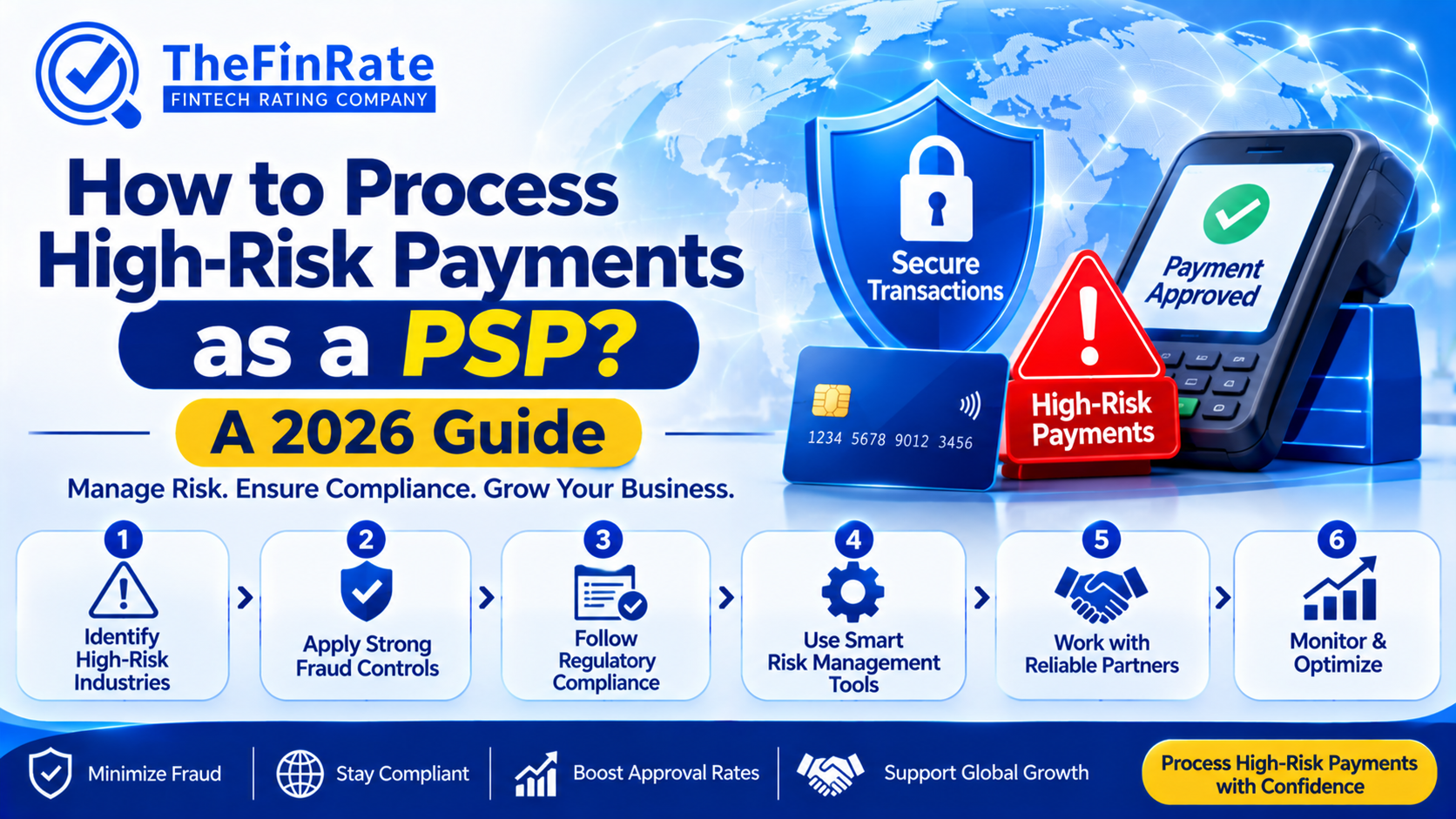
Processing high-risk payments as a PSP means more than switching on a gateway for a risky industry. A payment service provider that takes on merchants with higher chargeback, fraud or regulatory exposure owns much of the resulting liability, so it needs the right acquiring setup, onboarding checks, reserves, monitoring and exit rules before the first transaction goes live. This guide walks through ten steps, shows the thresholds that matter, and lists the mistakes that get PSPs into trouble with banks and card networks.
Quick answer
● Get acquiring and scheme permissions that explicitly cover higher-risk categories
● Run KYB, sanctions and MATCH checks before activating any merchant
● Underwrite the business model, not only the industry code
● Price for risk with reserves, caps and clear settlement terms
● Monitor chargebacks, fraud and AML signals in real time
● Keep a second acquiring route and a documented exit process
This guide is general information, not legal or compliance advice. Scheme rules and acquirer policies change, so confirm requirements with your acquiring bank and compliance team.
What “high-risk” means for a PSP
“High risk” is a judgement about loss exposure, not a moral label. It usually reflects chargeback history, delivery gaps, regulation or fraud patterns. Only a short list of merchant category codes, such as 5967, 7273, 7995 and 5122, sits on Visa’s high-integrity-risk list, and most other high-risk labels come from the provider’s own underwriting call.
The liability sits with the PSP. A payment facilitator bears chargeback and fraud liability for its sub-merchants, so a high-fraud sub-merchant’s disputes become the PayFac’s operational and financial problem. That is why a PSP handling high-risk payments as a PSP needs controls that a low-risk gateway can skip.
PSP models for high-risk payments
| Model | How it works | Who carries risk | Best for |
|---|---|---|---|
| Payment facilitator (PayFac) | Onboards sub-merchants under its own master merchant ID | PayFac, with its acquirer | Platforms that want control and speed |
| PayFac-as-a-service | A provider runs registration, compliance and sub-merchant management for you | Shared, set by contract | Platforms without their own registration |
| ISO or referral model | Introduces merchants to an acquirer, who underwrites each one | Acquirer, with limited ISO exposure | Providers that want low liability |
| Direct merchant accounts | Each merchant gets its own account through a bank | Bank and merchant | Larger or established merchants |
ISOs introduce merchants to acquirers with no ongoing transaction liability, while PayFacs process transactions for sub-merchants and carry ongoing chargeback and fraud liability. Our guide to the PayFac model for high-risk sub-merchants covers the trade-offs in more detail.
The 10 steps to process high-risk payments as a PSP
1. Get acquiring and scheme permissions in writing
Start with your acquirer. Visa and Mastercard require PayFacs to register before they can begin onboarding sub-merchants. Ask the acquirer which categories it will accept, what volume limits apply and which risk controls it expects from you.
● Watch for: Categories your acquirer has not approved, even if your own policy allows them
● Best for: Every PSP before launch
2. Build tiered onboarding with proper KYB
Visa and Mastercard require KYB due diligence on sub-merchants before processing is activated. Use tiers. High-risk categories such as supplements, regulated industries and high-volume merchants usually need manual underwriting review, while lower-risk merchants can be approved quickly.
● Watch for: Instant approval flows that skip manual review for risky categories
● Best for: Platforms onboarding at scale
3. Screen for MATCH, sanctions and ownership
Every PayFac is expected to screen applicants against the MATCH list, a shared card network database of previously terminated merchants. Add sanctions, adverse media and beneficial ownership checks.
● Watch for: Complex ownership structures and repeat applications under new names
● Best for: All new merchant applications
4. Underwrite the business model, not just the label
A software product that grants access the moment a payment clears carries little risk, while a product delivered manually weeks later carries a lot. Look at delivery time, refund policy, billing descriptor, marketing claims and past processing statements.
● Watch for: Long delivery gaps, subscriptions with hard-to-cancel terms and unclear billing descriptors
● Best for: Travel, continuity billing, supplements, digital goods and marketplaces
5. Price for risk: reserves, caps and fees
PayFacs reduce exposure through sub-merchant underwriting limits, rolling reserves, real-time fraud monitoring and contractual indemnification from sub-merchants. Set a processing cap per merchant, choose a reserve model and put fees in the contract.
● Watch for: Reserves that are not written into the merchant agreement
● Best for: Merchants with limited history or higher dispute rates
6. Control settlement and payout timing
Delay or stagger payouts for new or volatile merchants, and tie release to ratios and refund activity. After settlement, the PayFac pays each sub-merchant its share, minus fees and any reserve withheld for risk management.
● Watch for: Fast payouts to merchants with no history
● Best for: New high-risk merchants in their first months
7. Monitor chargebacks and fraud in real time
Track ratios daily, not monthly. PayFacs must continuously monitor sub-merchant activity for AML indicators, unusual patterns and chargeback ratio breaches. Know the thresholds that matter, listed in the next section.
● Watch for: Spikes after a promotion, a new product or a billing change
● Best for: Every live high-risk merchant
8. Add dispute and fraud tooling
Layer defences. The strongest chargeback assistance for high-risk merchants combines Verifi and Ethoca alerts, order screening before fulfilment and automated representment, instead of relying on one tool. Add 3D Secure where the market supports it. See our guide to 3D Secure 2.0 for high-risk merchants.
● Watch for: Relying on a single tool or a manual review queue
● Best for: Card-not-present merchants
9. Define review triggers and de-boarding rules
Decide in advance what pulls a merchant back into review and when you end the relationship. Merchants that exceed risk thresholds or break acceptable use policies are terminated and reported to the card networks as required.
● Watch for: Termination without evidence, notice or a clear policy
● Best for: PSPs that want consistent, defensible decisions
10. Keep a second acquiring route
A single acquirer is a single point of failure. Multi-acquirer routing lets you move volume if one bank pauses a category.
● Watch for: Contracts that block you from moving or splitting volume
● Best for: PSPs with meaningful high-risk volume
Thresholds to track
| Program | Threshold | What it means |
|---|---|---|
| Visa VAMP, merchant Excessive tier | Starts at a 1.5% ratio with at least 1,500 monthly events | Triggers enforcement for the merchant and the acquirer |
| Mastercard ECM | Starts at 100 chargebacks and a 1.5% ratio | Puts the merchant in a monitoring program |
Visa consolidated its older fraud and dispute programs into VAMP from 1 April 2025, and the ratio counts fraud reports and disputes over settled card-not-present transactions. Thresholds and fees change, so confirm current numbers with your acquirer. See also our guide to the Visa VAMP program.
Common mistakes
● Onboarding risky categories before the acquirer has approved them
● Letting instant approval replace manual underwriting
● Skipping MATCH and ownership checks
● Charging high-risk pricing but not setting reserves or caps
● Watching chargebacks monthly, after the damage is done
● Depending on one acquirer with no fallback
FAQ
- What is a PSP in payments?
A payment service provider offers merchants a way to accept payments through one integration and one contract. It usually bundles a gateway, acquiring access, fraud tools and payouts.
- What counts as a high-risk merchant?
A business with a higher chance of chargebacks, fraud or regulatory trouble. Typical examples include travel, subscriptions, supplements, adult content, gaming and crypto.
- Does a PSP need its own license or registration?
It depends on your model and country. In card payments, PayFacs register with Visa and Mastercard through their acquirer, and some regions add local licensing. Ask your acquirer and legal counsel.
- Can a PSP charge higher fees for risky merchants?
Yes. Risk-based pricing, reserves and processing caps are common, as long as they are clearly stated in the merchant agreement.
- What is a rolling reserve?
A share of each sale is held back for a set period to cover possible chargebacks and refunds, then released.
- What chargeback ratio is too high?
Visa’s Excessive merchant tier starts at 1.5% with enough monthly events, and Mastercard’s ECM starts at 100 chargebacks and 1.5%. Many acquirers set stricter internal limits, so aim well below them.
- What is the MATCH list?
A shared card network database of merchants that were previously terminated, which acquirers and PayFacs are expected to check at onboarding.
- How can a PSP lower dispute rates?
Use clear descriptors, refund-friendly policies, 3D Secure where suitable, dispute alerts, order screening and fast support.
Verdict
Handling high-risk payments as a PSP is a risk management job first and a payments job second. The PSPs that last agree acquiring terms in writing, vet every merchant, set limits and reserves, monitor ratios daily and keep a backup route. Those controls cost time up front, but they are cheaper than a frozen acquirer relationship.
Recent News and Developments in High-Risk Payment Processing
● October 2025: Visa began formal enforcement of its Acquirer Monitoring Program (VAMP) for merchants in the Excessive category.
● April 2026: The merchant Excessive threshold under VAMP was reported to tighten from 2.2% to 1.5% in North America, putting more merchants within enforcement scope.
Note: If you require specific details, provider comparisons, or insights that are not currently included in this overview, we are happy to accommodate your request. Please let us know your exact needs, and we will ensure the content is updated accordingly.
About Us:
TheFinRate is a B2B fintech information platform featuring payment provider reviews, comparisons, directories, industry guides, and educational resources. It helps online merchants, eCommerce businesses, SaaS companies, fintech startups, and payment professionals compare providers and make informed payment decisions.
Contact Us:
TheFinRate
Website: https://thefinrate.com/

 Arabic
 French
 Spanish
 Portuguese
 Deutsch
 Turkish
 Dutch
 Italiano
 Russian
 Romaian
 Portuguese (Brazil)
 Greek