


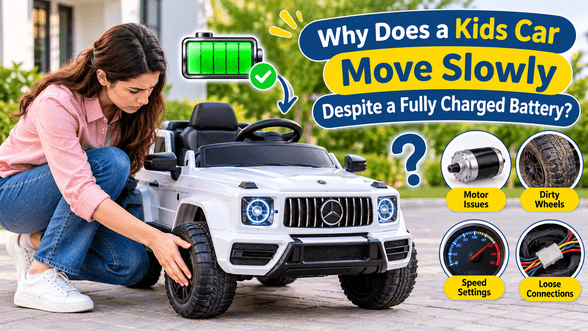
Why Does a Ride-On Car Move Slowly When Fully Charged?
A kids car that moves slowly even after a full charge can be confusing for parents. Many people assume that a fully charged battery always means the vehicle will deliver its normal speed and performance. However, several other components work together to keep a ride-on vehicle moving. Problems with the motor, wheels, wiring, controller, or even the driving surface can affect its speed. Understanding these possible reasons can help parents identify the issue and decide what needs attention.
1. The Battery May Be Weak or Worn Out
A fully charged battery does not always mean it is working properly. As rechargeable batteries get older, their ability to store and deliver energy can decrease.
For example, an older battery may show a full charge but struggle to provide enough power when the motor starts moving the vehicle. This can cause slow movement, especially when the car carries a child.
Common signs of a weak battery include:
- The vehicle moves more slowly than before.
- The battery loses charge quickly.
- The car slows down during acceleration.
- Driving time becomes shorter.
- Performance changes when the vehicle moves uphill.
If these signs appear regularly, parents should have the battery checked and replace it if necessary with a compatible model.
2. Motor Problems Can Reduce Speed
The motor is responsible for converting electrical energy into movement. If it is damaged, worn out, or not receiving enough power, the vehicle may not move at its normal speed.
Some common motor-related problems include worn internal components, damaged connections, and overheating.
Parents may notice that the vehicle makes unusual sounds, struggles to move, or performs differently from its normal condition.
A motor problem should not be ignored. If the vehicle continues to move slowly despite having a healthy battery, a qualified technician should inspect the motor and its connections.
3. Dirty or Blocked Wheels
Sometimes, the problem is not electrical at all. Dirt, stones, hair, or other small objects can become trapped around the wheels and make movement difficult.
When the wheels cannot rotate freely, the motor has to work harder to move the vehicle. This can reduce speed and increase battery consumption.
Parents should check:
- Whether all wheels rotate freely.
- If small stones or objects are stuck around the wheels.
- Whether any wheel is rubbing against the body.
- If the wheel covers are properly attached.
- Whether the wheels show signs of damage.
Cleaning the wheels and removing visible obstructions may help restore normal movement.
4. The Vehicle May Be Carrying Too Much Weight
Every ride-on vehicle has a maximum weight limit. When a child exceeds this limit or additional weight is placed inside the vehicle, the motor has to work harder.
This extra load can affect acceleration and overall speed.
For example, a vehicle designed for a maximum weight of 25 kg may struggle if it carries more than its recommended capacity.
Parents should always check the manufacturer's weight recommendations. They should also avoid placing heavy bags, toys, or other items inside the vehicle while it is being used.
5. Driving on the Wrong Surface
The surface where a vehicle is used can make a noticeable difference in its performance.
A ride-on car usually moves more easily on smooth, flat ground. However, grass, gravel, sand, and uneven surfaces create more resistance.
When the wheels struggle to move across these surfaces, the motor needs additional power. As a result, the vehicle may move more slowly even when the battery is fully charged.
Before using the vehicle, parents should check the manufacturer's recommended riding surfaces. Models designed mainly for indoor floors may not perform well on outdoor ground.
6. Loose or Damaged Electrical Connections
The battery, motor, accelerator, and controller are connected through electrical wires. If one of these connections becomes loose or damaged, the vehicle may not receive power properly.
This can cause slow movement, sudden stops, or inconsistent performance.
Possible warning signs include:
- The vehicle moves slowly without a clear reason.
- Power stops and starts during driving.
- The accelerator does not respond consistently.
- The vehicle works sometimes but not at other times.
Parents can visually inspect accessible wires and connectors for obvious damage while the vehicle is switched off and disconnected from its charger. Damaged electrical components should be checked by a qualified technician rather than repaired without proper knowledge.
7. The Speed Setting May Be Too Low
Some modern models include different speed settings that allow parents to control how fast the vehicle moves.
If the lowest speed mode is selected, the vehicle may appear slower even when everything is working correctly.
This can happen when:
- The remote control is set to low speed.
- The vehicle has multiple driving modes.
- A speed restriction is active.
- The child is using a beginner-friendly setting.
When comparing a kids electric car, parents should check the available speed options in the product manual. They should only select settings that are suitable for the child's age and experience.
8. Problems With the Accelerator or Control System
The accelerator pedal sends a command to the vehicle's electronic control system. This system then controls how much power reaches the motor.
If the pedal or controller is not working correctly, the vehicle may not respond properly when the child presses the accelerator.
For example, a damaged pedal connection may prevent the motor from receiving the expected command.
If the accelerator feels unusual, sticks, or does not respond consistently, stop using the vehicle until it has been inspected.
9. Simple Troubleshooting Steps for Parents
Before contacting a technician, parents can perform a few basic checks to identify possible causes.
-
Check the battery: Make sure it is properly charged and inspect it for visible damage.
-
Inspect the wheels: Remove dirt and small objects that may block movement.
-
Check the weight limit: Make sure the vehicle is not carrying too much weight.
-
Test the riding surface: Try the vehicle on a smooth, flat area if permitted by the manufacturer.
-
Review speed settings: Check whether the vehicle is operating in a low-speed mode.
-
Inspect visible connections: Look for loose or damaged wires without opening electrical components.
-
Check the accelerator: Make sure the pedal moves and responds normally.
If the problem continues, contact the manufacturer or a qualified technician. Avoid opening the motor, modifying the wiring, or using an incompatible battery.
Final Thoughts
A fully charged battery does not always guarantee normal driving performance. Several components, including the motor, wheels, accelerator, electrical connections, and controller, affect how a ride-on vehicle moves.
By checking these parts regularly and following the manufacturer's maintenance instructions, parents can identify common problems before they become more serious. When exploring different models, reviewing their battery, motor, and weight specifications through online stores such as ToysUAE can also help families make a more informed purchase decision.
Frequently Asked Questions
1. Why does a ride-on car move slowly with a full battery?
A weak battery, motor problem, blocked wheels, excessive weight, or damaged electrical connection can reduce speed even when the battery indicator shows a full charge.
2. Can old batteries affect vehicle speed?
Yes. Older batteries may lose their ability to deliver enough power to the motor, resulting in slower movement and shorter running time.
3. Do dirty wheels make a ride-on car slower?
Yes. Dirt, stones, and other objects can prevent wheels from rotating freely and increase resistance during movement.
4. Can the wrong speed setting reduce performance?
Yes. Some models have multiple speed settings, and selecting a lower setting can limit the vehicle's speed.
5. Should parents replace the motor if the vehicle moves slowly?
Not immediately. Parents should first check the battery, wheels, speed settings, and visible connections. A technician can determine whether the motor needs repair or replacement.
6. How can parents maintain normal driving performance?
Regularly check the battery, clean the wheels, avoid overloading the vehicle, inspect visible wires, and follow the manufacturer's charging and maintenance instructions.

 English
 Arabic
 French
 Spanish
 Portuguese
 Deutsch
 Turkish
 Dutch
 Italiano
 Russian
 Romaian
 Greek