


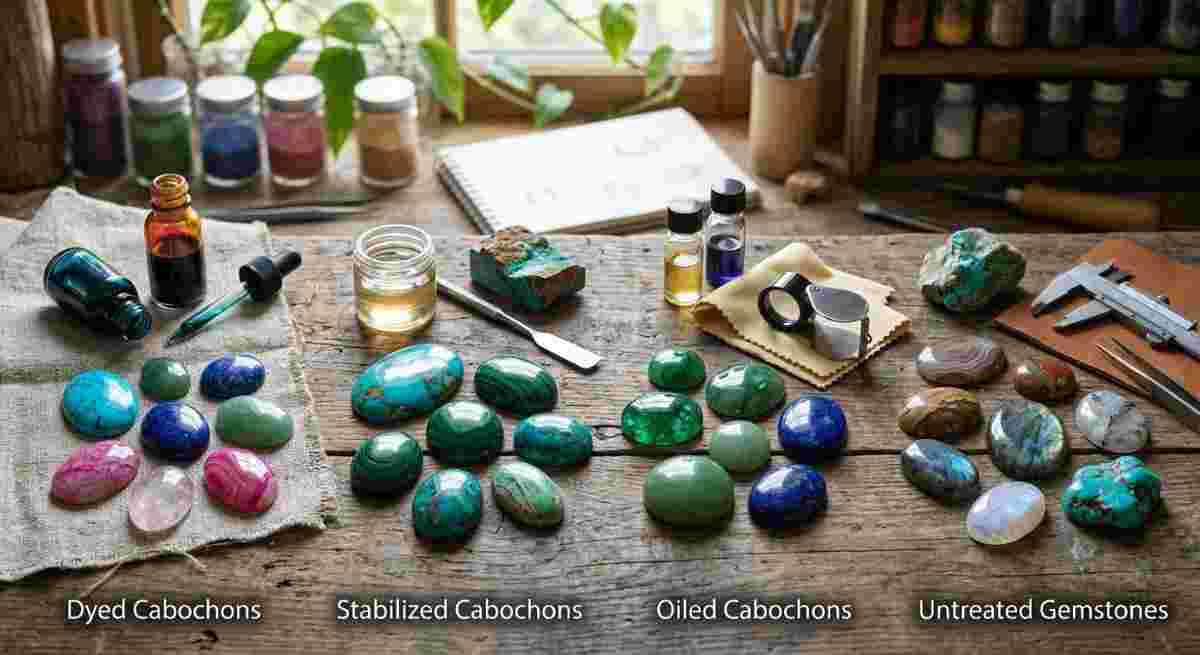
Some gems can captivate you before you even know why, and cabochon gems are one of the best examples. Their smooth, round shape looks like a water drop, instantly catches your attention, and makes you fall in love at just first glance. Their polished surfaces, attractive colors, and natural patterns are some of the main reasons that make cabochons a highly popular choice for gemstone jewelry and decorative designs.
Along with these exceptional quality traits and increasing popularity, there are certain steps that they go through. Not every cabochon reaches its final appearance through cutting and polishing alone. There are some gems that need to undergo treatments to improve their color, stability, durability, and overall appearance.
And today, we are going to uncover some of the popular cabochon treatments that every buyer should know, so that they can easily determine what they are paying for. Start with:
Knowing Why Cabochons Are Treated in the First Place
Many raw stones are not strong or vibrant enough to wear on your finger straight from the earth. That is why treatment exists - to turn that imperfect rough material into the perfect, wearable one. These treatments often happen on soft, porous, or pale gems to improve their physical and visual properties.
Note that not all treatments are undesirable. Some are widely accepted in the cabochon for sale trade, provided they are properly disclosed. Knowing whether your desired gemstone is natural, treated, or untreated is what matters most.
Here is what treatments fix:
-
Treatment fills the gem's pores and fractures so that the stone does not crumble or chip during cutting and setting.
-
It deepens or evenly distributes the color.
-
Treatment improves surface lustre on naturally porous material.
The Four Main Gemstone Treatments Explained (Cabochon Categories)
-
Dyed Cabochons - Treatment that Enhances or Changes Color
Dyed cabochons represent those gemstones whose colors have been enhanced or changed using some coloring agents. This process works best on porous or finely granular material that can absorb the dye.
Why are gemstones dyed?
-
To create brighter or more attractive colors.
-
To produce colors that are not so common in the untreated material.
-
To achieve consistent shades across matching cabochons.
-
To offer more color choices for jewelry designs.
Common Stones - Howlite, agate, lapis lazuli, jade, quartz.
Care Considerations - Dyed cabochons are supposed to be kept away from acetone, alcohol, and sunlight.
-
Stabilized Cabochons - Treatment that Improves Durability
Stabilized cabochons represent those gemstones that undergo a stabilization process. In this process, a gemstone is treated with bonding material, commonly resin or polymer, to improve its structural strength. This is the standard treatment for those stones that are naturally soft, porous, and fragile.
Why are gemstones stabilized?
-
To strengthen fragile or porous material.
-
To reduce the risk of cracking or breaking the stone during cutting.
-
To protect the stone from absorbing skin oils and lotions that cause discoloration.
-
To improve resistance to everyday handling.
-
To make the stone easier to polish and use in jewelry.
Common Stones - Turquoise, malachite, chrysocolla, variscite.
Care Considerations - Stabilized cabochons are durable, but try to avoid using harsh chemicals.
-
Oiled Cabochons - Treatment that Elevates Appearance
Oiled cabochons represent those gemstones in which oil is introduced into surface-reaching fractures or fissures to make them less visible. It’s safe to say that this treatment’s effect is cosmetic because it deepens gem color slightly, hides fine surface scratches, and gives a softer or more even lustre.
Why are gemstones oiled?
-
To improve their appearance and clarity.
-
To make their natural inclusions and fissures less noticeable.
-
To give the surface a softer, more even glow.
-
To reduce the visibility of surface-reaching fractures.
Common Stones - Emerald, turquoise, jade, lapis lazuli.
Care Considerations - Never use ultrasonic cleaners, heat, or soaps on oiled cabochons.
-
Natural Untreated Gemstones - Cabochons that Preserve Natural Characteristics
Untreated cabochons are those gemstones that are entirely natural or untreated. They have only been cut, shaped, and polished, and nothing has been added to the stone to enhance or change its color, clarity, or durability. They offer pure earth-made beauty, displaying some natural inclusions, color variations, undeniable patterns, and other characteristics that make every natural cabochon for sale distinctive.
Why prefer untreated gemstones?
-
They retain their natural appearance.
-
Their original color and internal characteristics remain unchanged by enhancement treatments.
-
They offer greater transparency about the gem’s original condition when properly documented.
-
They are a favorite among collectors who value naturally occurring features.
Common Stones - Agate, jasper, labradorite, moonstone, high-grade turquoise.
Care Considerations - Care for natural untreated gems depends entirely on the gem's characteristics and hardness. Mild soap, warm water, and a soft cloth are all they need.
Gathering Thoughts
Be it dyed, stabilized, oiled, or untreated, each cabochon has different characteristics and uses. None of these categories alone determines the good or bad quality of a gemstone. With all that being said, treatments are not the problem — an undisclosed treatment is what creates real issues.
That is why, whenever down the road you plan to purchase gemstones for sale, look out for a reputable seller who happily tells you all the details about the stone’s treatment. Secondly, trust your instincts too with pricing. If a rare stone looks too good to be true for the price, it has likely been treated.

 Arabic
 French
 Spanish
 Portuguese
 Deutsch
 Turkish
 Dutch
 Italiano
 Russian
 Romaian
 Portuguese (Brazil)
 Greek