


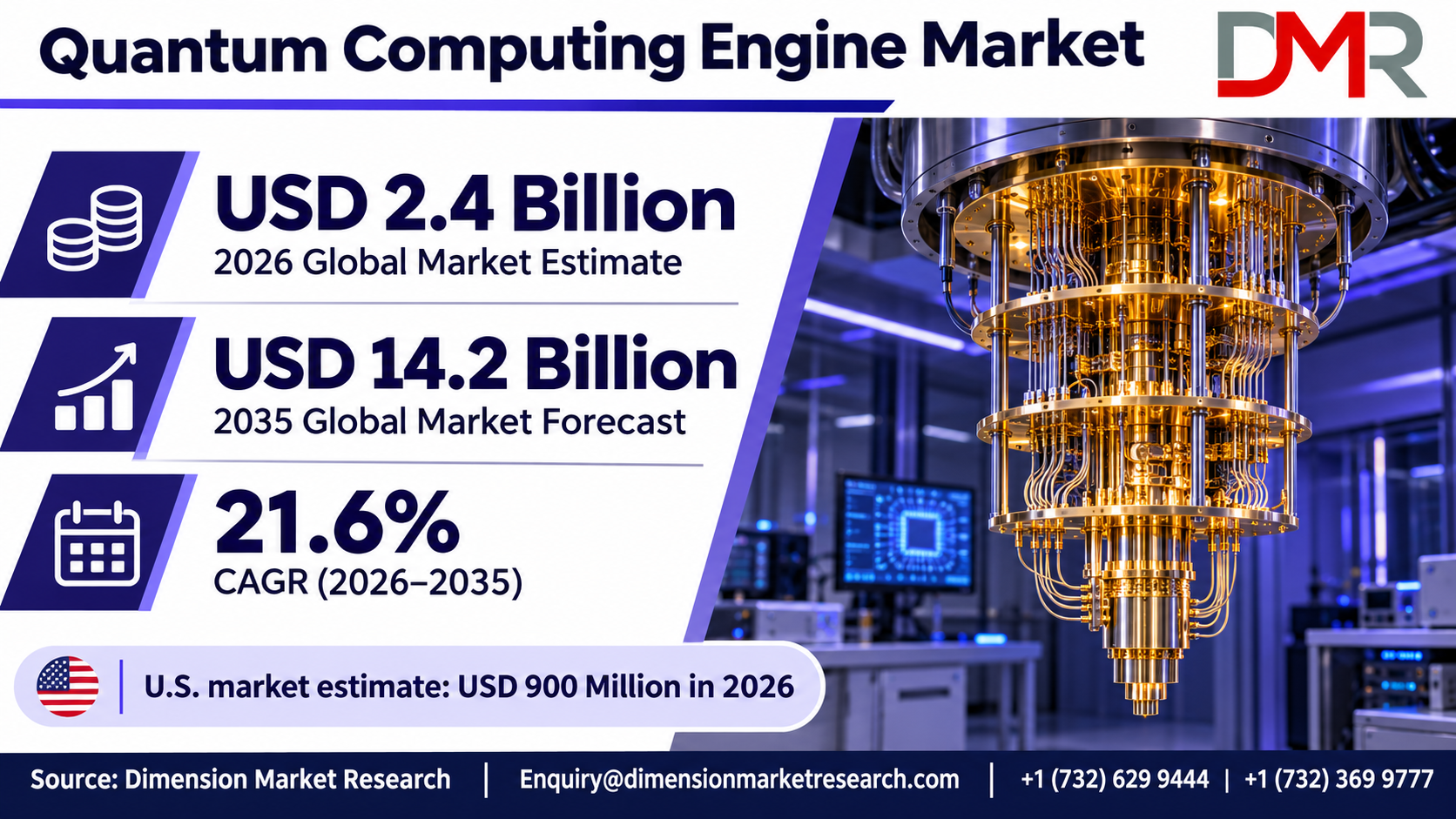
According to Dimension Market Research, the Quantum Computing Engine Market is estimated at USD 2.4 billion in 2026 and projected to reach USD 14.2 billion by 2035, at a compound annual growth rate of 21.6% from 2026 to 2035. Demand for research in optimization and simulation supports the forecast. Systems are expected to lead by offering, while cloud access leads by deployment mode.
That combination reflects two ways organizations are investing in the technology. Hardware developers and research institutions need processors, control equipment, and other infrastructure to build and operate quantum systems. Enterprise teams can use cloud access to investigate specific workloads before deciding whether to commit more resources. The commercial opportunity therefore extends across the equipment used to run experiments and the platforms that make those experiments accessible.
What Is the Quantum Computing Engine Market?
The Quantum Computing Engine Market covers the systems and related offerings used to carry out quantum computations. A quantum processor uses qubits, and supporting equipment controls those qubits and reads the results. Some architectures also require specialized infrastructure, such as cryogenic systems. The report examines deployment models, qubit technologies, applications, and end users.
For buyers, the distinction between a processor and a usable system matters. The processor is one part of the setup, while controls, software, and supporting equipment determine how researchers can run and repeat experiments. For a team evaluating a platform, the practical question is whether it can execute the intended workload and produce results that can be compared consistently.
Get a Free Sample of the Quantum Computing Engine Market Report
https://dimensionmarketresearch.com/request-sample/quantum-computing-engine-market/
Why Systems Lead and Cloud Access Matters
Systems are projected to account for about 62% of the market in 2026. The report attributes their lead to investment in hardware, including processors, qubit control devices, and cooling infrastructure. Research organizations, governments, and enterprises investing in quantum capabilities help sustain demand for these components.
Cloud is expected to capture the largest share by deployment mode. Remote access allows teams to run experiments on quantum hardware without installing a system at their own site. For an enterprise exploring a narrowly defined problem, that makes it possible to start with a pilot and assess whether further investment is justified. For providers, the usability of development tools and the ability to connect quantum experiments with classical computing workflows can influence platform selection.
Optimization Leads as Financial Services Explore Use Cases
Optimization is projected to account for 39% of the market by application in 2026. The report highlights opportunities in logistics, finance, and manufacturing, where teams often have to choose among many possible combinations under operational constraints. A logistics team, for example, can frame a planning problem around routes, capacity, and delivery windows, then compare a quantum approach with its existing method on the same problem.
Banking, financial services, and insurance is the largest projected end-user segment, with an estimated 28% share in 2026. The report identifies portfolio optimization, risk management, and fraud analysis as areas of interest. For financial institutions, a pilot can test whether a particular approach produces useful results under the constraints that matter to the business. The size of the end-user segment reflects market activity, while the case for a specific deployment depends on the outcome of that evaluation.
Qubit Technology and Error Correction Shape Competition
Superconducting qubits are estimated to account for 47% of the technology segment in 2026. The report links their position to sustained research investment and an established development base. It also identifies trapped-ion and photonic approaches as alternatives under development. These architectures face different engineering trade-offs, which means their suitability can vary by workload and by the conditions needed to run it.
The report identifies IBM Corporation, Google, and AWS among the companies in the market. It describes scalability and error correction as areas of competition, alongside partnerships with academic institutions and governments. As platforms develop, teams comparing providers have reason to examine how reliably the hardware runs a target experiment and how easily researchers can repeat it.
North America Leads the Regional Market
North America is projected to hold 41.0% of global revenue in 2026. The report attributes the region’s position to public funding, advanced research facilities, and an ecosystem of established technology companies and startups. The United States is estimated at USD 900 million in 2026, while Europe and Japan are estimated at USD 480 million and USD 120 million, respectively. For suppliers assessing expansion, the concentration of research institutions and enterprise partners helps explain where early equipment purchases and pilot projects may originate.
Select a License and Proceed to Checkout for the Quantum Computing Engine Market Report
https://dimensionmarketresearch.com/checkout/quantum-computing-engine-market/
Frequently Asked Questions
1. How big is the Quantum Computing Engine Market?
The market is estimated at USD 2.4 billion in 2026 and projected to reach USD 14.2 billion by 2035.
2. What is the projected Quantum Computing Engine Market CAGR?
The report projects a CAGR of 21.6% from 2026 to 2035.
3. Which deployment mode leads the market?
Cloud deployment is expected to account for the largest revenue share in 2026.
4. Which application has the largest projected market share?
Optimization leads the application segment with a projected 39% share in 2026.
5. Which region leads the Quantum Computing Engine Market?
North America is projected to lead with a 41.0% share in 2026.
Conclusion
The Quantum Computing Engine Market outlook through 2035 reflects hardware investment and demand for accessible ways to test optimization and simulation workloads. Cloud platforms can bring more enterprise teams into that process, while progress in system reliability and error correction will shape which experiments can move toward practical use. For providers, the opportunity is to help customers test a defined problem and evaluate the result against an established baseline.

 English
 Arabic
 French
 Spanish
 Portuguese
 Deutsch
 Dutch
 Italiano
 Russian
 Romaian
 Portuguese (Brazil)
 Greek