


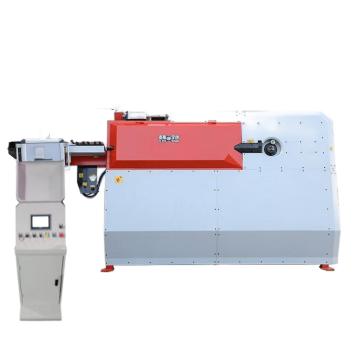
Metal wire is used in a wide range of industries, from construction and automotive manufacturing to furniture production, agriculture, and industrial equipment. As product designs become more detailed and customer expectations continue to rise, manufacturers need reliable methods to shape wire accurately and consistently. Traditional manual bending can be suitable for simple tasks, but it often becomes time-consuming and difficult to maintain when production volumes increase.
Modern machinery is helping manufacturers overcome these challenges. An automatic wire bending machine can automate important bending operations, allowing businesses to produce components with consistent dimensions and repeatable shapes. By reducing dependence on manual handling, automated systems support more organized production processes and help manufacturers improve their overall manufacturing capabilities.
Understanding Automated Wire Bending Systems
Automated wire bending equipment is designed to transform straight metal wire into specific shapes according to programmed requirements. Depending on the machine configuration, it can perform multiple bending operations, create different angles, and manufacture components with varying dimensions.
Computer numerical control (CNC) technology plays an important role in many advanced systems. Operators can enter or configure production parameters so the machine follows a defined bending sequence. This provides greater control over the manufacturing process and makes it easier to reproduce previously created designs.
Instead of relying entirely on manual measurements and physical adjustments, manufacturers can use programmed instructions to guide production. This approach is particularly useful when businesses need to manufacture repeated components or switch between different product specifications.
Improving Accuracy and Product Consistency
Accuracy is essential in metal fabrication because even small dimensional differences can affect how a finished component fits into a larger assembly. Inconsistent bends may create additional work during installation, increase material waste, or require time-consuming corrections.
Automated bending systems help address these concerns by following controlled production settings. Once the required parameters have been configured, the equipment can repeat the same bending sequence across multiple workpieces. This improves consistency and helps reduce variations associated with manual operations.
Manufacturers can also benefit from more predictable production results. When components are produced according to established specifications, quality inspections and downstream assembly processes can become easier to manage.
Increasing Production Efficiency
Production speed is an important consideration for businesses working with regular or large-volume manufacturing orders. Manual wire bending requires workers to measure, position, bend, and check individual pieces. These activities can consume considerable time, especially when products involve several bends or complicated shapes.
Automation can reduce the amount of repetitive manual work involved in these operations. Once a suitable program is prepared and the machine is properly set up, production can follow a more structured sequence.
This can help businesses:
-
Reduce repetitive manual bending tasks.
-
Maintain more consistent production cycles.
-
Improve workflow organization.
-
Complete repeated orders more efficiently.
-
Allocate workers to inspection, preparation, and other valuable activities.
The actual productivity improvement depends on the machine's specifications, wire material, product complexity, and production environment. Businesses should therefore evaluate equipment according to their real manufacturing requirements rather than relying only on advertised production speeds.
Supporting Different Manufacturing Applications
Wire bending is required in many industries, and each application may involve different materials, shapes, dimensions, and tolerances. Manufacturers may produce metal frames, wire baskets, furniture components, reinforcement elements, industrial fittings, and customized metal products.
Automated equipment can support a variety of production requirements when its working range and capabilities match the intended application. Some businesses prioritize simple repeated bends, while others require more complex shapes and multiple bending sequences.
Before selecting equipment, manufacturers should consider the types of products they currently produce and the designs they may need to manufacture in the future. Wire diameter, material properties, bending angles, feeding requirements, and finished component dimensions are all important factors.
Choosing equipment with suitable capabilities can help businesses maintain flexibility without investing in features they may rarely use.
Reducing Material Waste and Operational Challenges
Material waste can affect manufacturing costs, particularly when production involves expensive metal wire or large order quantities. Incorrect measurements, inconsistent bending, and repeated adjustments can result in unusable components.
Automated processes can help reduce some of these problems by making production settings more repeatable. When operators establish suitable parameters and follow consistent procedures, businesses can improve control over material handling and reduce avoidable production errors.
However, automation does not eliminate the need for skilled operators or quality control. Proper machine setup, regular inspection, material selection, and maintenance remain essential. Manufacturers should also test new programs before starting large production runs to identify potential issues early.
Important Factors When Choosing Equipment
Selecting suitable wire bending equipment requires more than comparing machine prices. Businesses should examine the technical specifications and determine whether the system can handle their regular production requirements.
Several factors deserve attention:
Material compatibility: Check whether the equipment supports the types and grades of wire used in production.
Wire diameter range: Confirm that the machine can process the required wire thicknesses.
Bending capabilities: Evaluate the available bending directions, angles, and shaping functions.
Control system: Understand how production programs are entered, adjusted, and stored.
Production requirements: Consider expected output, product complexity, and the number of different designs.
Maintenance and support: Review maintenance requirements, spare-part availability, and technical assistance.
A careful assessment helps manufacturers choose equipment that supports their existing operations while allowing room for future production needs.
The Future of Automated Wire Processing
Manufacturing continues to move toward greater automation, improved process control, and more flexible production systems. As businesses seek to handle customized orders alongside regular manufacturing work, programmable equipment is becoming increasingly valuable.
Wire bending technology is part of this wider development. More controlled production processes can help manufacturers respond to changing design requirements, maintain consistent output, and organize their operations more effectively.
Businesses that understand their production challenges and invest in suitable machinery can build stronger manufacturing workflows over time. The most effective solution is not necessarily the most complicated machine, but the one that matches the company's materials, products, production volume, and long-term objectives.
For manufacturers exploring ways to modernize metal fabrication, reviewing the capabilities of an automatic wire bending machine can be a practical starting point for identifying opportunities to improve accuracy, consistency, and operational efficiency.

 English
 Arabic
 French
 Spanish
 Portuguese
 Deutsch
 Turkish
 Dutch
 Italiano
 Russian
 Portuguese (Brazil)
 Greek