



Tap, confirm, done. A Google Pay deposit lands on an Irish casino account in seconds, charged to the debit card stored in the wallet. What the deposit screen never mentions is that the same wallet almost never carries the money back.
Among the Google Pay casinos for Irish players the pattern repeats: the phone authorises the deposit in one gesture, and the withdrawal is routed to the linked debit card or a bank transfer days later. Understanding that asymmetry — before the first top-up — is most of the game.
What Google Pay actually does at a casino cashier
Google Pay at a casino is a front for your debit card. The wallet sends a tokenised card number to the cashier, the casino charges the card behind it, and the balance appears in euro within seconds. For the player this means three practical things.
First, the deposit limits belong to the card, not the app: casinos on the Irish-facing lists usually take Google Pay deposits from €10 to €20 minimum, and the cap is whatever the card and the casino agree on. Second, the deposit is instant but the money leaves the bank account like any card payment — there is no float, no credit, no delay. Third, the casino records a card transaction on its side, which decides how the withdrawal is allowed to happen.
A small caveat worth knowing: some operators list Google Pay in the cashier but quietly exclude wallet deposits from their welcome offer. Reading the bonus eligibility line before depositing matters more than the speed of the tap.
Debit cards only: the Irish credit card rule
Ireland's gambling framework moved to a strict position on borrowed money: gambling with a credit card is being barred for licensed operators under the new regime created by the Gambling Regulation Act 2024 — the law that set up the new regulator and rewrote the licensing rules for the market. The Act itself sits on the Irish Statute Book, where the credit-card prohibition and the regulator's powers are spelled out section by section.
The practical consequence lands exactly on Google Pay users: the wallet can hold both credit and debit cards, so the burden of choosing the right card shifts to the player. Topping up from a credit card inside the wallet is not a workaround — the casino's cashier sees a credit BIN and can refuse the payment or, worse, flag the account at withdrawal time.
Keeping a single debit card inside Google Pay for gambling deposits is the clean version: the deposit passes any card-type check, and the payout route stays consistent.
Why the winnings come back to the card, not the wallet
Casinos treat Google Pay as a deposit-only method in almost every implementation. The wallet has no inbound IBAN, so the operator sends the cash-out to the card that funded the deposit — the same card, just without the Google Pay wrapper — or to a bank account in the player's name.
That is where the pending window appears. The stated promise splits roughly like this:
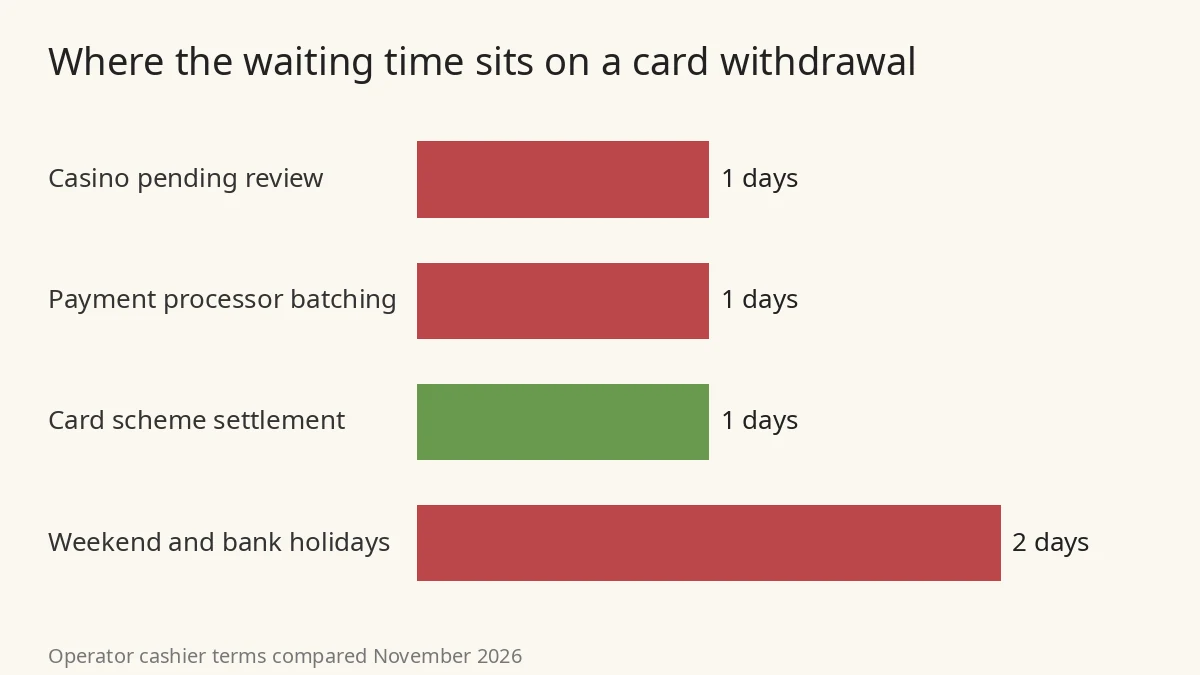
The best-placed operators aim for a pending window of 24 hours or less; the weakest stretch the stated window to 72 hours before the money even enters the card system. Two casinos can show identical payout pages and differ by two full days in what the player actually receives.
Google Pay against the other Irish options
Each cashier method has its own compromise, and the honest comparison looks like this:
| Method | Deposit | Withdrawal route | Typical wait | Notes |
|---|---|---|---|---|
| Google Pay | Instant, €10–20 min | Linked debit card or bank | 24–72 h pending + settlement | Deposit-only at most casinos |
| Debit card typed in | Instant | Same card | Same window | Identical rails, slower checkout |
| Bank transfer | 1–3 days | Same account | Slower but direct | Best for large cash-outs |
| PayPal / e-wallet | Instant | Same wallet | Often fastest | Excluded from some bonuses |
| USDT / crypto | Minutes | Same wallet | Operator-dependent | No Irish card rules, own risks |
The e-wallets and crypto deserve a note of their own. PayPal-style wallets often pay out faster because they carry funds both ways, while the crypto route skips card rules entirely — at the price of exchange spread and price movement between deposit and withdrawal. The network's own AnalystCasino breakdown of USDT casinos covers that side in detail for players who prefer the stablecoin route.
For most players the comparison ends simply: Google Pay is a faster version of the debit card at deposit time and an identical one at withdrawal time. The only real edge it keeps is convenience — one biometric check instead of sixteen card digits, plus a phone that already sits in your hand while the casino asks for the next €20.
There is one more quiet benefit: the wallet keeps a clean record. Every casino deposit appears as a named entry in Google Pay's activity feed, which makes the monthly review of what went where a thirty-second job instead of a card-statement archaeology project.

Bonus terms Google Pay players should read twice
Welcome offers set their own thresholds, and the wallet complicates them in two ways. The first is eligibility: some operators exclude wallet deposits from the headline offer, so the €10 Google Pay deposit that qualified on the cashier page can disqualify on the bonus page. The second is the qualifying minimum itself — a typical offer asks for €10 to qualify, and depositing the true Google Pay minimum under it gets the money in without the spins.
Wagering deserves the same care. A requirement of 35x on the bonus amount alone is a reasonable benchmark; 40x or more on deposit plus bonus quietly doubles the real turnover. A welcome bonus of up to €1,000 with 200 free spins looks identical either way until the multiplier line is read.
Things worth checking before the deposit:
- Does the offer accept Google Pay deposits on equal terms?
- Is the wagering on bonus only, or deposit plus bonus?
- What is the stated pending window for card withdrawals — 24 hours or 72?
- Which account will the operator insist on paying out to?
Where a Google Pay withdrawal stalls
Three choke points account for nearly every complaint. The first is unfinished KYC: the casino asks for photo ID and proof of address before the first payout, and the 24-hour processing promise only starts after that check clears. Depositing early and verifying late turns a fast cashier into a slow one.
The second is the payout route itself. If the deposit card has been replaced since — a reissued card with a new number — the operator may need manual review to match the account, and support queues add days. The third is the weekend: a withdrawal approved Friday evening can sit through two non-banking days before the card settlement even begins.
The stalls are predictable, which also makes them avoidable.

The short version
Google Pay is an excellent way into a casino and a non-existent way out of one. Verify the account before the first deposit, use a debit card inside the wallet to stay inside the Irish rules, check that the welcome offer accepts wallet deposits, and expect the winnings to land on the linked card or in the bank — typically within the operator's stated 24-to-72-hour window plus a day of settlement.
Do those four things in order and the only surprise left is the size of the win.

 Arabic
 French
 Spanish
 Portuguese
 Deutsch
 Turkish
 Dutch
 Italiano
 Russian
 Romaian
 Portuguese (Brazil)
 Greek