The global aviation industry is currently navigating a period of transformative change, characterized by a renewed focus on sustainability, operational efficiency, and advanced material science. At the heart of this evolution is the aerospace coatings sector, which provides the critical protective layer for commercial, military, and general aviation aircraft. These coatings are far more than aesthetic enhancements; they are engineered solutions designed to withstand extreme temperature fluctuations, prevent corrosion, and minimize aerodynamic drag.
As the industry moves toward 2033, the integration of smart technologies and eco-friendly formulations is reshaping the competitive landscape. Aerospace coatings now incorporate nanotechnology to offer self-healing properties and enhanced UV resistance, ensuring that aircraft remain flight-ready for longer durations. This shift is driven by the dual need to reduce maintenance costs and comply with increasingly stringent environmental regulations regarding volatile organic compound (VOC) emissions.
Aerospace Coatings Market Size and Forecast (2025–2033)
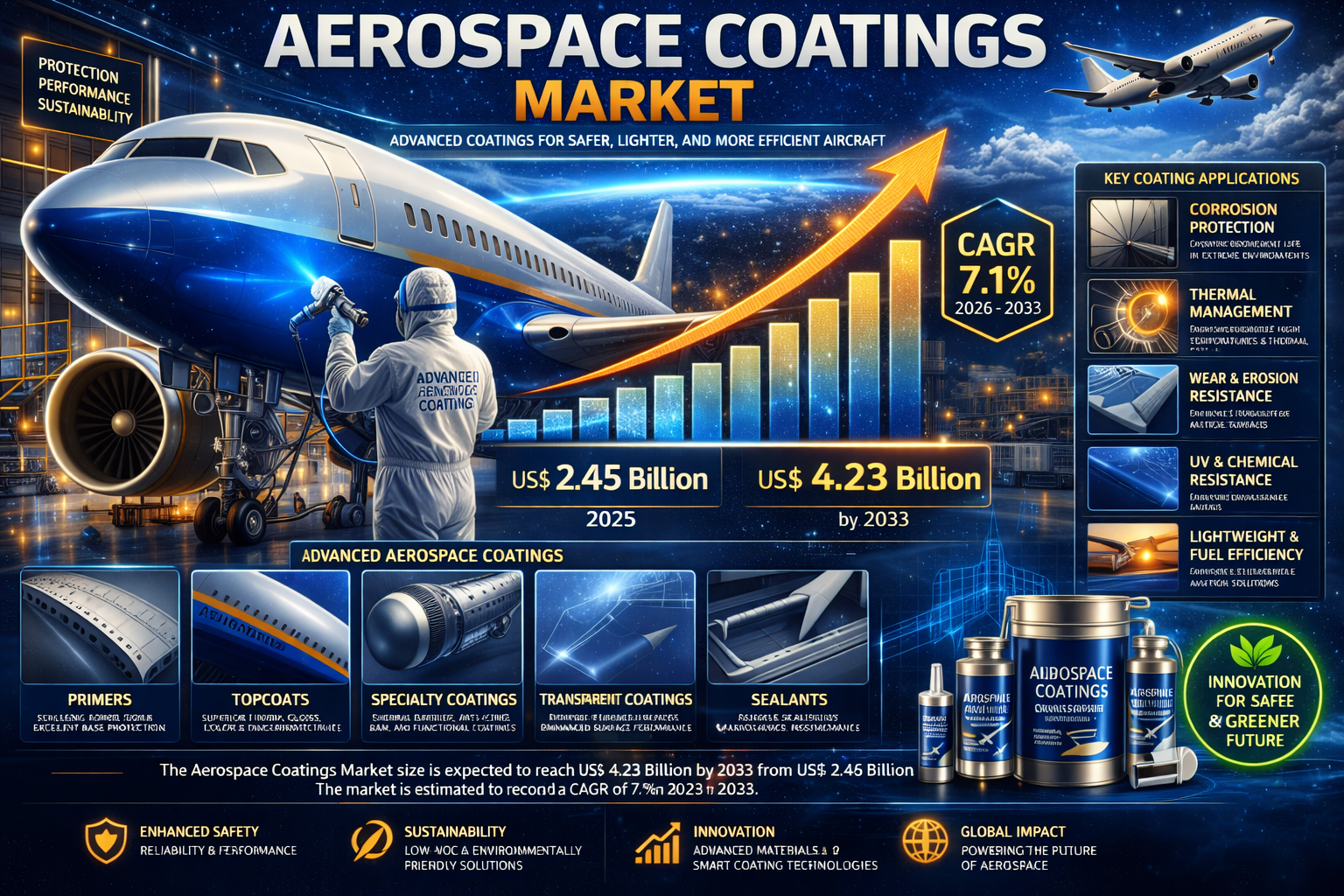
The financial trajectory of this sector reflects its vital importance to the aviation supply chain. The Aerospace Coatings Market size is expected to reach US$ 4.23 Billion by 2033 from US$ 2.45 Billion in 2025. The market is estimated to record a CAGR of 7.1% from 2026 to 2033. This robust growth is underpinned by a surge in aircraft deliveries and an expanding global fleet that requires regular maintenance, repair, and overhaul (MRO) services.
Aerospace Coatings Market Trends and Drivers and Opportunities
The primary driver of the market is the significant rise in aircraft production. Global aerospace manufacturers are clearing massive order backlogs to meet the rising demand for air travel, particularly in emerging economies. New-generation aircraft require advanced coating systems that offer weight reduction benefits, directly contributing to fuel efficiency and lower carbon footprints.
Another critical driver is the expansion of MRO activities. As existing fleets age, the frequency of repainting and surface restoration increases. Coatings play a pivotal role in these processes by protecting airframes from harsh environmental stresses and chemical exposure. Furthermore, the industry is seeing a major trend toward "chrome-free" and waterborne coatings. Innovations in polyurethanes and epoxy resins have allowed manufacturers to develop sustainable solutions without compromising on the durability or performance required for high-altitude flight.
The market also presents substantial opportunities in the realm of functional or "smart" coatings. These include anti-icing coatings that reduce the need for chemical de-icing and heat-reflective coatings that manage the thermal load on the aircraft fuselage. As defense spending increases globally, the military aviation segment offers additional growth avenues, particularly for specialized coatings that provide stealth capabilities and radar absorption.
Download Sample PDF Report: https://www.businessmarketinsights.com/sample/BMIPUB00033745
Market Segmentation and Dominant Segments
The aerospace coatings market is highly specialized, with specific segments leading the growth:
-
By Product Type: The top-coat segment remains the dominant force, as it provides the primary barrier against UV radiation and environmental contaminants.
-
By Resin Type: Polyurethane resins are the most widely used due to their superior flexibility and resistance to chemicals.
-
By User Type: While Original Equipment Manufacturers (OEM) drive initial demand, the MRO segment accounts for a substantial share of recurring revenue due to periodic maintenance cycles.
-
By Application: Exterior coatings hold the largest market share, as they are subjected to the most grueling atmospheric conditions.
Competitive Landscape and Top Players
The global market is characterized by the presence of several tier-one chemical and coating giants who invest heavily in R&D to maintain their market position. The leading players in the industry include:
-
Akzo Nobel N.V.
-
PPG Industries, Inc.
-
Sherwin-Williams Company
-
BASF SE
-
Axalta Coating Systems
-
Hempel A/S
-
RPM International Inc.
-
Kansai Paint Co., Ltd.
-
Nippon Paint Holdings Co., Ltd.
-
Jotun A/S
These companies are increasingly focusing on strategic partnerships with aircraft OEMs and airlines to provide end-to-end coating solutions that include digital color matching and precision application technologies.
Conclusion
The path toward 2033 for the aerospace coatings market is one of innovation and sustainability. With a projected CAGR of 7.1%, the industry is set to play a foundational role in the next generation of aviation. By addressing the challenges of environmental impact and operational costs through advanced chemistry, coating manufacturers are ensuring that the global fleet remains safe, efficient, and visually striking.
About Us:
Business Market Insights is a market research platform that provides subscription services for industry reports, company profiles, and country reports. Our team of expert analysts consistently monitors various industries to provide actionable insights that help businesses make informed decisions.
Contact us:
Phone: +1-646-491-9876
Email: sales@businessmarketinsights.com

 English
 Arabic
 Spanish
 Portuguese
 Deutsch
 Turkish
 Dutch
Dutch
 Italiano
 Russian
 Romaian
 Portuguese (Brazil)
 Greek
Greek