


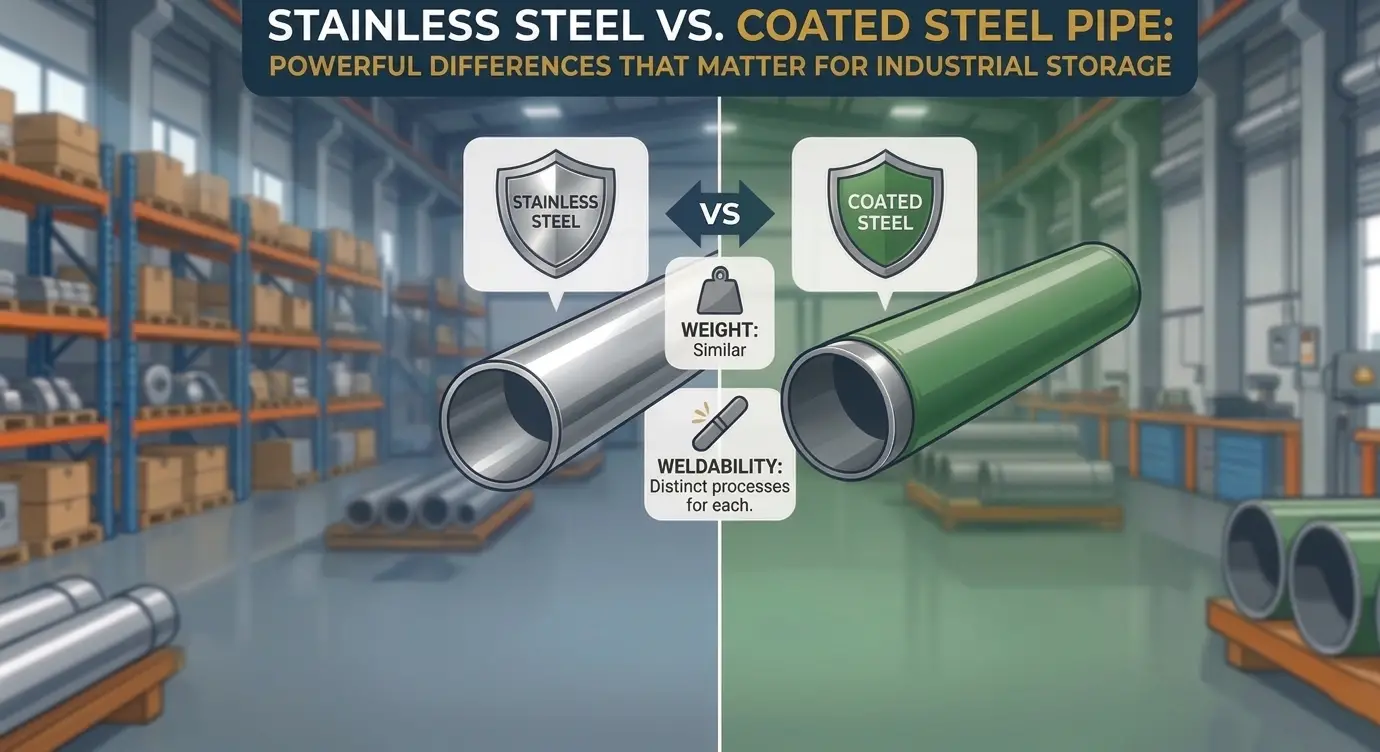
When it comes to industrial piping, construction projects, and manufacturing facilities, the comparison between stainless steel and coated steel pipe is more relevant than ever. Selecting the right material directly influences durability, safety, maintenance costs, and long-term performance.
Both stainless steel and coated steel pipes are widely used across industries such as oil and gas, water treatment, automotive manufacturing, and warehousing. However, the differences extend far beyond appearance. Factors such as corrosion resistance, strength, cost, and storage requirements play a critical role in determining the most suitable option.
An equally important—but often overlooked—factor is how these pipes are stored and handled. Improper storage can lead to coating damage, corrosion, and safety risks. This is where structured solutions such as Flexpipe pipe racking systems become essential.
In this guide, we break down the differences between stainless steel and coated steel pipes and explain how effective storage systems can protect your investment and improve operational efficiency.
What Are Stainless Steel Pipes?
Stainless steel pipes are manufactured from steel alloys containing chromium. This element forms a passive protective layer on the surface, preventing rust and corrosion even in demanding environments.
Key Characteristics
- Natural corrosion resistance
- High strength-to-weight ratio
- Smooth and clean surface finish
- Long service life
- Low maintenance requirements
These pipes are commonly used in industries where hygiene and corrosion resistance are critical, such as food processing, pharmaceuticals, and chemical manufacturing.
Advantages
- Excellent resistance to moisture and chemicals
- No need for additional coatings
- Maintains structural integrity over time
- Suitable for high-temperature and high-pressure applications
Limitations
- Higher initial cost
- Heavier compared to some alternatives
- Requires careful storage to prevent surface damage
What Are Coated Steel Pipes?
Coated steel pipes are carbon steel pipes treated with protective layers such as zinc, epoxy, or polymers. These coatings act as a barrier against environmental exposure and corrosion.
Common Coating Types
- Galvanized (zinc-coated)
- Epoxy-coated
- Polyethylene or polymer-coated
Advantages
- More cost-effective than stainless steel
- Coatings can be customized for specific environments
- Strong mechanical properties
- Available in a wide range of sizes
Limitations
- Coatings may chip or degrade over time
- Higher maintenance requirements
- Risk of corrosion if the coating is damaged
- Requires careful handling and storage
Stainless Steel vs. Coated Steel Pipe: Comparison Overview
| Feature | Stainless Steel Pipes | Coated Steel Pipes |
|---|---|---|
| Corrosion Resistance | Excellent | Good (coating-dependent) |
| Initial Cost | High | Moderate |
| Maintenance | Low | Medium to High |
| Durability | Very High | High (if coating intact) |
| Weight | Heavier | Slightly lighter |
| Storage Sensitivity | Moderate | High |
This comparison highlights that the choice between stainless steel and coated steel pipes is not only a material decision but also an operational one.
Cost Considerations
Cost is often a key deciding factor.
Stainless steel pipes require a higher upfront investment but offer long-term savings due to minimal maintenance and extended lifespan.
Coated steel pipes are more affordable initially, making them suitable for large-scale projects. However, ongoing maintenance, potential coating damage, and replacement costs can increase total lifecycle expenses.
Implementing proper storage solutions can significantly reduce hidden costs by preventing damage during handling and storage.
Corrosion Resistance and Environmental Performance
Corrosion resistance is a critical consideration in this comparison.
- Stainless steel provides inherent resistance to rust and performs well in humid or chemically aggressive environments.
- Coated steel relies entirely on the integrity of its protective layer. Once compromised, corrosion can develop rapidly.
Proper storage plays a crucial role in maintaining corrosion resistance. Keeping pipes elevated, spaced correctly, and protected from impact helps preserve material quality over time.
The Importance of Proper Pipe Storage
Regardless of the material, improper storage can lead to serious issues, including:
- Scratches on stainless steel surfaces
- Chipping or cracking of protective coatings
- Corrosion due to moisture exposure
- Increased workplace safety risks
Traditional methods, such as stacking pipes on the floor or using basic wooden racks, are often inadequate for modern industrial environments.
How Modular Pipe Racking Systems Improve Storage
Flexpipe Pipe Racking Systems are engineered to provide a flexible, modular, and durable solution for storing both stainless steel and coated steel pipes.
Key Benefits
- Adjustable design to accommodate different pipe diameters
- Prevention of pipe-to-pipe contact and surface damage
- Elevated storage for improved protection against moisture
- Enhanced organization and accessibility
- Easy reconfiguration as inventory changes
These systems help maintain material integrity while improving operational efficiency.
Safety and Efficiency in Warehouse Operations
Well-organized storage systems have a direct impact on workflow and safety. Structured pipe racking solutions enable facilities to:
- Reduce material handling time
- Minimize lifting and handling injuries
- Improve inventory visibility
- Maximize available floor space
Both stainless steel and coated steel pipes benefit from stable, well-designed storage that prevents rolling, impact, and improper stacking.
Sustainability and Long-Term Value
Sustainability is increasingly important in industrial operations.
- Stainless steel is highly recyclable and offers a long service life.
- Coated steel can also be recycled, although this may depend on the coating material used.
By extending the lifespan of stored materials and reducing damage-related waste, modular racking systems contribute to more sustainable and cost-efficient operations.
Conclusion
Choosing between stainless steel and coated steel pipe depends on specific performance requirements, budget constraints, and environmental conditions. Stainless steel offers superior corrosion resistance and durability, while coated steel provides a cost-effective alternative for less demanding applications.
However, regardless of the material selected, proper storage remains essential. Investing in modular pipe racking systems ensures better protection, improved safety, and enhanced operational efficiency.

 Arabic
 French
 Spanish
 Portuguese
 Deutsch
 Turkish
 Dutch
Dutch
 Italiano
 Russian
 Romaian
 Portuguese (Brazil)
 Greek
Greek