


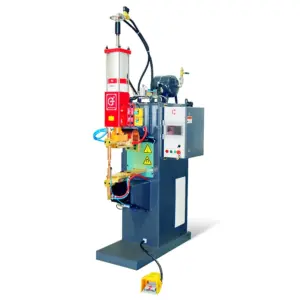
In modern manufacturing, precision, repeatability, and production speed define welding success. A projection welder is one of the most efficient resistance welding solutions used in high-volume metal joining, especially where multiple weld points or fastener integration is required. For OEMs, automotive suppliers, and automation integrators, it offers a highly controlled and scalable joining process for complex assemblies.
As a global manufacturer of resistance welding and automation systems, Heron Welder provides advanced projection welding machines designed for industrial-grade performance, stability, and production efficiency.
What is a Projection Welder?
A projection welder is a type of resistance welding machine that uses pre-formed projections (raised points or embossments) on metal parts to concentrate welding current and pressure at precise locations. These projections act as controlled contact points where heat is generated, allowing strong and localized welds in a very short cycle time.
Unlike spot welding, where electrodes define the weld area, projection welding relies on the workpiece geometry itself for positioning welds. This enables multi-point welding in a single operation and improves production consistency.
Working Principle of Projection Welding
The working process of a projection welder is based on resistance heat generation and pressure collapse:
- Two metal components are placed between flat electrodes.
- Electrical current passes through the parts.
- The current concentrates at projection points due to higher electrical resistance.
- Heat is rapidly generated at these points.
- Under electrode force, the projections collapse and form a solid-state weld.
This process ensures localized heating, controlled deformation, and strong metallurgical bonding.
Key advantage: multiple welds can be completed simultaneously, reducing cycle time and increasing throughput.
Types of Projection Welding Systems
Industrial projection welders are typically designed in different configurations depending on production needs:
1. Manual / Semi-Automatic Projection Welders
- Used for small batches or flexible production
- Suitable for maintenance and component assembly
2. Pneumatic Projection Welding Machines
- Provide consistent electrode force
- Ideal for medium-volume manufacturing
3. Servo-Controlled & Automated Systems
- Fully integrated into production lines
- Used in automotive and appliance industries
4. Multi-Head Projection Welding Stations
- Allow simultaneous welding of multiple points
- Designed for high-volume mass production
Industrial Applications of Projection Welders
Projection welding is widely used across industries due to its speed and reliability:
- Automotive manufacturing (nuts, bolts, brackets, seat frames)
- Electrical components (terminals, connectors, busbars)
- Sheet metal fabrication
- Home appliances (compressor parts, housings)
- Industrial machinery assemblies
Because it supports fastener welding and dissimilar thickness joining, it is highly valued in mass production environments.
Projection Welding vs Spot Welding
Although both are resistance welding methods, they differ significantly in process control and application:
- Weld location control: Projection welding uses built-in projections, while spot welding depends on electrode placement.
- Productivity: Projection welding allows multiple welds in a single cycle.
- Electrode life: Projection welding reduces electrode wear due to distributed current load.
- Complexity: Projection welding requires part design optimization but delivers higher consistency.
For OEMs focused on automation and repeatable quality, projection welding often provides a more scalable solution.
Advantages of Projection Welder Technology
A modern projection welding system offers several engineering and production benefits:
- High-speed multi-point welding
- Strong and consistent joint quality
- Reduced electrode wear and maintenance
- Better heat control and localization
- Ideal for automation integration
- Lower cycle cost in mass production
These advantages make it a preferred choice for smart factories and automated production lines.
Best Practices for Stable Projection Welding Quality
To achieve optimal performance, manufacturers should follow key guidelines:
1. Proper Projection Design
Uniform size and shape ensure even current distribution.
2. Material Selection
Suitable metals (steel, low-carbon alloys) improve weld consistency.
3. Electrode Alignment
Accurate force distribution prevents uneven collapse of projections.
4. Process Control Systems
Using advanced controllers helps maintain stable current, force, and time parameters.
5. Regular Maintenance
Clean electrodes and fixtures ensure long-term welding stability.
Heron Welder: Engineering Reliable Projection Welding Solutions
At Heron Welder , projection welding systems are engineered for:
- High-duty industrial production environments
- Automated integration with robotic lines
- Precision control of force, current, and timing
- Long service life and reduced maintenance downtime
With expertise in resistance welding technologies including spot, projection, seam, MFDC, and capacitor discharge systems Heron supports manufacturers in building efficient and scalable metal joining processes.
FAQs about Projection Welder
1. What materials are best suited for projection welding?
Low-carbon steel, stainless steel, and coated metals are commonly used due to stable resistance behavior.
2. Can projection welding be automated?
Yes. It is widely used in automated production lines, especially in automotive and appliance industries.
3. Why use projection welding instead of spot welding?
It allows multiple welds at once, better consistency, and longer electrode life.
4. Is projection welding suitable for thin sheets?
Yes, but projection design must be carefully controlled to avoid burn-through or deformation.
5. What industries use projection welders most?
Automotive, electrical, construction, and heavy machinery industries.
Conclusion
A projection welder is a powerful and efficient resistance welding solution designed for high-volume, precision metal joining. Its ability to deliver multiple welds in a single cycle makes it a key technology in modern manufacturing and automation environments.
For manufacturers aiming to improve productivity, weld quality, and process stability, projection welding offers a highly scalable solution.
Request a Custom Welding Solution
Heron Welder provides advanced projection welding systems and fully automated resistance welding solutions tailored to your production needs.
If you are looking to improve efficiency, reduce cycle time, or integrate welding into your automation line, contact Heron Welder (https://heron-welder.com) for a customized consultation and quotation today.

 English
 French
 Spanish
 Portuguese
 Deutsch
 Turkish
 Dutch
Dutch
 Italiano
 Russian
 Romaian
 Portuguese (Brazil)
 Greek
Greek