


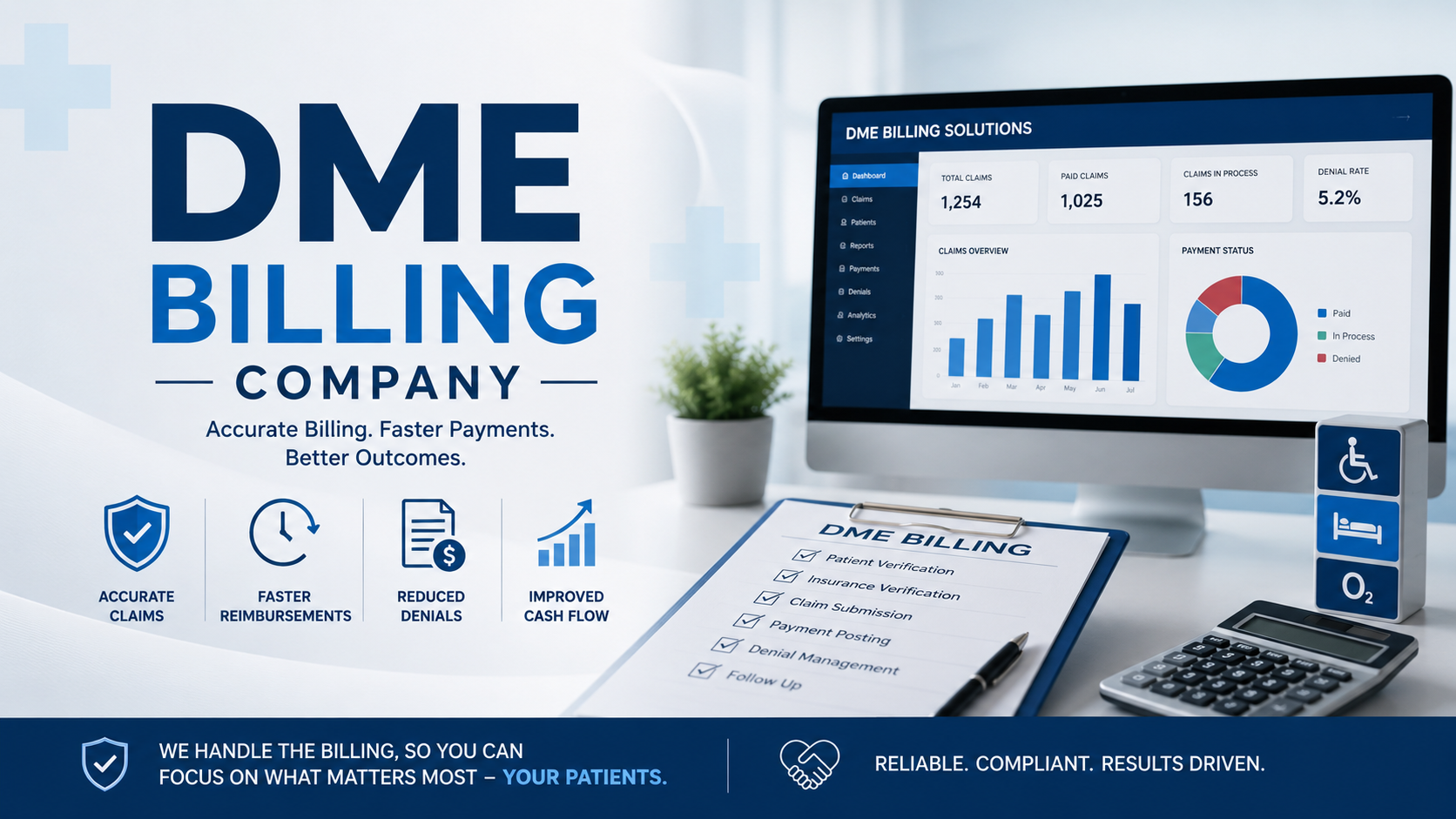
The durable medical equipment (DME) industry plays a major role in patient care. From wheelchairs and oxygen equipment to CPAP machines and hospital beds, DME suppliers help patients manage long-term health conditions and recover comfortably at home. However, behind every successful DME business is a billing process that must be accurate, compliant, and efficient.
That is why many providers choose a durable medical equipment billing agency to manage their revenue cycle and reduce claim denials.
DME billing is very different from standard medical billing. It involves strict documentation rules, insurance verification, prior authorizations, HCPCS coding, and ongoing compliance with Medicare and commercial payer guidelines. Even a small mistake can delay payments or lead to rejected claims.
In this blog, we will explain why DME billing requires specialized expertise, the challenges DME suppliers face, and how partnering with a professional billing agency can improve cash flow and operational efficiency.
What Is a Durable Medical Equipment Billing Agency?
A durable medical equipment billing agency is a specialized medical billing company that focuses on handling billing and reimbursement for DME providers and suppliers.
These agencies manage the entire billing cycle, including:
- Insurance eligibility verification
- Prior authorizations
- HCPCS coding
- Claim submission
- Denial management
- Payment posting
- Accounts receivable follow-up
- Compliance monitoring
Unlike general medical billing services, DME billing agencies understand the unique regulations associated with equipment billing and recurring claims. They are experienced in working with Medicare, Medicaid, and private insurance companies that often have strict documentation requirements.
A professional billing agency helps DME providers reduce administrative burdens while improving reimbursement rates.
Common Challenges in DME Billing
DME billing is one of the most complicated areas in healthcare reimbursement. Providers often struggle with claim denials, delayed payments, and changing payer regulations.
Complex Documentation Requirements
Insurance companies require detailed medical documentation before approving DME claims. Missing physician signatures, incomplete prescriptions, or insufficient medical necessity documentation can result in denied claims.
For example, equipment like CPAP machines or oxygen therapy devices often require:
- Face-to-face evaluation documentation
- Physician orders
- Proof of medical necessity
- Compliance records
Without proper documentation, reimbursement becomes difficult.
Frequent Changes in Billing Regulations
Medicare and commercial payers regularly update DME billing guidelines. HCPCS codes, coverage policies, and authorization rules can change frequently.
Keeping up with these updates internally can be time-consuming for DME providers. A specialized durable medical equipment billing agency stays updated with the latest payer requirements to ensure compliance.
High Claim Denial Rates
DME claims are commonly denied for reasons such as:
- Incorrect modifiers
- Missing authorization
- Invalid HCPCS codes
- Eligibility issues
- Duplicate billing
- Lack of medical necessity
Repeated denials affect revenue and create additional administrative work for providers.
Delayed Payments
Unlike traditional physician billing, DME reimbursement may involve rental periods, recurring billing schedules, and capped rental policies. Delayed claim processing can negatively impact cash flow if accounts receivable are not managed properly.
Benefits of Hiring a Durable Medical Equipment Billing Agency
Working with an experienced billing agency offers several advantages for DME suppliers and healthcare organizations.
Improved Claim Accuracy
Professional billing teams understand payer-specific requirements and ensure claims are submitted correctly the first time. This reduces rejections and improves first-pass claim acceptance rates.
Accurate coding and modifier usage also help maximize reimbursements.
Faster Reimbursements
An experienced durable medical equipment billing agency follows up on claims proactively and resolves denials quickly. Faster claim processing leads to improved cash flow and reduced aging accounts receivable.
Providers can focus on patient care instead of spending hours dealing with insurance companies.
Reduced Administrative Burden
Managing DME billing internally requires dedicated staff, training, and constant monitoring of payer regulations.
Outsourcing billing allows providers to:
- Save staff time
- Reduce operational costs
- Minimize billing errors
- Improve workflow efficiency
This is especially beneficial for small and mid-sized DME suppliers with limited in-house resources.
Better Compliance Management
Healthcare billing compliance is critical in the DME industry. Billing errors or non-compliance can trigger audits and financial penalties.
Specialized billing agencies maintain compliance with:
- Medicare guidelines
- HIPAA regulations
- Documentation standards
- Insurance payer rules
This reduces risk and protects the provider’s reputation.
Detailed Revenue Reporting
Most professional billing agencies provide regular reports on:
- Claim status
- Denial trends
- Revenue performance
- Aging accounts receivable
- Collection rates
These insights help DME providers make informed business decisions and improve financial performance.
Key Services Offered by a DME Billing Agency
Not all billing companies specialize in DME billing. A dedicated durable medical equipment billing agency usually offers services specifically designed for equipment suppliers.
Insurance Eligibility Verification
Before equipment is dispensed, billing teams verify:
- Patient insurance coverage
- Deductibles
- Co-payments
- Prior authorization requirements
This prevents claim denials caused by coverage issues.
Prior Authorization Management
Many DME products require prior approval from insurance providers. Billing agencies handle authorization requests and ensure supporting documentation is submitted correctly.
HCPCS Coding and Modifier Management
DME claims rely heavily on HCPCS codes and modifiers. Incorrect coding can lead to underpayments or denials.
Experienced billing specialists ensure accurate coding based on payer guidelines.
Claims Submission and Tracking
Billing agencies electronically submit claims and monitor them throughout the reimbursement cycle. They track unpaid claims and follow up with insurance companies to avoid delays.
Denial Management and Appeals
Denied claims are analyzed and corrected quickly. Agencies prepare appeals with supporting documentation to recover lost revenue.
Effective denial management can significantly increase reimbursement rates.
Accounts Receivable Follow-Up
Outstanding claims are continuously monitored to improve collections and reduce aging balances.
Consistent follow-up helps maintain steady cash flow for DME providers.
How to Choose the Right Durable Medical Equipment Billing Agency
Selecting the right billing partner can make a major difference in the financial health of your DME business.
Here are some important factors to consider:
Industry Experience
Choose an agency with proven experience in DME billing. They should understand:
- Medicare DMEPOS guidelines
- HCPCS coding
- Rental billing
- Authorization requirements
- Payer-specific policies
Specialized experience leads to better claim accuracy.
Transparent Reporting
A reliable agency should provide detailed reports and regular communication regarding billing performance.
Transparency helps providers monitor revenue and identify improvement opportunities.
Technology and Billing Software
Modern billing software improves claim tracking, reporting, and workflow efficiency.
Ask whether the agency integrates with your current systems and uses secure billing technology.
Denial Management Expertise
Strong denial management processes are essential for maximizing reimbursements.
The agency should have a dedicated team that actively follows up on denied or delayed claims.
Compliance and Security
Ensure the billing company follows HIPAA regulations and maintains secure data handling practices.
Patient information security should always be a priority.
Why Outsourcing DME Billing Is Growing
More DME providers are outsourcing billing because the healthcare reimbursement landscape continues to become more complex.
In-house billing departments often struggle with:
- Staffing shortages
- Training costs
- Frequent regulation updates
- Increased administrative workload
Outsourcing to a durable medical equipment billing agency provides access to trained billing experts without the overhead costs of maintaining a full internal billing team.
It also helps providers:
- Improve collections
- Reduce claim denials
- Increase operational efficiency
- Focus more on patient service
As competition grows in the healthcare industry, efficient billing processes become essential for long-term success.
Frequently Asked Questions
What does a durable medical equipment billing agency do?
A durable medical equipment billing agency manages billing and reimbursement processes for DME suppliers. Services include coding, claim submission, denial management, insurance verification, and payment follow-up.
Why is DME billing more complicated than regular medical billing?
DME billing involves strict documentation requirements, recurring billing schedules, HCPCS coding, prior authorizations, and payer-specific compliance rules that are more complex than standard physician billing.
Can outsourcing DME billing improve revenue?
Yes. Outsourcing to experienced billing professionals can reduce claim denials, speed up reimbursements, and improve overall collections.
What equipment is included under DME billing?
Common examples include:
- Wheelchairs
- CPAP machines
- Oxygen equipment
- Hospital beds
- Walkers
- Prosthetics
- Orthopedic braces
How do billing agencies reduce claim denials?
Billing agencies use accurate coding, verify insurance eligibility, manage authorizations, and review documentation before claim submission to minimize errors.
Is DME billing covered by Medicare?
Yes. Medicare covers many durable medical equipment items when medically necessary and prescribed by a physician. Coverage rules vary depending on the equipment type and patient eligibility.
Conclusion
Managing DME billing requires specialized knowledge, attention to detail, and continuous compliance monitoring. From handling complex documentation requirements to reducing claim denials, a professional durable medical equipment billing agency can help providers streamline operations and improve financial performance.
As payer regulations continue to evolve, outsourcing billing services allows DME suppliers to focus on patient care while experienced professionals manage the reimbursement process efficiently.
If your organization is looking for reliable DME billing support, 247 Medical Billing Services can help simplify your billing workflow, improve collections, and ensure accurate claim management tailored to the unique needs of durable medical equipment providers.

 English
 French
 Spanish
 Portuguese
 Deutsch
 Turkish
 Dutch
Dutch
 Italiano
 Russian
 Romaian
 Portuguese (Brazil)
 Greek
Greek