


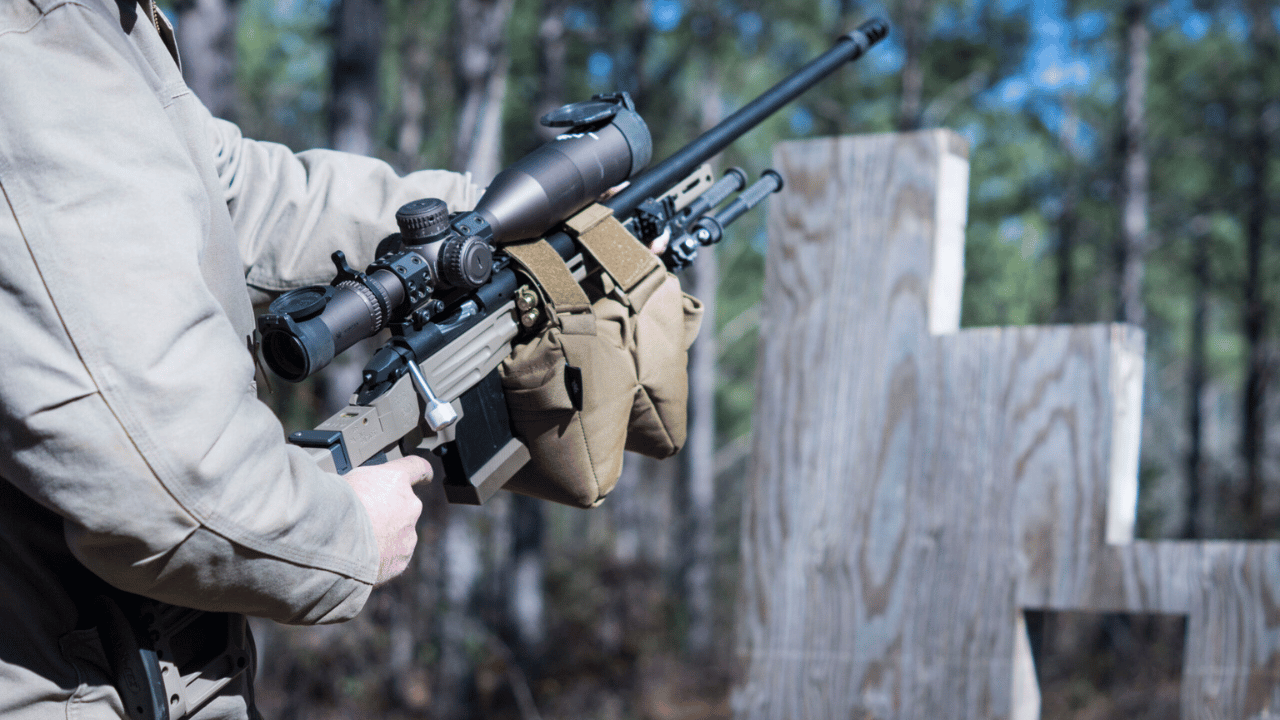
Owning quality shooting bags is only half the equation. Knowing how to set them up correctly determines whether you get the full stability benefit they offer. Improper bag placement is one of the most common reasons shooters do not see the improvement they expected after purchasing bags. This guide walks through the correct setup for the two most common supported shooting positions.
Understanding the Relationship Between Bag and Stock
A shooting bag interfaces with the rifle's stock, not the barrel or action. Placing a bag under the barrel can deflect the barrel downward and dramatically shift the point of impact. The bag belongs under the wooden or synthetic stock — under the forend for front support, and under the stock heel or toe for rear support.
The geometry of your bolt action rifle's stock directly affects how the bag performs. Flat-bottomed precision stocks provide maximum contact area with the bag surface, creating stable and consistent support. Traditional rounded hunting stocks require bags with defined grooves or cradle profiles to prevent lateral rolling.
Setting Up for Bench Rest Shooting
Begin by positioning your shooting bench at a comfortable height — your elbows should rest naturally without raised or dropped shoulders. Place the front bag on a solid rest, sandbag, or purpose-built front rest positioned approximately where the forend will naturally rest when you are behind the rifle in your normal position.
Lower the rifle onto the front bag with the forend sitting in the bag's groove. The barrel must not contact the bag. Position the rear bag under the stock heel — the rearmost point of the stock where it contacts the bag naturally. Sit behind the rifle and look through the scope without touching the rifle. The crosshair should settle near your target. Adjust the front bag height and rear bag position until the crosshair is naturally on target without any muscular effort.
This is your natural point of aim. Only when the crosshair settles on target naturally should you make any shots. Gripping the forend or pulling the stock into your shoulder to force the crosshair on target introduces muscle force that destroys the stability the bags provide.
Setting Up for Prone Shooting
Prone shooting with shooting bags follows similar principles but requires body position discipline. Begin by lying down behind the rifle with your body at a slight angle to the target — typically 10 to 20 degrees — rather than directly behind the rifle. This reduces pulse transmission through the rifle.
Position a front bag under the forend or use a bipod for front support. Place the rear bag under the stock heel. Move your entire body — not just the bags — until the crosshair rests naturally on the target when you are fully relaxed. This body adjustment maintains natural point of aim correctly.
Use your non-dominant hand to grip the rear bag rather than the stock. Apply light upward pressure to raise the crosshair, or relax to lower it. This 'milking' technique provides elevation fine-tuning without disturbing the rifle's horizontal position. Practice this until it becomes instinctive before attempting long-range precision work.
Common Setup Mistakes and How to Avoid Them
The most common mistake is setting up the bags and then moving the rifle to the target rather than moving the body. Moving only the rifle forces a new natural point of aim that requires muscular compensation to maintain. Always move the entire position — body, mat, and bags together — to change the point of aim.
Another common error is overfilling bags until they are rock-hard. A properly filled bag has slight give — it conforms to the stock's contact surface. An overfilled bag acts like a rigid surface and can actually increase rifle bounce under recoil.
How to Check Your Setup Quality
A simple check: settle into position, close your eyes, take three slow breaths, then open your eyes. The crosshair should be on or very near your target. If it has moved significantly, your natural point of aim is wrong. Adjust body position until this test consistently shows the crosshair on target.
Conclusion
Correct bag setup is a skill that takes practice but rewards that practice with measurably better results. Take time to establish natural point of aim correctly every session, and your shooting bags will allow your bolt action rifle to perform at its genuine mechanical accuracy potential.

 English
 French
 Spanish
 Portuguese
 Deutsch
 Turkish
 Dutch
Dutch
 Italiano
 Russian
 Romaian
 Portuguese (Brazil)
 Greek
Greek