


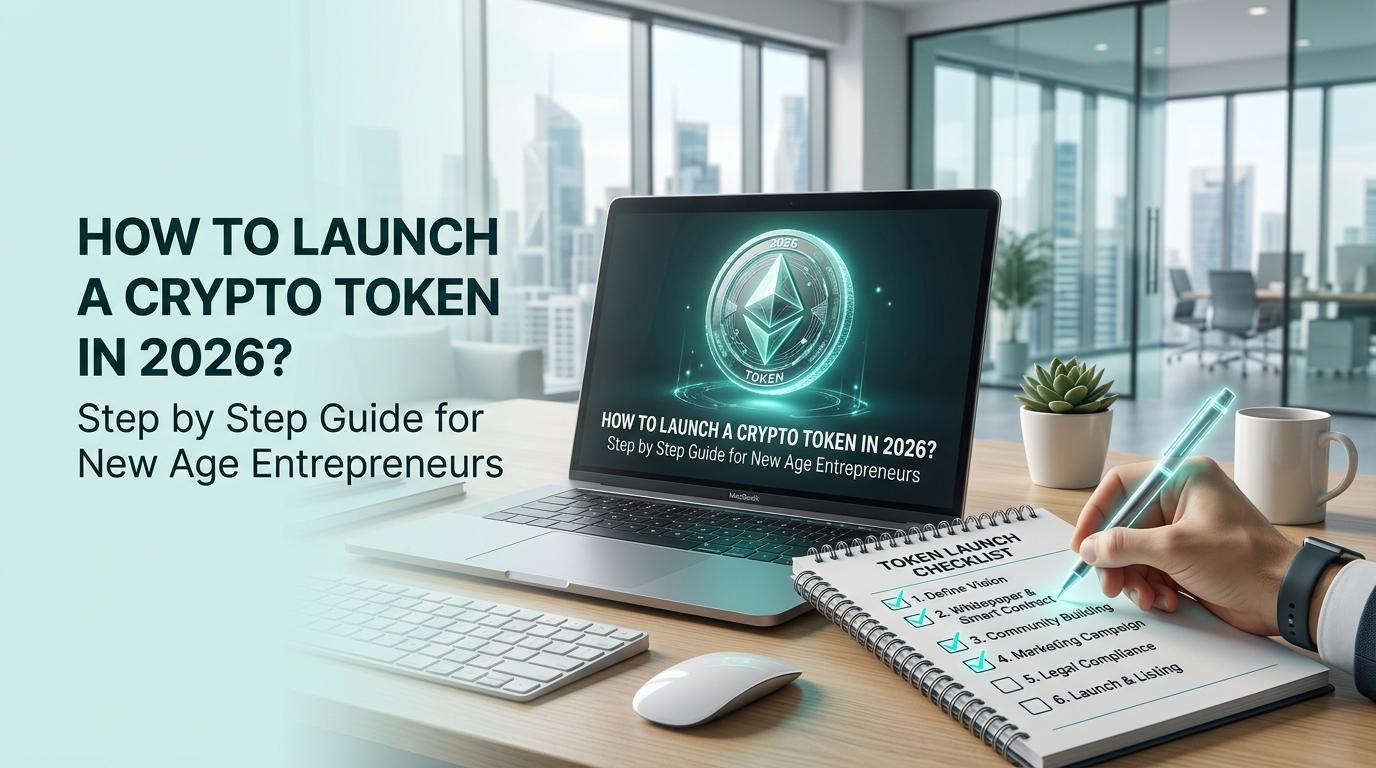
Launching a crypto token in 2026 is no longer a quick fundraising experiment. It is a full-scale business initiative that requires legal preparation, technical execution, economic design, community trust, and post-launch discipline.
The market has matured. Investors are more careful. Regulators are more active. Exchanges are more selective. Security threats are more sophisticated.
A token launch today must prove one thing clearly:
It deserves to exist.
For entrepreneurs, this means the process begins long before the token goes live. The strongest launches are built around a real business model, a useful product, credible tokenomics, and a roadmap that can survive beyond launch-day excitement.
Step 1: Define the Token’s Real Purpose
Every successful token begins with a clear reason for existing.
A token should not be added simply because the business is blockchain-based. It must solve a specific problem inside the ecosystem and create measurable value for users.
Identify the Core Utility
The first question is simple: what can users do with the token?
Common utility models include:
- Paying transaction or platform fees
- Accessing premium ecosystem features
- Participating in governance
- Earning rewards for useful activity
- Staking to secure or support the network
The token should make the product stronger, not more complicated.
Avoid Weak Token Use Cases
Many failed projects created tokens that had no real role beyond trading. Once speculative interest faded, demand disappeared.
Weak use cases include:
- Tokens created only for fundraising
- Reward tokens with no spending purpose
- Governance tokens where users have no real influence
- Utility tokens attached to products with no users
If the product works better without the token, the model needs revision.
Connect Utility to Business Growth
The best token models link user growth with token demand. For example, if a gaming platform requires tokens for asset upgrades, tournament entry, or creator rewards, increased platform activity naturally supports token usage.
That connection matters more than hype.
Step 2: Choose the Right Token Type
The token structure determines development complexity, compliance needs, and user expectations.
Entrepreneurs should select the token model based on business goals rather than copying market trends.
Utility Tokens
Utility tokens provide access to a product or service. They are commonly used in gaming, DeFi, SaaS platforms, marketplaces, and decentralized applications.
The key challenge is proving genuine utility before public sale.
Governance Tokens
Governance tokens allow holders to vote on ecosystem decisions. These work best when the project has an active community, treasury, and protocol parameters worth governing.
Governance without meaningful decision-making feels performative.
Security or Asset-Backed Tokens
Tokens linked to financial rights, revenue, equity, debt, or real-world assets may fall under stricter regulatory frameworks.
In Europe, MiCA introduced clearer rules around crypto-assets, including disclosure, transparency, authorization, and supervision requirements. In 2026, token founders cannot treat compliance as an afterthought.
Meme and Community Tokens
Community tokens can succeed, but they require exceptional culture, storytelling, liquidity planning, and community management.
They are easy to launch but hard to sustain.
Step 3: Build the Legal and Compliance Foundation
Legal preparation is one of the most important launch steps in 2026.
Regulators are no longer observing from a distance. Crypto projects must understand where they operate, who they sell to, and how their token may be classified.
Select the Right Jurisdiction
Different countries treat tokens differently. A project may be acceptable in one market and restricted in another.
Founders should evaluate:
- Company registration options
- Tax obligations
- Token sale restrictions
- Investor eligibility rules
- Marketing limitations
- Exchange listing requirements
The goal is not to find the easiest jurisdiction. The goal is to find one that supports long-term operations.
Prepare Legal Documentation
Before any public sale, projects should prepare clear documentation such as:
- Token terms and conditions
- Risk disclosures
- Privacy policy
- Website terms
- Investor agreements
- Token sale terms
- AML and KYC policies where required
Professional documentation protects both the company and the community.
Know Your Buyer
Public token sales often require strong controls around investor screening, geographic restrictions, and wallet monitoring.
A compliant launch may feel slower, but it protects the project from future disruptions.
Step 4: Design Tokenomics That Can Survive the Market
Tokenomics is not about making a supply chart look attractive.
It is about designing incentives that support growth, reduce sell pressure, and reward long-term participation.
Define Supply Clearly
Founders must decide:
- Total token supply
- Initial circulating supply
- Team allocation
- Investor allocation
- Community rewards
- Treasury reserves
- Liquidity allocation
A low circulating supply may create early scarcity, but it can also trigger volatility when large unlocks begin.
Build Vesting Discipline
Vesting schedules are critical. Without them, early investors, advisors, or team members may create heavy sell pressure soon after launch.
A healthier structure usually includes:
- Team vesting over multiple years
- Investor cliffs
- Gradual unlocks
- Transparent public schedules
- On-chain or independently verifiable vesting contracts
Trust improves when people know when tokens enter the market.
Protect the Ecosystem Treasury
The treasury should fund product development, grants, partnerships, liquidity, audits, and long-term operations.
It should not become an uncontrolled founder wallet.
A transparent treasury strategy signals maturity.
Step 5: Build the Token and Smart Contracts
Once the token model is clear, development begins.
This stage requires precision because smart contracts are difficult to fix after deployment.
Choose the Blockchain Network
The choice of blockchain affects cost, speed, liquidity, ecosystem access, and user experience.
Popular options include:
- Ethereum for security and ecosystem depth
- BNB Chain for affordability and retail reach
- Polygon for scalability and enterprise-friendly use cases
- Solana for high-speed applications
- Layer-2 networks for lower fees and Ethereum alignment
The best network is the one your users can actually use.
Select the Token Standard
Common standards include:
- ERC-20 for fungible tokens
- ERC-721 for NFTs
- ERC-1155 for mixed asset models
- SPL tokens on Solana
- BEP-20 on BNB Chain
The token standard should match the product, not the marketing narrative.
Develop Core Contracts
Depending on the launch model, entrepreneurs may need:
- Token contract
- Vesting contract
- Staking contract
- Sale contract
- Liquidity contract
- Governance contract
- Reward distribution contract
This is where expert development becomes valuable.
Blockchain App Factory is a token development company that helps entrepreneurs create custom crypto tokens, smart contracts, tokenomics frameworks, and launch-ready blockchain ecosystems for modern Web3 businesses.
Step 6: Audit Security Before Going Public
Security is now a launch requirement, not a premium feature.
Crypto security failures remain expensive. Chainalysis reported that more than $2.17 billion was stolen from crypto services in the first half of 2025 alone, exceeding total losses for the previous year at that point.
That data sends a clear message: users will not trust unaudited infrastructure.
Conduct Smart Contract Audits
Independent auditors should review the code for:
- Reentrancy vulnerabilities
- Access control weaknesses
- Integer issues
- Faulty minting logic
- Upgradeability risks
- Liquidity manipulation risks
One audit is useful. Multiple reviews are stronger for high-value launches.
Run Testnet Campaigns
Testnets allow users and developers to stress-test the product before real funds are involved.
A strong testnet campaign can reveal:
- Broken user flows
- Gas inefficiencies
- Wallet connection problems
- Reward calculation errors
- Scalability issues
It also builds early community confidence.
Use Bug Bounties
Bug bounty programs encourage ethical hackers to identify vulnerabilities before attackers do.
For serious projects, security should continue after launch.
Step 7: Build the Community Before the Sale
A token should not go public into silence.
Community building must begin months before launch, but it should focus on credibility rather than artificial hype.
Define the Audience
Different tokens attract different communities.
A DeFi project may target liquidity providers and yield strategists. A gaming token may target players, guilds, creators, and esports communities. A real-world asset token may target investors seeking transparency and regulated access.
Messaging should match the audience.
Create Educational Content
Before launch, users should understand:
- What the product does
- Why the token is needed
- How rewards work
- What risks exist
- How governance will evolve
- What the roadmap includes
Education reduces confusion and improves retention.
Build Contributor Loops
The strongest communities do more than comment on posts.
They create content, test products, translate materials, suggest features, report bugs, and onboard new users.
Rewarding useful contribution is better than rewarding noise.
Step 8: Plan the Fundraising and Launch Model
The token launch model shapes investor expectations and market behavior.
Entrepreneurs should choose a structure that matches their stage, compliance strategy, and community size.
Private Sale
Private sales are often used to raise early capital from strategic investors, venture funds, angels, or ecosystem partners.
They work best when investors bring more than money, such as exchange connections, technical support, liquidity relationships, or market access.
Public Sale
A public sale can expand ownership and community participation, but it requires careful compliance and communication.
Founders must explain:
- Sale price
- Allocation limits
- Vesting terms
- Refund rules if applicable
- Eligibility restrictions
- Token delivery schedule
Transparency prevents backlash.
Fair Launch
Fair launches avoid large private allocations and allow broader market participation.
They can work well for community-first projects, but they require strong liquidity, clear rules, and active moderation.
Step 9: Prepare Liquidity and Exchange Strategy
Liquidity determines whether users can buy, sell, and use the token smoothly.
A poorly planned liquidity strategy can create extreme volatility and damage trust.
Start With DEX Liquidity
Many projects begin with decentralized exchanges because they offer faster market access.
Founders must plan:
- Initial liquidity amount
- Trading pair selection
- Liquidity lock duration
- Slippage expectations
- Market maker support if needed
Liquidity should be deep enough to support healthy trading.
Approach Centralized Exchanges Carefully
Centralized exchange listings can increase visibility, but they also bring higher scrutiny.
Exchanges typically evaluate:
- Legal readiness
- Security audits
- Community strength
- Trading demand
- Token utility
- Team credibility
A listing should support growth, not replace product adoption.
Avoid Artificial Volume
Wash trading and fake volume may create short-term attention, but they damage reputation and increase regulatory risk.
Real liquidity beats manufactured activity.
Step 10: Execute the Launch With Precision
Launch day is operationally intense.
Every weak point becomes visible when thousands of users interact with the project at once.
Prepare the Launch Checklist
Before going live, confirm:
- Contracts are deployed and verified
- Audits are published or summarized
- Token addresses are announced through official channels
- Liquidity is ready
- Website traffic capacity is tested
- Community moderators are active
- Scam warnings are visible
- Support channels are staffed
Small mistakes can become expensive quickly.
Control Communication
Scammers often create fake token addresses, phishing links, and impersonation accounts during launch.
Projects must repeatedly publish verified links and educate users on how to avoid fraud.
Monitor the First 72 Hours
The first three days are critical.
Teams should monitor:
- Trading activity
- Contract interactions
- Community sentiment
- Liquidity performance
- Wallet distribution
- Technical errors
- Scam attempts
Fast response builds confidence.
Step 11: Deliver After the Launch
The real work begins after the token is live.
Many projects fail because they treat launch as the finish line. In reality, it is only the opening act.
Ship Product Updates
Post-launch execution should include visible progress such as:
- Feature releases
- Ecosystem integrations
- Governance upgrades
- Partnership rollouts
- Developer tools
- Community programs
Markets forgive volatility more easily than inactivity.
Report Metrics Publicly
Useful reporting may include:
- Active users
- Transaction volume
- Treasury usage
- Staking participation
- Governance turnout
- Protocol revenue
- Development milestones
Data builds confidence when marketing slows down.
Improve Governance Gradually
Entrepreneurs do not need to decentralize everything on day one.
A practical path is progressive decentralization, where the founding team handles early execution while gradually transferring authority to token holders.
Conclusion
Launching a crypto token in 2026 requires strategy, structure, and discipline. New-age entrepreneurs must move beyond the old formula of whitepaper, presale, listing, and promotion. That playbook no longer works in a market shaped by regulation, security threats, investor scrutiny, and stronger competition.
A successful token launch begins with a real use case. It continues with strong tokenomics, legal readiness, secure smart contracts, community education, liquidity planning, and disciplined post-launch execution.
The entrepreneurs who win in 2026 will not be the ones who launch fastest. They will be the ones who launch with clarity, credibility, and the ability to keep building after the market starts watching.

 English
 Arabic
 Spanish
 Portuguese
 Deutsch
 Turkish
 Dutch
Dutch
 Italiano
 Russian
 Romaian
 Portuguese (Brazil)
 Greek
Greek