


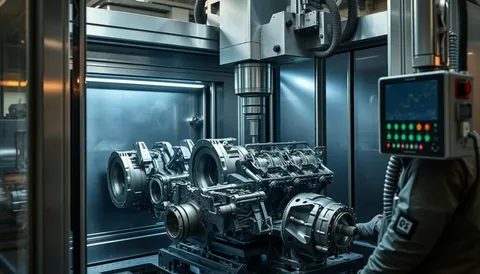
In today’s highly competitive automotive industry, precision and consistency are essential for manufacturing reliable vehicle components. Automotive CNC machining plays a critical role in producing high-performance engine and transmission parts with tight tolerances and superior durability. From prototype development to mass production, CNC technology ensures accuracy, repeatability, and efficiency across all stages of automotive manufacturing.
Modern vehicles demand components that can withstand extreme heat, pressure, and mechanical stress. This is where CNC (Computer Numerical Control) machining becomes indispensable. It enables manufacturers to produce complex geometries and fine details that traditional machining methods cannot achieve, ensuring optimal performance and long service life.
The Role of Automotive CNC Machining in Engine Component Production
Automotive CNC machining is widely used in producing critical engine parts such as cylinder heads, engine blocks, pistons, and crankshafts. These components require extremely tight tolerances to ensure proper combustion, efficiency, and engine longevity. CNC machines eliminate human error and deliver consistent precision across every unit produced.
The ability to automate complex cutting processes also allows manufacturers to scale production without compromising quality. Advanced multi-axis CNC machines can perform milling, drilling, and turning operations in a single setup, reducing production time and improving accuracy.
Key benefits include:
- High dimensional accuracy for engine components
- Reduced production errors and material waste
- Ability to produce complex engine geometries
- Consistent quality in mass production
In addition, CNC machining supports the use of high-performance materials such as aluminum alloys, titanium, and hardened steel, which are commonly used in engine manufacturing. This ensures durability under high temperature and pressure conditions.
Precision Manufacturing of Transmission System Parts
Transmission systems require extremely precise components to ensure smooth gear shifting and efficient power transfer. Automotive CNC machining is essential for manufacturing gears, shafts, clutch housings, and synchronizers with exact specifications.
Even minor deviations in transmission parts can lead to inefficiencies, noise, or mechanical failure. CNC technology ensures that every gear tooth and shaft dimension is produced with micron-level precision, significantly improving vehicle reliability and performance.
Key benefits include:
- Accurate gear and shaft alignment
- Improved transmission efficiency
- Reduced friction and wear between parts
- Enhanced driving performance and durability
Furthermore, CNC machining allows for the production of customized transmission components for performance vehicles, racing applications, and heavy-duty machinery, where standard parts may not be sufficient.
Advanced CNC Technologies Used in Automotive Manufacturing
Modern automotive CNC machining utilizes advanced technologies such as 5-axis machining, CAD/CAM integration, and automated tool changers. These innovations allow manufacturers to produce highly complex automotive parts with minimal manual intervention.
CAD (Computer-Aided Design) and CAM (Computer-Aided Manufacturing) software enable precise digital modeling and toolpath planning before production begins. This reduces errors and ensures that every cut, drill, and contour is executed exactly as designed.
Key benefits include:
- Ability to machine complex 3D geometries
- Faster production cycles with automation
- Reduced setup time and operational costs
- High repeatability for large production runs
Additionally, real-time monitoring systems in CNC machines help detect tool wear and machining errors instantly, ensuring consistent quality and reducing downtime in automotive production lines.
Material Efficiency and Durability in CNC Machined Automotive Parts
One of the major advantages of automotive CNC machining is its ability to optimize material usage while maintaining structural integrity. CNC processes are highly precise, which minimizes waste and ensures maximum utilization of raw materials.
Automotive manufacturers often work with strong yet lightweight materials such as aluminum alloys, stainless steel, and composites. CNC machining ensures these materials are shaped accurately without compromising their mechanical properties.
Key benefits include:
- Reduced material wastage and cost efficiency
- Enhanced strength-to-weight ratio in components
- Improved corrosion resistance and durability
- Consistent surface finish and quality
In addition, CNC-machined parts undergo rigorous quality control testing, ensuring they meet international automotive standards for safety, performance, and reliability.
Applications of CNC Machining in Modern Automotive Engineering
Automotive CNC machining is not limited to engines and transmissions; it is widely used across various vehicle systems including suspension, braking, steering, and exhaust systems. This versatility makes CNC technology a cornerstone of modern automotive engineering.
From electric vehicles (EVs) to high-performance sports cars, CNC machining supports innovation by enabling rapid prototyping and production of custom-designed components.
Key applications include:
- Engine blocks, pistons, and camshafts
- Transmission gears and clutch assemblies
- Brake calipers and rotors
- Suspension and steering components
As the automotive industry evolves toward electric and hybrid vehicles, CNC machining continues to play a vital role in producing lightweight, high-efficiency components that support improved energy performance and sustainability.
Conclusion
Automotive CNC machining has revolutionized the production of engine and transmission parts by delivering unmatched precision, efficiency, and reliability. Its ability to manufacture complex components with tight tolerances ensures that modern vehicles perform at their highest level while maintaining safety and durability.
As automotive technology continues to advance, CNC machining will remain a core manufacturing process, supporting innovation in both traditional and electric vehicle industries. Manufacturers who invest in advanced CNC systems gain a significant competitive advantage in quality, performance, and production efficiency.

 English
 Arabic
 French
 Spanish
 Portuguese
 Turkish
 Dutch
Dutch
 Italiano
 Russian
 Romaian
 Portuguese (Brazil)
 Greek
Greek