


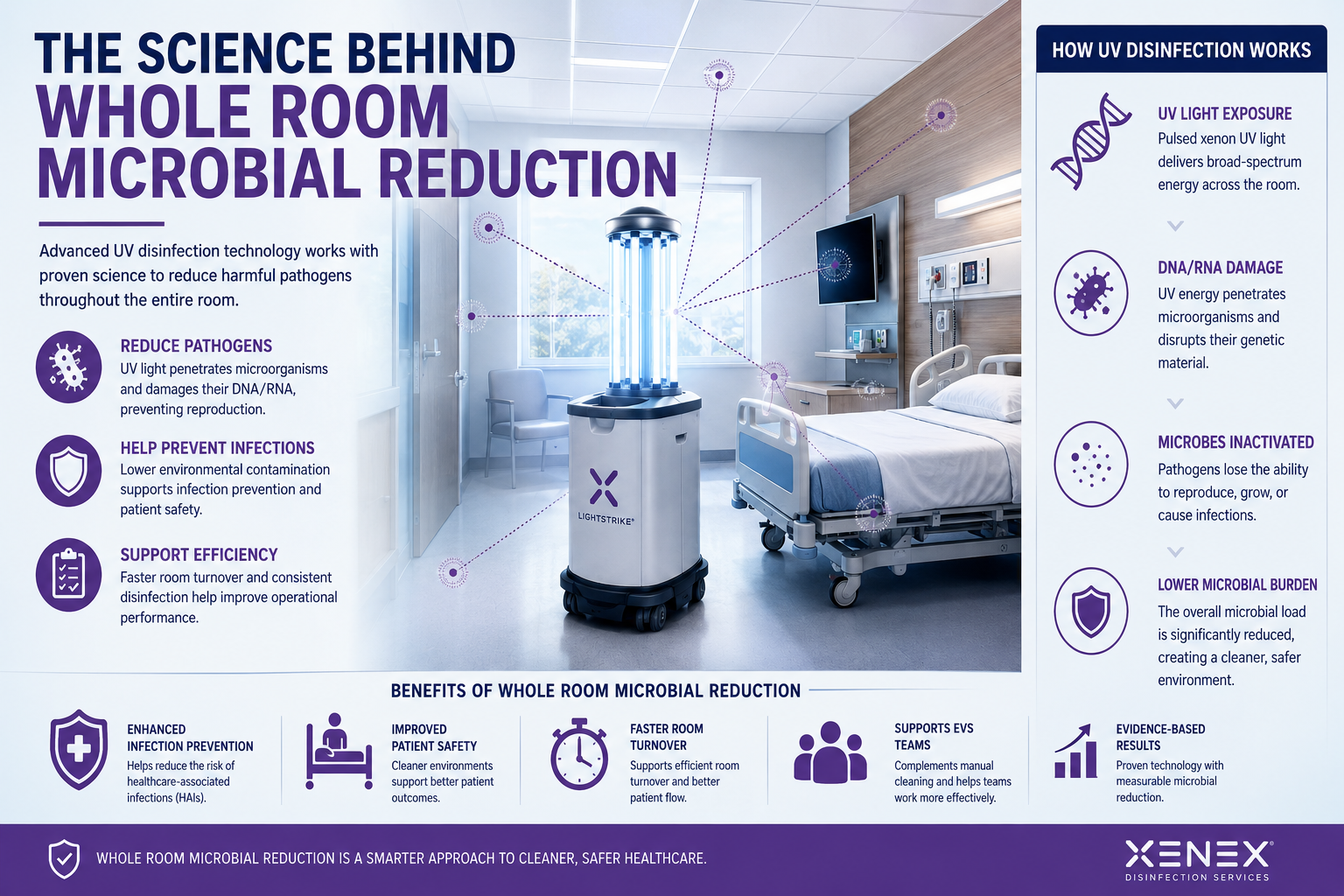
Healthcare facilities face constant challenges in preventing the spread of harmful pathogens. While traditional cleaning methods remain an essential part of infection prevention programs, they may not always eliminate microorganisms hidden on high-touch surfaces and difficult-to-reach areas. This is why many healthcare organizations are turning to advanced technologies that support whole room microbial reduction.
Solutions provided by Xenex help healthcare facilities strengthen environmental hygiene protocols through innovative UV disinfection technology designed to reduce microbial contamination and support safer patient care environments.
Understanding Whole Room Microbial Reduction
Whole room microbial reduction refers to the process of decreasing the number of harmful microorganisms throughout an entire healthcare environment. These microorganisms can include bacteria, viruses, fungi, and other pathogens that may contribute to healthcare-associated infections (HAIs).
Unlike manual cleaning alone, whole room microbial reduction focuses on treating the entire patient room, including surfaces that may be overlooked during routine environmental services procedures. The goal is to create a cleaner environment that reduces opportunities for pathogen transmission between patients, healthcare workers, and visitors.
Healthcare facilities commonly target pathogens such as:
-
Methicillin-resistant Staphylococcus aureus (MRSA)
-
Clostridioides difficile (C. diff)
-
Vancomycin-resistant Enterococci (VRE)
-
Influenza viruses
-
Coronaviruses
-
Multidrug-resistant organisms (MDROs)
Reducing the presence of these microorganisms plays a critical role in improving patient safety and supporting infection prevention efforts.
Why Environmental Surfaces Matter
Research has shown that environmental surfaces can serve as reservoirs for harmful pathogens. High-touch surfaces such as bed rails, call buttons, door handles, light switches, and medical equipment may become contaminated throughout the day.
Even after routine cleaning, some microorganisms can remain on surfaces due to:
-
Human error during cleaning
-
Inaccessible areas
-
Time constraints between patient admissions
-
Complex room layouts
-
Pathogen resistance to certain disinfectants
When a contaminated surface is touched, pathogens may spread through direct or indirect contact. This chain of transmission can increase the risk of healthcare-associated infections and negatively impact patient outcomes.
The Role of UV Disinfection Technology
One of the most effective advancements in whole room microbial reduction is ultraviolet (UV) disinfection technology. UV systems provide a no-touch disinfection process that complements standard environmental cleaning protocols.
Pulsed xenon UV technology works by producing intense bursts of broad-spectrum ultraviolet light. This UV energy penetrates microorganisms and damages their DNA and RNA structures, preventing them from reproducing and causing infections.
Unlike chemical disinfectants that depend on direct surface application, UV disinfection can reach a wide range of exposed surfaces throughout the room. This helps healthcare facilities achieve a more comprehensive approach to environmental hygiene.
The Science Behind Microbial Inactivation
The effectiveness of UV disinfection is rooted in microbiology and photochemistry.
Microorganisms rely on intact genetic material to survive and reproduce. When exposed to high-intensity UV light, their DNA and RNA absorb the ultraviolet energy. This exposure causes molecular damage that disrupts replication processes.
As a result:
-
Bacteria lose the ability to multiply.
-
Viruses become inactive.
-
Pathogens cannot continue their lifecycle.
-
The overall microbial burden decreases significantly.
This process is known as microbial inactivation and serves as the scientific foundation for whole room microbial reduction technologies.
Benefits of Whole Room Microbial Reduction
Enhanced Infection Prevention
Reducing environmental contamination helps healthcare facilities strengthen infection prevention programs. Lower pathogen levels can contribute to a safer care environment and support efforts to reduce healthcare-associated infections.
Improved Patient Safety
Patients recovering from surgery, illness, or immune-related conditions may be particularly vulnerable to infections. Whole room microbial reduction helps minimize environmental risks and supports better patient outcomes.
Consistent Disinfection Results
Manual cleaning quality can vary depending on staffing levels, training, and time pressures. Automated UV disinfection technologies provide a standardized process that helps improve consistency across healthcare environments.
Support for Environmental Services Teams
Environmental Services (EVS) professionals play a critical role in healthcare cleanliness. Whole room microbial reduction technologies complement their efforts by addressing areas that may be difficult to disinfect manually.
Faster Room Turnover
Advanced UV disinfection systems can support efficient room turnover processes. Faster room availability can improve patient flow, reduce waiting times, and increase operational efficiency throughout healthcare facilities.
Applications Across Healthcare Facilities
Whole room microbial reduction can be implemented in a variety of healthcare settings, including:
Patient Rooms
Disinfecting patient rooms between admissions helps reduce the risk of pathogen transmission from previous occupants.
Operating Rooms
Surgical environments require strict infection control standards. UV disinfection can support enhanced cleanliness protocols before and after procedures.
Intensive Care Units
ICUs often house high-risk patients who are more susceptible to infections. Additional microbial reduction measures can provide an added layer of protection.
Emergency Departments
Emergency departments experience high patient volumes and rapid room turnover. Whole room microbial reduction helps maintain environmental hygiene in these fast-paced settings.
Long-Term Care Facilities
Nursing homes and rehabilitation centers can also benefit from advanced disinfection technologies that help reduce microbial contamination and improve resident safety.
The Future of Healthcare Environmental Hygiene
Healthcare leaders continue to prioritize infection prevention and patient safety. As pathogens evolve and healthcare demands increase, facilities are seeking evidence-based technologies that improve environmental cleanliness and operational efficiency.
Whole room microbial reduction represents a significant advancement in modern healthcare disinfection strategies. By combining manual cleaning practices with UV disinfection technology, healthcare organizations can create a comprehensive approach to reducing microbial contamination.
As innovation continues to shape infection control practices, healthcare facilities that invest in advanced environmental hygiene solutions will be better positioned to protect patients, support staff, and maintain high standards of care.
Conclusion
The science behind whole room microbial reduction is based on a simple but powerful principle: reducing the number of harmful microorganisms reduces opportunities for infection transmission. Through advanced UV disinfection technology, healthcare facilities can complement traditional cleaning methods and achieve more effective environmental hygiene.
By targeting pathogens throughout the entire patient environment, whole room microbial reduction supports infection prevention initiatives, improves patient safety, enhances room turnover efficiency, and contributes to healthier healthcare facilities overall. As hospitals continue to embrace evidence-based disinfection solutions, whole room microbial reduction will remain an essential component of modern infection control strategies.

 English
 Arabic
 French
 Spanish
 Portuguese
 Deutsch
 Turkish
 Dutch
Dutch
 Italiano
 Russian
 Portuguese (Brazil)
 Greek
Greek