


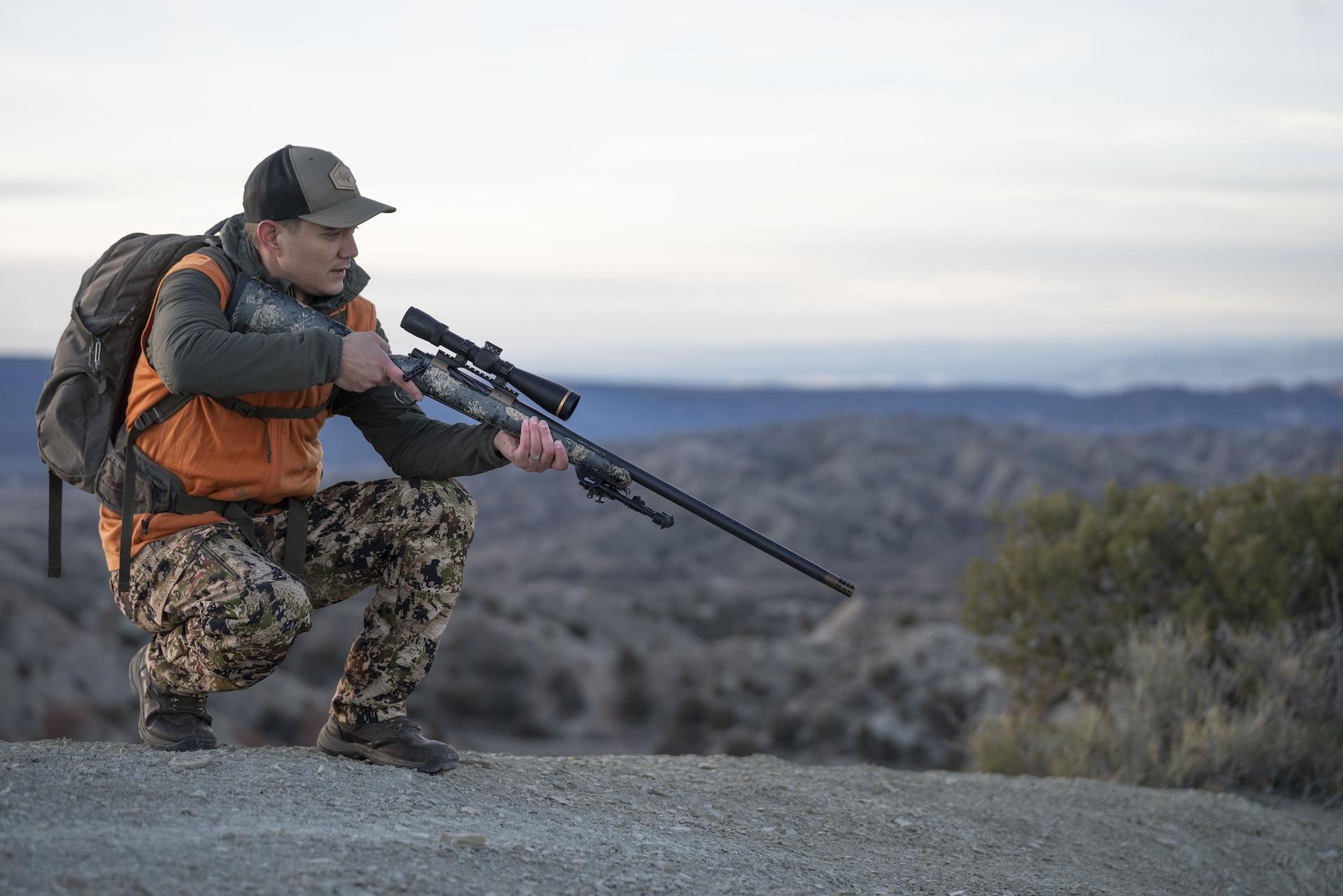
Late-season whitetail hunting comes down to two things: staying still and staying undetected. If your gear cannot keep you comfortable through long, motionless sits, you will move, fidget, and climb down early — and the buck will step out the moment you are gone. So how do you build a cold-weather system from scratch that actually holds up? Work from the outside in, treat every piece as part of a whole, and do not make the classic mistake of obsessing over the clothing while ignoring the rifle that has to finish the job.
Start With the Shell
Your outer layer does the heavy lifting against wind, which is the real heat thief in an exposed tree stand. You are not generating much warmth sitting still, so the wind has nothing to fight against except your shell. You need something genuinely windproof and, just as importantly, silent — fabric noise at the moment of the draw or the shoulder mount is what busts most hunters at close range. This detailed sitka stratus jacket review walks through exactly what temperature range a windproof shell covers and how to layer it for hard cold fronts, which takes most of the guesswork out of choosing an outer layer and matching it to the forecast.
Insulation in the Middle
A windproof shell is only as warm as what you wear under it. A puffy or grid-fleece mid-layer traps the heat your body generates; the shell then keeps the wind from stealing it away. For sub-freezing sits this is the layer you add or subtract as conditions change through the day, so pick something that packs down small enough to stuff in your pack on the warm walk in and pull on once you are settled and cooling off in the stand.
A Base That Moves Moisture
Merino or synthetic base layers pull sweat off your skin during the hike to your stand so you do not chill once you stop moving. This is the layer beginners most often get wrong. Cotton has no place in the system — it soaks up moisture, holds it against your skin, and turns into a cold compress the moment you sit down and stop working. Spend a little here; it is the foundation everything else sits on.
Do Not Forget the Rifle Side
A perfect clothing system still fails if you flinch the shot away after three hours in the cold. Stiff, cold hands make for jerky trigger pulls, and a heavy factory trigger only magnifies the problem at the worst possible moment. If you shoot the most popular bolt action out there, this look at whether a remington 700 trigger upgrade is worth it makes the case clearly: a clean, predictable break lets you stop muscling the shot and start trusting it, even when your fingers are numb and your heart is pounding. Warmth keeps you in the stand; a good trigger cashes in the chance once you are there.
The Small Stuff That Finishes the System
A hand muff, a quality beanie, and insulated boots complete the build. Extremities go cold first, and a cold hunter is a hunter who climbs down early and misses the best movement of the evening. A hand muff in particular is badly underrated — it keeps your trigger hand warm and ready so that crisp break you paid for actually gets used the way it should, instead of being ruined by a hand too stiff to feel the pressure.
Build It as a System
The mistake most hunters make is buying gear piecemeal — a jacket one year, boots the next, a base layer when the old one wears out — and ending up with a pile of mismatched items that do not work together. Build the layers as a coordinated system instead. The base moves moisture, the mid-layer holds heat, the shell blocks wind, and the rifle is set up so that even a numb hand can break a clean shot. Each piece is chosen to cover a specific weakness the others cannot, and the whole thing only works when every part pulls its weight.
Test the System Before Opening Day
The final step that almost everyone skips is a dress rehearsal. Put the whole system on and sit outside in the cold for an hour before the season ever opens, exactly the way you will in the stand. You will discover the gaps fast: a draft at the wrists, boots that are a half-size too tight for thick socks, a hand muff that does not reach your trigger hand, a shell that rustles when you shoulder the rifle. Far better to find those problems in your own backyard, where you can fix them, than at first light on the morning a real buck walks under your stand. A system that has been tested is a system you can trust to keep you still.
Treat your cold-weather kit as one connected system rather than a collection of unrelated purchases, and you will sit longer, stay hidden, and be ready when the buck finally commits.

 English
 French
 Spanish
 Portuguese
 Deutsch
 Turkish
 Dutch
Dutch
 Italiano
 Russian
 Romaian
 Portuguese (Brazil)
 Greek
Greek