


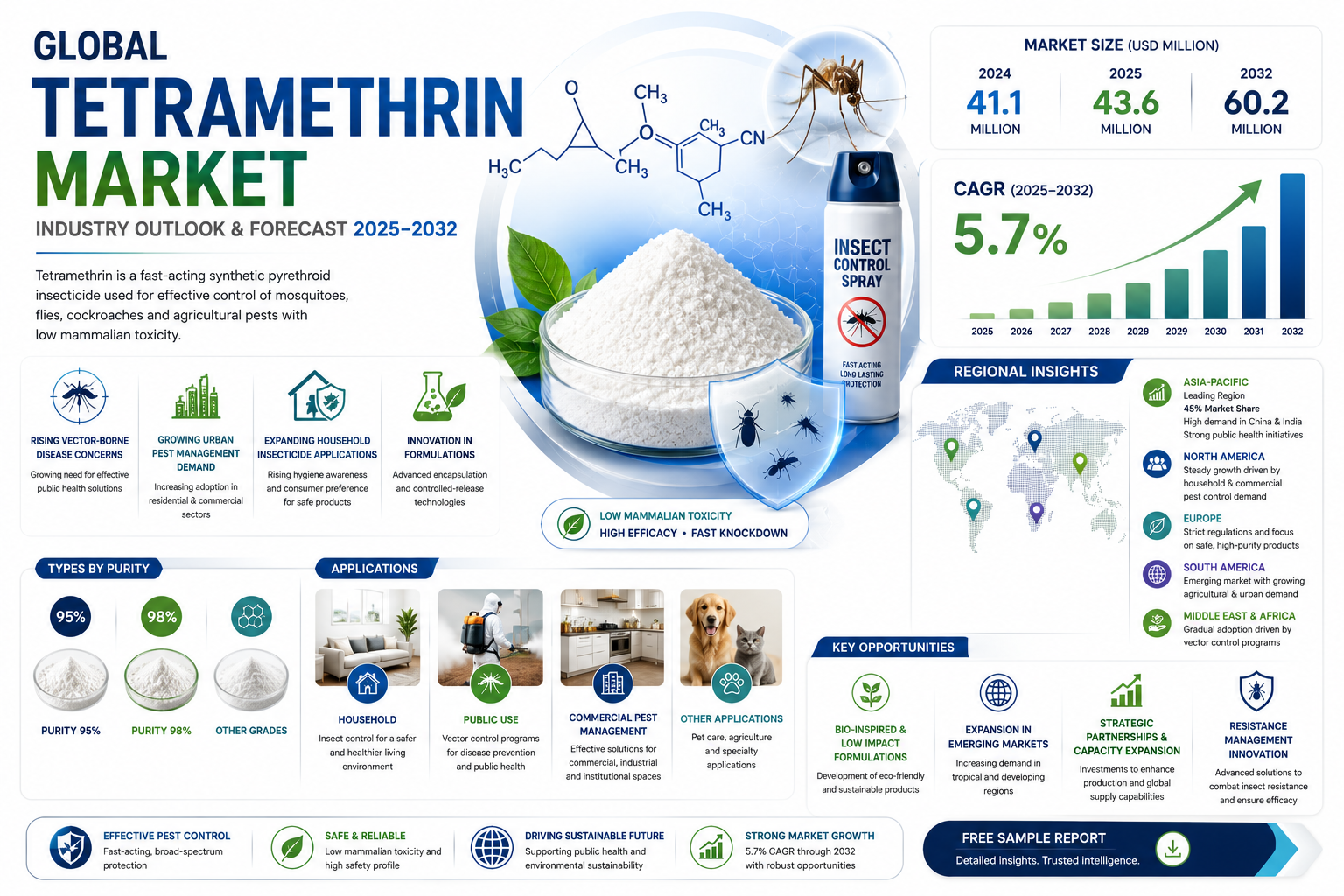
The global tetramethrin market size was valued at USD 41.1 million in 2024. The market is projected to grow from USD 43.6 million in 2025 to USD 60.2 million by 2032, exhibiting a CAGR of 5.7% during the forecast period.
Tetramethrin is a synthetic pyrethroid insecticide widely used for pest control in agricultural and household applications. This fast-acting neurotoxin disrupts insect nervous systems by delaying sodium channel closure, making it particularly effective against mosquitoes, flies, cockroaches, and agricultural pests. The compound is typically formulated as a white crystalline powder with low mammalian toxicity.
Market growth is driven by rising pest control demands in tropical regions, increasing public health concerns about vector-borne diseases, and growing adoption in urban pest management programs. However, regulatory restrictions in some regions and insect resistance development pose challenges. Leading manufacturers like Sumitomo Chemical and Jiangsu Yangnong Chemical are investing in advanced formulations to address these constraints while expanding production capacity to meet global demand.
Download FREE Sample Report: https://www.24chemicalresearch.com/download-sample/284863/tetramethrin-market
Market Overview & Regional Analysis
Asia-Pacific stands as the dominant region in the Tetramethrin market, capturing 45% of global volume due to high pest prevalence and robust demand for effective insecticides in both household and public health sectors. Countries like China and India lead consumption, driven by tropical climates that foster vector-borne diseases such as dengue and malaria. The region's market benefits from extensive urbanization, which heightens the need for indoor pest control solutions, while public health initiatives further bolster Tetramethrin's role in mosquito abatement programs. Major producers in China, including Jiangsu Yangnong Chemical, supply bulk quantities for domestic use and export, supporting applications in household sprays and treated nets. However, varying regulatory environments across the region influence product formulations, with advanced markets like Japan emphasizing high-purity grades for professional applications.
Regulatory frameworks in Asia-Pacific vary, with China's strict pesticide registration processes ensuring quality control, while India's Central Insecticides Board mandates efficacy testing for public health products. These standards promote consistent demand for Tetramethrin in vector control, though harmonization efforts are needed to streamline cross-border trade and formulation approvals. China and India together account for over 60% of the region's Tetramethrin consumption, fueled by large-scale manufacturing and high-volume household applications. Cost-effective production in China drives exports, while India's growing urban population sustains demand for affordable pest control solutions in residential settings. Rapid urbanization and rising awareness of hygiene standards accelerate Tetramethrin adoption, particularly for cockroach and mosquito control in densely populated areas. Public health campaigns targeting vector-borne diseases, combined with the expansion of the pet care sector in countries like South Korea, open new avenues for flea and tick products, enhancing overall market expansion. Pest resistance development in key species like mosquitoes poses a significant hurdle, necessitating frequent innovation in formulations. Additionally, counterfeit products in rural markets undermine premium Tetramethrin brands, while environmental concerns in export-oriented economies push for greener alternatives, potentially moderating growth in less regulated areas.
North America exhibits steady demand for Tetramethrin, primarily in household and commercial pest control, with the United States holding over 70% of the regional market share. The U.S. Environmental Protection Agency's rigorous oversight ensures low-toxicity formulations, aligning with consumer preferences for safe insecticides amid rising concerns over diseases like West Nile virus. While outdoor applications are limited by seasonal climates, indoor usage remains strong in urban centers, supported by professional pest management services. Canada's market focuses on integrated approaches, incorporating Tetramethrin in public health vectors control. However, competition from natural alternatives challenges synthetic pyrethroids, prompting manufacturers to innovate low-odor, high-efficacy products. Growth is further driven by pet care applications, as flea control products gain traction with increasing pet ownership. Regulatory compliance costs are high, but they foster quality improvements and market trust. Overall, the region benefits from advanced distribution networks, enabling quick adaptation to emerging pest threats, though economic factors influence pricing strategies for end-users.
Europe's Tetramethrin market is influenced by stringent EU Biocidal Products Regulation, requiring comprehensive safety assessments that favor high-purity formulations. Germany and France import technical-grade Tetramethrin for household and public sector use, particularly in southern regions combating mosquito vectors. The phase-out of older pesticides under REACH has boosted demand for safer options like Tetramethrin, blended with synergists to enhance efficacy and reduce doses. Scandinavia prioritizes eco-friendly labels, driving innovations in controlled-release technologies. Post-Brexit, the UK navigates separate registrations, impacting supply chains but sustaining demand through mosquito abatement programs. Challenges include high compliance expenses deterring smaller players, yet public health initiatives ensure steady growth. Consumer shift toward organic solutions tempers expansion, but Tetramethrin's low mammalian toxicity maintains its edge in urban hygiene applications.
In South America, Brazil and Argentina spearhead Tetramethrin demand, with significant use in agriculture for crop storage pests alongside household applications. Regulatory inconsistencies lead to varied product quality, though Brazil's ANVISA enforces toxicity labeling to protect consumers. Dengue outbreaks drive periodic surges in municipal procurements, highlighting Tetramethrin's role in vector control. Economic instability limits investments in advanced formulations, favoring generics in informal markets. Colombia's export-oriented flower industry relies on Tetramethrin to meet international residue standards, creating a niche for compliant products. Urbanization exacerbates indoor pest issues, boosting residential sales, but logistical challenges in remote areas hinder distribution. Long-term growth hinges on harmonized regulations and partnerships for integrated pest management, balancing efficacy with environmental concerns in tropical settings.
The Middle East and Africa present an emerging landscape for Tetramethrin, with GCC nations like the UAE importing premium grades for hospitality and healthcare pest control. South Africa upholds strict registrations via SAHPRA, ensuring quality in commercial applications, while Sub-Saharan regions depend on donor-funded programs for malaria vectors. Locust outbreaks in East Africa prompt emergency uses, though supply chain gaps reduce impact. Saudi Arabia's development projects, such as Neom City, incorporate advanced pest management, signaling opportunities. Challenges persist from pest resistance due to climate variability and unregulated cross-border trade. Nonetheless, improving public health infrastructure and rising urbanization foster demand for effective, low-toxicity solutions, positioning Tetramethrin for gradual expansion in this diverse region.
Key Market Drivers and Opportunities
Global health organizations report over 700,000 annual deaths from mosquito-borne diseases, creating substantial demand for effective vector control solutions. Tetramethrin's rapid knockdown effect against flying insects positions it as a frontline defense in malaria-endemic regions. Recent outbreaks of dengue and Zika virus have prompted governments across tropical regions to increase insecticide procurement budgets by an estimated 18-22% annually. The compound's effectiveness in public health applications, particularly in indoor residual spraying programs, continues to drive adoption in disease-control initiatives worldwide.
With global urban populations projected to reach 68% by 2030, concentrated living conditions are increasing pest-related health concerns. Tetramethrin-based household insecticides now capture 42% of the urban pest control market, favored for their balance of efficacy and safety. Market intelligence indicates that dual-income households in developing nations allocate 7-9% of their home maintenance budgets to pest control, with product efficacy being the primary purchasing driver. The chemical's low mammalian toxicity makes it preferred for residential use compared to older organophosphate alternatives.
Microencapsulation advances now enable controlled-release formulations that extend Tetramethrin's residual activity by 25-30%. These next-generation products show particular promise in fabric treatments for disease prevention, with market trials demonstrating 85% mosquito repellency for up to 30 washes. The technology also reduces environmental impact through targeted delivery, addressing regulatory concerns while enhancing performance.
Tropical developing nations represent the fastest-growing Tetramethrin markets, with vector control programs expanding to address climate change-related disease patterns. Africa's insecticide-treated bed net programs alone create demand for 15-20 million units annually. As disposable incomes rise in these regions, household insecticide spending follows, growing at 8-12% yearly. Strategic partnerships with local manufacturers and public health agencies offer routes to penetrate these expanding markets efficiently.
Challenges & Restraints
Recent environmental impact assessments have led to stricter regulation of synthetic pyrethroids in several jurisdictions. The EU's revised Biocidal Products Regulation now requires additional ecotoxicological studies that can increase registration costs by 35-40%. While Tetramethrin remains approved in most markets, these regulatory hurdles delay product launches and require manufacturers to reformulate for compliance. In North America, the EPA's ongoing pyrethroid review may impose additional use restrictions, potentially affecting label claims and application methods.
The organic pest control segment is growing at 14% CAGR, nearly triple the rate of conventional insecticides. Consumer preference is shifting toward plant-derived pyrethrins and microbial pesticides perceived as more environmentally friendly. Premium markets now demand pesticide-free certifications for residential and commercial spaces, creating challenges for traditional synthetic solutions. While Tetramethrin maintains advantages in cost-effectiveness and immediate efficacy, manufacturers must demonstrate clear performance benefits to maintain market share against these alternatives.
Field studies indicate that over 60 insect species have developed some level of resistance to pyrethroid compounds, including Tetramethrin. Mosquito populations in Southeast Asia show 40-60% reduced susceptibility compared to a decade ago. This resistance development forces manufacturers to continually invest in formulation improvements, with R&D expenditures rising by 15% annually. The situation requires strategic product rotations and combination formulations to maintain effectiveness in key markets.
Market Segmentation by Type
● Purity 95%
● Purity 98%
● Other grades
Purity 98% segment leads due to higher efficiency in pest control applications.
Download FREE Sample Report: https://www.24chemicalresearch.com/download-sample/284863/tetramethrin-market
Market Segmentation by Application
● Public use
● Household
● Other applications
Household segment dominates with rising demand for domestic insect control solutions.
Market Segmentation and Key Players
● Sumitomo Chemical Co., Ltd. (Japan)
● Jiangsu Yangnong Chemical Group Co., Ltd. (China)
● Aestar (Zhongshan) Pharmaceutical Co., Ltd. (China)
● Changzhou Kangmei Chemical Industry Co., Ltd. (China)
● Ningbo Generic Chemical Co., Ltd. (China)
● Hangzhou Udrangon Chemistry Co., Ltd. (China)
● Zhejiang Rayfull Chemicals Co., Ltd. (China)
● Endura S.p.A. (Italy)
● Meghmani Organics Limited (India)
Report Scope
This report presents a comprehensive analysis of the global and regional markets for Tetramethrin, covering the period from 2024 to 2032. It includes detailed insights into the current market status and outlook across various regions and countries, with specific focus on:
● Sales, sales volume, and revenue forecasts
● Detailed segmentation by type and application
The report features in-depth competitive intelligence including:
● Market share analysis of leading manufacturers
● Production capacity expansions
● Product portfolio assessments
● Strategic partnership evaluations
Our research methodology combines primary interviews with industry leaders and comprehensive data analysis of:
● Production facilities and their geographical distribution
● Raw material sourcing patterns
● End-user industry consumption trends
● Regulatory impact assessments
Get Full Report Here: https://www.24chemicalresearch.com/reports/284863/global-aluminum-plate-sheet-market
About 24chemicalresearch
Founded in 2015, 24chemicalresearch has rapidly established itself as a leader in chemical market intelligence, serving clients including over 30 Fortune 500 companies. We provide data-driven insights through rigorous research methodologies, addressing key industry factors such as government policy, emerging technologies, and competitive landscapes.
● Plant-level capacity tracking
● Real-time price monitoring
● Techno-economic feasibility studies
With a dedicated team of researchers possessing over a decade of experience, we focus on delivering actionable, timely, and high-quality reports to help clients achieve their strategic goals. Our mission is to be the most trusted resource for market insights in the chemical and materials industries.
International: +1(332) 2424 294 | Asia: +91 9169162030
Website: https://www.24chemicalresearch.com/

 English
 French
 Spanish
 Portuguese
 Deutsch
 Turkish
 Dutch
Dutch
 Italiano
 Russian
 Romaian
 Portuguese (Brazil)
 Greek
Greek