


Key Takeaways
-
FinOps turns AWS cost management into a shared responsibility across finance, engineering, and leadership, not a once a quarter finance exercise.
-
Rightsizing and reserved capacity planning typically account for the largest share of recoverable AWS spend.
-
Tagging and cost allocation are the foundation of every successful cloud spend management program.
-
Cloud cost optimization services add value by combining automated tooling with human judgment on workload patterns.
-
Savings plans and reserved instances work best when paired with accurate usage forecasting, not blanket commitments.
-
Continuous monitoring, not periodic audits, is what keeps AWS billing management sustainable long term.
-
Cultural buy in from engineering teams is the single biggest predictor of whether a FinOps program succeeds.
Cloud bills rarely shock anyone on day one. They creep up quietly, one unused instance, one oversized database, one forgotten snapshot at a time, until finance teams open the monthly AWS invoice and ask engineering what happened. This is the moment most organizations realize that cloud spending cannot be managed the way traditional IT budgets were managed. AWS cloud cost optimization is not a one time cleanup project. It is an ongoing discipline, and that discipline has a name: FinOps.
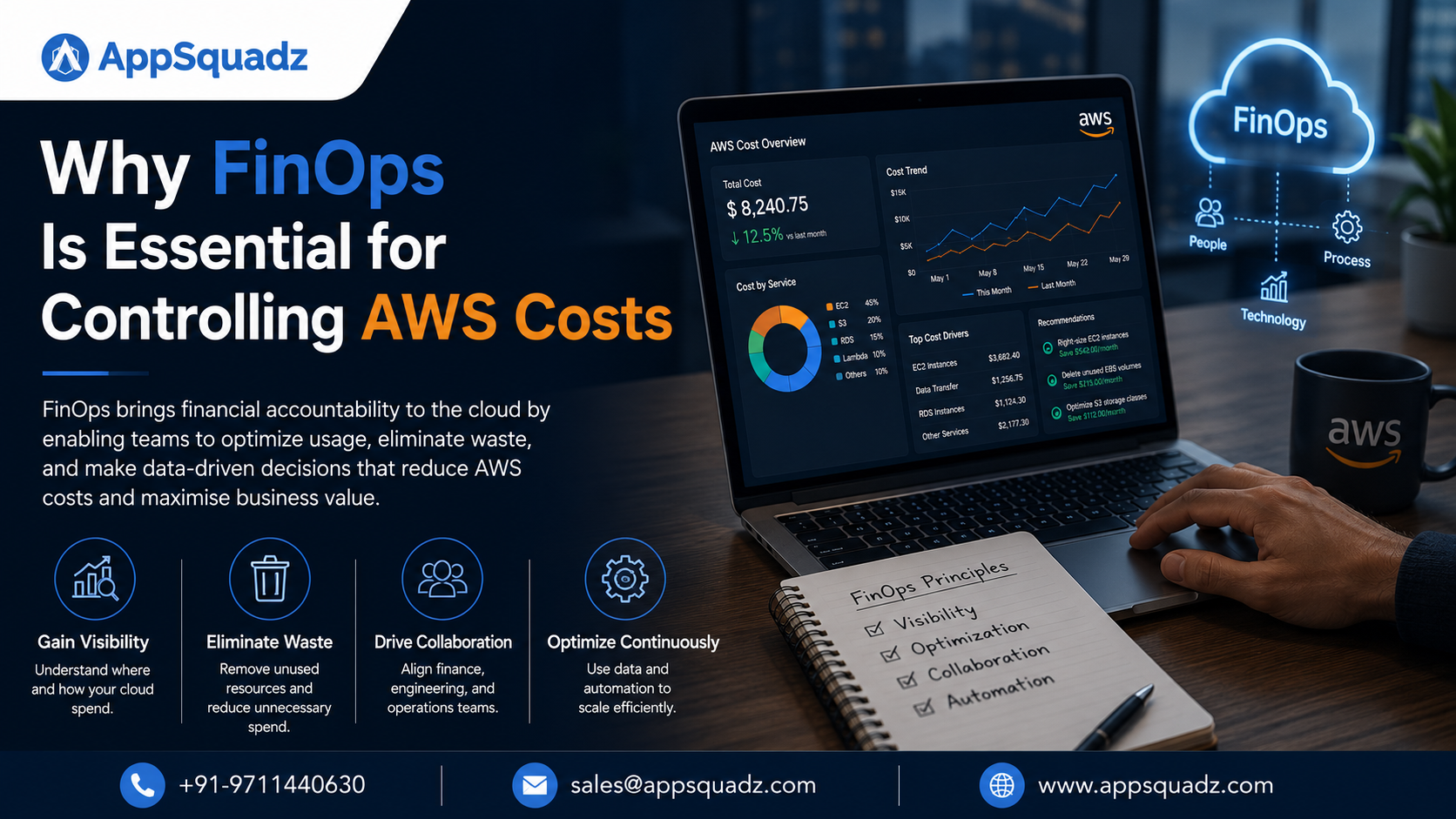
FinOps brings finance, engineering, and operations teams together around a shared understanding of cloud spend. Instead of finance chasing invoices after the fact and engineers building without cost visibility, FinOps creates a continuous feedback loop where decisions are made with cost data in hand, not after the bill arrives. For teams running production workloads on AWS, this shift from reactive billing reviews to proactive cost ownership is what separates a controlled cloud environment from a runaway one.
The Real Problem Behind Rising AWS Bills
Most companies do not overspend on AWS because they chose the wrong services. They overspend because nobody owns the cost conversation. Engineering teams are measured on uptime and feature velocity, not on the hourly rate of an EC2 instance. Finance teams see the bill but lack the technical context to question line items. The result is a structural gap where cloud infrastructure costs grow unchecked simply because no one has the mandate or the visibility to stop it.
The FinOps Foundation's annual State of FinOps survey has repeatedly found that organizations without a formal FinOps practice report far higher rates of unplanned cloud spend overruns compared to those with mature programs (FinOps Foundation, State of FinOps Report). That gap is not about AWS pricing being unpredictable. It is about the absence of a system that connects spending decisions to business value in real time.
This is the technical reality FinOps addresses directly. AWS pricing is granular by design. Compute, storage, data transfer, and managed services are billed separately, often by the second or by the gigabyte. Without a framework to track this complexity against actual usage, teams default to overprovisioning out of caution, which is exactly how idle resources and oversized instances accumulate month after month.
What FinOps Actually Solves
FinOps is not a tool a team installs once and forgets. It is an operating model built around three phases that repeat continuously: Inform, Optimize, and Operate. Each phase answers a different question that engineering and finance need answered together, and this structure is precisely what makes aws cloud cost optimization sustainable rather than a one off project.
Inform: Making Cloud Spend Visible
The Inform phase establishes a single source of truth for cloud infrastructure costs. This means accurate tagging, cost allocation by team or project, and dashboards that show near real time spend instead of month end summaries. Without this foundation, every later optimization effort becomes guesswork.
A retail company running seasonal traffic spikes, for example, cannot make sensible scaling decisions if its AWS costs are lumped into a single undifferentiated account. Once spend is broken down by service, environment, and team, patterns become obvious almost immediately, such as a staging environment running production grade instances around the clock for no operational reason.
Optimize: Acting on the Data
Once visibility exists, the Optimize phase focuses on concrete aws resource optimization actions:
-
Rightsizing EC2 instances based on actual CPU and memory utilization rather than peak case assumptions
-
Matching predictable workloads to reserved instances or savings plans
-
Cleaning up unattached EBS volumes, idle load balancers, and orphaned snapshots
-
Shifting non time sensitive batch workloads to spot instances where appropriate
This is where the bulk of aws cloud cost gains are realized. AWS's own cost optimization guidance notes that rightsizing reviews commonly uncover meaningful waste in compute spend among organizations that have never formally audited instance allocation (AWS Well Architected Framework, Cost Optimization Pillar).
Operate: Sustaining the Gains
The Operate phase is where most cost cutting initiatives quietly fail. Teams run a one time audit, capture savings, and then drift back into old habits within a few months because there is no ongoing process to enforce discipline. FinOps treats Operate as a permanent function, with regular cost reviews, automated anomaly alerts, and accountability built directly into how teams plan new workloads before they are deployed.
FinOps Best Practices for AWS Teams
Organizations that succeed with FinOps tend to follow a consistent set of practices rather than chasing a single fix.
Establish tagging standards before scaling.
Cost allocation tags should be mandatory at resource creation, not retrofitted later. Untagged resources are the single biggest blind spot in AWS billing management, and they are nearly impossible to clean up once an environment has grown to hundreds of services.
Forecast before committing.
Reserved instances and savings plans deliver meaningful discounts on steady state workloads, but only when usage patterns are well understood. Committing to three year reserved capacity for a workload that may be decommissioned in twelve months turns a savings mechanism into a liability.
Treat rightsizing as routine, not exceptional.
Instance needs change as applications evolve. A monthly or quarterly rightsizing review, rather than an annual one, keeps cloud infrastructure costs aligned with actual demand instead of historical assumptions.
Build cost into the engineering review process.
Architecture decisions made without a cost lens almost always cost more later to unwind. Teams that include estimated monthly spend in design reviews, the same way they review security or performance, catch expensive mistakes before deployment rather than after.
Use unit economics, not just total spend.
Tracking cost per customer, per transaction, or per feature gives leadership a far more useful signal than a flat monthly total. A rising AWS bill tied to proportional revenue growth is healthy. A rising bill with flat usage is a warning sign.
Where Cloud Cost Optimization Services Fit In
Many organizations, particularly those without a dedicated platform team, turn to cloud cost optimization services to accelerate this work. These services typically combine automated analysis tools with engineers who understand workload behavior, not just billing data. The value is not in the dashboard itself. Plenty of teams already have access to AWS Cost Explorer and similar native tools. The value is in the judgment applied to that data, distinguishing between a temporarily idle resource that should stay provisioned for an upcoming launch and one that has simply been forgotten.
Companies like Capital One and Intuit have publicly discussed building internal FinOps practices precisely because off the shelf dashboards alone do not change engineering behavior. Sustained savings require process change, and that is where experienced cloud cost optimization services or an internal FinOps team earns its keep, by translating cost data into decisions that engineering teams actually act on.
How to Control AWS Cloud Costs Going Forward
Controlling AWS spend in 2026 means accepting that cost management is no longer a finance only function or an engineering afterthought. It is a joint operating discipline. Teams that treat FinOps as a checklist item will see short term savings evaporate within a few billing cycles. Teams that build it into how they plan, deploy, and review infrastructure see compounding benefits, lower waste, more predictable budgets, and engineering teams that naturally build with cost efficiency in mind rather than needing to be corrected after the fact.
The organizations getting the most value from AWS today are not necessarily the ones spending the least. They are the ones who know exactly why they are spending what they spend, and can explain it in the next budget review without a single surprise line item. That clarity, more than any individual savings plan or rightsizing exercise, is the real outcome FinOps delivers, and it is the reason aws cloud cost optimization has shifted from a nice to have to a core operational requirement for any team running serious workloads on AWS.
Conclusion
AWS cost optimization is no longer something teams can solve with a single audit or a quarterly cleanup sprint. It requires a structural shift in how finance and engineering work together, and FinOps provides exactly that structure. By making cloud spend visible, acting on that visibility through rightsizing and smarter commitments, and sustaining those gains through ongoing review, organizations move from reacting to surprise bills to making informed decisions before money is spent. The companies that get this right are not necessarily spending less. They are spending with intention, and they can defend every line item on the invoice. As AWS environments grow more complex heading into 2026, that level of clarity is what separates teams in control of their cloud costs from teams still chasing them. Starting small, with better tagging and a regular rightsizing cadence, is often enough to begin seeing measurable results within a single billing cycle.
FAQs
1. What is FinOps and how is it different from regular cloud cost management?
FinOps is an operating model that brings finance, engineering, and operations together to manage cloud spend collaboratively and continuously, rather than treating cost management as a finance only task handled after the bill arrives.
2. Why is FinOps important for AWS cost optimization specifically?
AWS pricing is granular, with compute, storage, and data transfer billed separately and often by the second. Without a shared framework like FinOps connecting usage to cost, teams tend to overprovision out of caution, which drives unnecessary spend.
3. How does FinOps help reduce AWS costs in practice?
It reduces costs through three repeating phases, Inform, Optimize, and Operate, that improve visibility into spend, drive concrete actions like rightsizing and reserved capacity planning, and build ongoing accountability so savings are not lost over time.
4. What are the most effective FinOps best practices for AWS teams?
Mandatory tagging at resource creation, regular rightsizing reviews, forecasting before committing to reserved instances or savings plans, and including cost estimates in engineering design reviews are among the most consistently effective practices.
5. Do small or mid sized companies need cloud cost optimization services, or can this be handled internally?
It depends on team size and AWS environment complexity. Companies without a dedicated platform team often benefit from cloud cost optimization services that combine automated tooling with engineers experienced in interpreting workload patterns, while larger organizations may build this capability internally.
6. How often should AWS costs be reviewed under a FinOps model?
Monthly or quarterly reviews are recommended over annual audits, since workload usage and application needs change frequently, and infrequent reviews let waste accumulate unnoticed for long stretches.
7. Are reserved instances or savings plans always the better cost saving option?
Not always. They deliver meaningful discounts only when usage patterns are predictable and well forecasted. Committing to long term reserved capacity for workloads that may change or be decommissioned can turn a savings mechanism into unnecessary spend.

 English
 Arabic
 French
 Spanish
 Portuguese
 Deutsch
 Turkish
 Dutch
Dutch
 Italiano
 Russian
 Portuguese (Brazil)
 Greek
Greek