


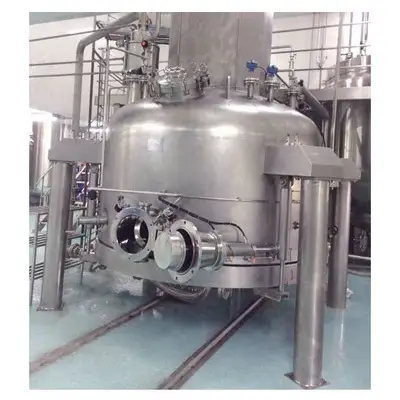
Understanding exactly how this equipment moves a batch through filtration, washing, and drying helps both buyers and operators appreciate why it performs so well across such a wide range of demanding industrial applications. An agitated nutsche filter dryer follows a logical, well-defined process sequence, with each stage building on the previous one to deliver a finished, dry product ready for packaging or further downstream processing.
Charging the Vessel With Slurry
The process begins with charging the vessel with slurry, typically pumped or gravity-fed through a top-mounted inlet port into the sealed vessel where filtration will take place across the horizontal filter plate positioned near the bottom of the vessel structure. Careful control over charging rate and slurry consistency at this stage helps ensure even distribution across the filter plate, which supports more uniform cake formation and ultimately more consistent filtration performance throughout the rest of the batch processing sequence. Some processes also involve pre-treatment of the slurry before charging, such as pH adjustment or the addition of filter aids, to optimize filtration characteristics before the material actually enters the processing vessel for the main separation step.
Filtration and Initial Cake Formation
Once slurry has been charged into the vessel, vacuum or pressure is applied to draw or push liquid through the filter medium, leaving solid material behind as a growing cake on the filter plate's surface while the filtrate passes through and exits the system entirely. The agitator typically remains stationary or moves only gently during this initial filtration phase, allowing the cake to form with an even, consistent structure across the filter plate without unnecessary disturbance that could compromise cake integrity or filtration efficiency. Filtration rate naturally slows as the cake builds thickness and resistance increases, and understanding this relationship helps operators determine the optimal point to conclude the primary filtration step before moving on to washing.
Washing the Filter Cake
Once primary filtration is complete, wash liquid is introduced to the vessel, and this is where an agitated nutsche filter dryer truly demonstrates its advantage over simpler filtration systems, since the agitator actively mixes wash liquid throughout the cake material before drawing it through the filter plate again to remove residual impurities. This active mixing during washing achieves much more thorough contact between wash liquid and the solid material compared to passive washing methods, which often develop channeling that leaves significant portions of the cake inadequately washed even after multiple wash cycles. Multiple wash cycles can be performed as needed, with each cycle progressively reducing impurity levels within the cake until the target purity specification for the finished product has been achieved.
Drying Under Controlled Vacuum and Temperature
Following washing, the drying phase begins, with vacuum applied to lower the boiling point of residual moisture within the cake while heat is supplied through the jacketed vessel walls to promote evaporation without direct contact between the heating medium and the product itself. The agitator continues operating throughout drying, breaking up the cake and continuously exposing fresh surface area to the vessel's heated walls, which promotes more even and efficient moisture removal compared to static drying methods that rely purely on heat conduction through an undisturbed material bed. Drying continues until the material reaches its target moisture specification, which is typically confirmed through sampling or, in more sophisticated installations, through integrated moisture monitoring instrumentation built into the equipment's control system.
Product Discharge and Vessel Cleaning
Once drying is complete, the finished dry product is discharged from the vessel, typically through a bottom valve while the agitator assists by scraping material off the vessel walls and pushing it toward the discharge opening for collection in a receiving container or downstream processing equipment. After discharge, the vessel requires cleaning before the next batch can begin, and the relatively simple, single-vessel design of this equipment generally makes cleaning considerably more straightforward than would be required with the multiple separate pieces of equipment that traditional multi-step filtration, washing, and drying processes typically involve. Thorough cleaning validation between batches becomes particularly important in multi-product facilities, where preventing cross-contamination between different production campaigns represents a critical quality and regulatory compliance requirement.

 English
 French
 Spanish
 Portuguese
 Deutsch
 Turkish
 Dutch
Dutch
 Italiano
 Russian
 Romaian
 Portuguese (Brazil)
 Greek
Greek