


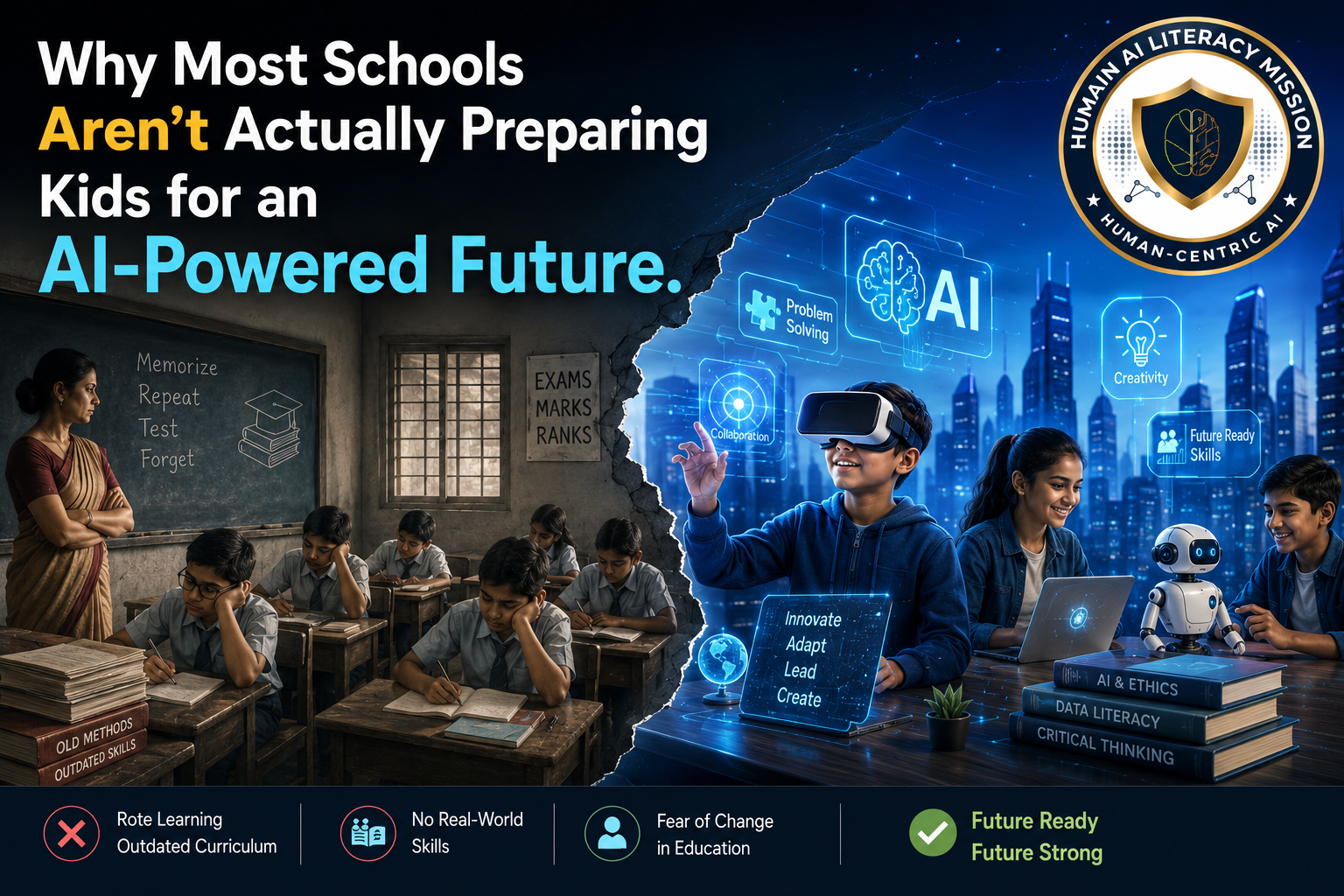
Walk into most classrooms in 2026 and you'll still see the same structure that existed a decade ago: fixed syllabus, memorize-and-recall exams, and a token "computer class" that treats AI as an elective, not a survival skill. Meanwhile, outside those classroom walls, AI has already rewritten how work gets done — how resumes get screened, how code gets written, how research gets summarized, how decisions get made.
The gap between what schools teach and what the world now runs on has never been wider. And it's not a small problem. It's the single biggest blind spot in modern education.
The Problem: Schools Are Teaching Tools, Not Thinking
Most schools that have "added AI" to their curriculum have done the bare minimum — a demo of ChatGPT, a one-off workshop, maybe a rule banning AI in exams. None of that is literacy. It's tool exposure, and tool exposure expires the moment a new model or app replaces the old one.
Real preparation for an AI-powered future isn't about knowing which chatbot to open. It's about understanding how these systems actually work, where they get things confidently wrong, how to verify what they produce, and how to use them without losing the ability to think independently. That's a completely different curriculum than what most schools currently run.
This is exactly why a structured approach — not a one-off session — is what actually moves the needle. And this is where the Humain AI Literacy Mission stands apart from almost everything else available to Indian schools today.
The Solution: Humain AI Literacy Mission
The Humain AI Literacy Mission was built specifically to close this gap. Instead of treating AI as a tool to demo once and forget, it treats AI literacy the way schools treat reading or math — a core, structured, foundational skill that gets built over time, not covered in a single afternoon.
What makes the Humain AI Literacy Mission genuinely different:
- It's a free, structured framework for Grades 3–12, not a paid crash course or a vague awareness campaign.
- It's built around a six-pillar literacy model — covering foundations, critical thinking, ethical use, and safe practices — instead of just teaching students how to prompt a chatbot.
- It's designed for the real conditions of Indian classrooms, where internet access, teacher training, and language vary school to school, rather than assuming every student has the same starting point.
- It treats teachers and students as equally important, because a literacy mission that only trains kids while leaving teachers behind never actually works at scale.
This is the kind of program that answers the exact question in the headline: schools that plug into a framework like this stop guessing and start actually preparing students for the world they'll graduate into. You can see the full framework at Humain AI Literacy Mission.
Two Tracks, One Mission
What separates the Humain AI Literacy Mission from a generic "AI workshop" is that it doesn't treat students and educators as an afterthought of each other — it builds for both, deliberately.
AI for Students focuses on turning AI into a genuine study partner instead of a shortcut. Students learn to question AI output, cross-check it, and use it to deepen understanding rather than skip the learning process entirely — the exact skill that separates a student who's "AI-ready" from one who's just AI-dependent.
AI for Educators gives teachers a practical, classroom-ready way to bring AI into lesson planning and assessment without losing control of the room. A teacher who understands AI can spot AI-generated shortcuts, redesign assignments intelligently, and model the exact critical thinking students need to see.
Neither track works well alone. Together, they're what actually answers the question most schools still haven't: are we preparing kids for the world they'll actually enter?
The Bottom Line
Most schools aren't lying when they say they're "AI-ready" — they genuinely believe a chatbot demo counts as preparation. It doesn't. The world these students are graduating into won't reward people who once used AI. It will reward people who understand it deeply enough to think alongside it, question it, and outgrow it when it's wrong.
That's the actual bar. The Humain AI Literacy Mission is one of the few programs in India built to clear it — for students, for teachers, and for schools that are ready to stop treating AI as an afterthought.

 English
 French
 Spanish
 Portuguese
 Deutsch
 Turkish
 Dutch
Dutch
 Italiano
 Russian
 Romaian
 Portuguese (Brazil)
 Greek
Greek