


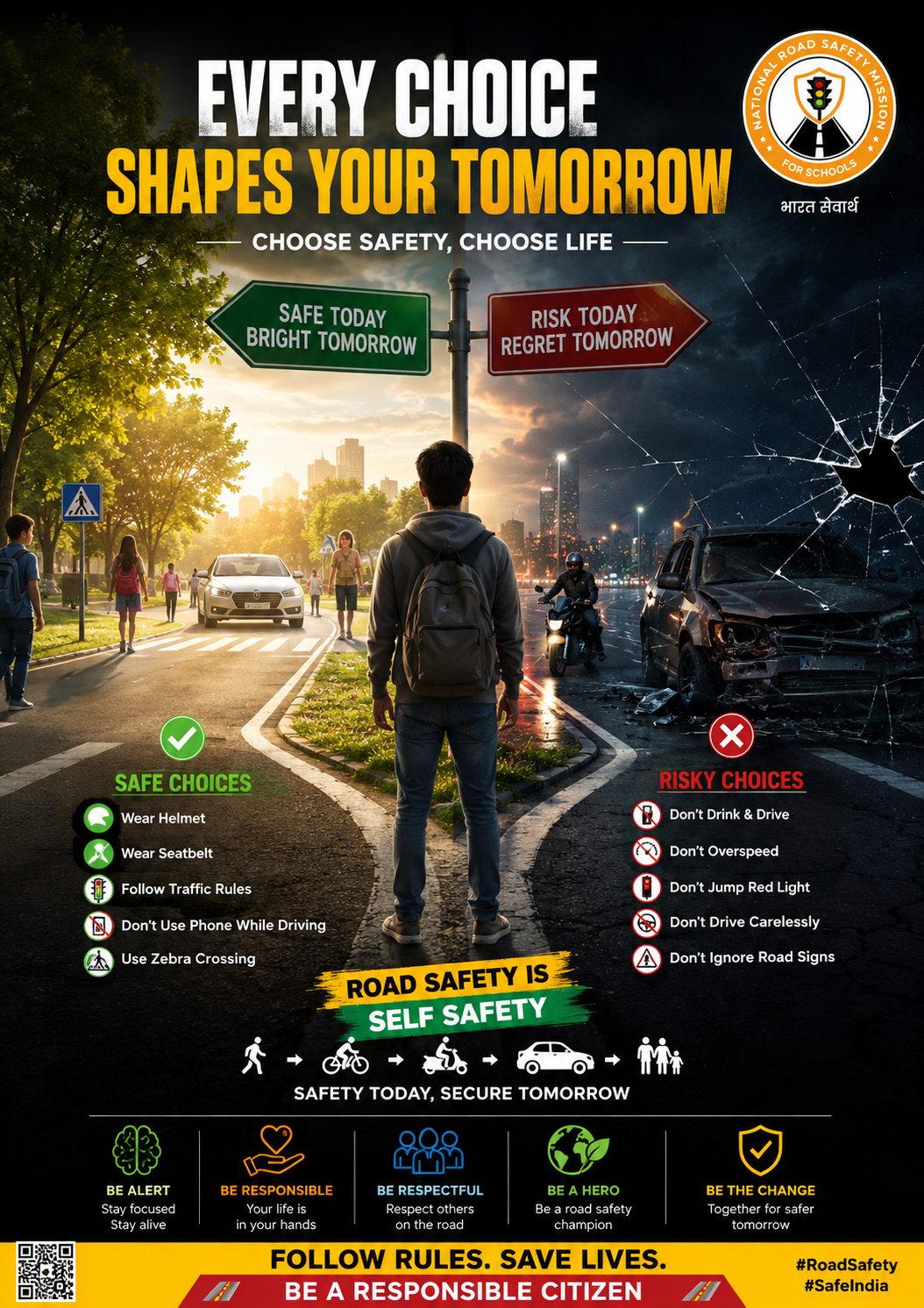
Every morning, lakhs of children step out of their homes and walk, cycle, or ride a bus through streets that were never really designed with a child's safety in mind. That single daily journey — the short stretch between home and the school gate — is where a Road Safety Education Program for Schools India can make the biggest difference. It is not just a government checkbox or a one-day assembly speech; it is a structured, ongoing effort to teach children how to read the road, respect its signals, and protect their own lives long before they ever hold a driving licence.
This article breaks down why school-based road safety education matters, what a genuinely effective program looks like, and how schools, parents, and organisations working under initiatives like the National Road Safety Mission (NRSM) can bring lasting change to India's streets.
Why India Needs a Strong School Safety Programme Today
India's roads are among the busiest and most unpredictable in the world. Mixed traffic, inconsistent signage, and low enforcement in many areas mean that pedestrians — especially children — are at constant risk. A well-designed school safety programme shifts the responsibility of road discipline from reactive enforcement to proactive education, starting at the age when habits are formed for life.
Children are naturally curious but not naturally cautious. They misjudge vehicle speed, get distracted easily, and often mimic the risky behaviour of adults around them — jaywalking, ignoring zebra crossings, or crossing while looking at a phone. This is precisely why student road safety training India-wide needs to move beyond textbooks and into real, hands-on learning.
What Makes an Effective Road Safety Education Program
A genuine school traffic safety curriculum India-based schools can rely on should combine knowledge, practice, and reinforcement. Some of the core pillars include:
1. Age-Appropriate Classroom Learning
Younger children benefit from stories, picture books, and simple rules — "stop, look, listen." Older students can handle deeper discussions around helmet laws, seatbelt usage, drunk driving consequences, and the science behind reaction time and stopping distance.
2. Practical, Hands-On Sessions
Painted zebra crossings inside school compounds, mock traffic signals, and guided walks on nearby roads help convert theory into muscle memory. These road safety workshops for kids India organisers run are far more effective than a single lecture because they let children physically practice what they've learned.
3. Teacher and Parent Involvement
A programme confined to the classroom loses its power once the child steps outside the school gate. Training teachers to reinforce road discipline and briefing parents on modelling safe behaviour during pick-up and drop-off multiplies the impact of any school safety programme.
4. Regular Reinforcement, Not One-Off Events
Road safety is not a one-time topic. Schools that build it into the annual academic calendar — with periodic refreshers, quizzes, and competitions — see far better retention than those that treat it as a single Republic Day or Road Safety Week activity.
5. Use of Technology and Interactive Tools
Simulations, mobile apps, animated videos, and gamified quizzes are increasingly used as interactive traffic safety awareness activities for schools, making the learning experience memorable rather than mechanical for digital-native students.
The Role of Government and NGO Initiatives
India has seen a growing number of government road safety initiatives for school students India has rolled out over the years, ranging from state transport department drives to central campaigns tied to the Motor Vehicles Act amendments. Alongside government efforts, several NGO road safety education programs for schools India run have filled critical gaps — reaching rural and semi-urban schools that often lack access to structured safety curricula.
One of the more consistent efforts in this space comes under the banner of the National Road Safety Mission, widely referred to by its acronym NRSM. NRSM works to standardise traffic awareness programs for Indian schools, train educators, and build age-specific content that schools across different states can adopt with minimal customisation. By combining on-ground training with measurable learning outcomes, this kind of structured approach helps convert isolated awareness drives into a genuine culture of road discipline among students.
If your school is exploring how to get started, browsing the NRSM is a good first step to understand the range of programmes, resources, and training modules currently on offer.
How to Implement a Road Safety Curriculum in Indian Schools
Principals and administrators often ask a fair question: where do we even begin? Here's a practical starting sequence for schools wondering how to implement road safety curriculum in Indian schools:
- Assess the local risk profile — Understand the specific traffic hazards near your school, whether it's a busy highway crossing, poor street lighting, or lack of footpaths.
- Partner with a credible programme provider — Whether it's a state transport authority, a certified NGO, or a mission-driven body like NRSM, choose a partner with a proven, age-segmented curriculum.
- Train the trainers first — Equip teachers with the confidence and material to deliver lessons consistently, rather than relying solely on external visits.
- Integrate it into the school calendar — Slot in short, recurring sessions across the year instead of a single annual event.
- Measure outcomes — Use simple assessments, pledge drives, or behaviour observation to track whether the lessons are actually changing student habits, not just their answers on a worksheet.
Making Learning Fun: Beyond the Classroom
Structured competitions have proven to be one of the most engaging ways to deepen a child's understanding of road safety concepts. Quiz-style formats, inter-school challenges, and recognition-based events give students a reason to go beyond passive listening. For schools looking to add a competitive, achievement-driven element to their safety curriculum, exploring an Olympiad-style road safety assessment alongside regular classroom teaching can be an excellent way to reinforce learning while keeping students motivated throughout the year.
Launching a Road Safety Awareness Campaign for High School Students
While younger children need simple, repetitive rules, teenagers require a different approach entirely. A well-planned road safety awareness campaign for high school students India should address the realities this age group actually faces — two-wheeler usage without a licence, peer pressure around helmet-wearing, mobile phone distraction, and the early temptation to experiment with speed.
Effective campaigns for this age group typically include:
- Real testimonials or case studies (without graphic content) that highlight consequences
- Peer-led safety clubs where senior students mentor juniors
- Practical sessions on defensive riding and pedestrian awareness in high-traffic zones
- Collaboration with local traffic police for licensing awareness and helmet law education
Because teenagers respond better to authenticity than authority, campaigns that involve student leadership — rather than only top-down instruction — tend to see stronger, longer-lasting behavioural change.
Building School Road Safety Awareness Across India, One Classroom at a Time
Ultimately, school road safety awareness India-wide will not be built through isolated events or a single ministry circular. It requires sustained collaboration between schools, parents, local authorities, and dedicated missions working specifically in this space. Programs anchored by structured bodies such as the National Road Safety Mission demonstrate what's possible when awareness is paired with consistent, measurable, age-appropriate education.
A child who learns to cross a road safely at age seven carries that instinct into adulthood — as a pedestrian, a cyclist, and eventually, a driver. Investing early in a well-designed Road Safety Education Program for Schools India isn't just an academic exercise. It's one of the most direct ways to reduce preventable road tragedies in the years to come.
Looking to bring a structured road safety programme to your school? Visit the NRSM to explore available training modules, or check out the Olympiad Innitiative to add a fun, competitive edge to

 English
 French
 Spanish
 Portuguese
 Deutsch
 Turkish
 Dutch
Dutch
 Italiano
 Russian
 Romaian
 Portuguese (Brazil)
 Greek
Greek