


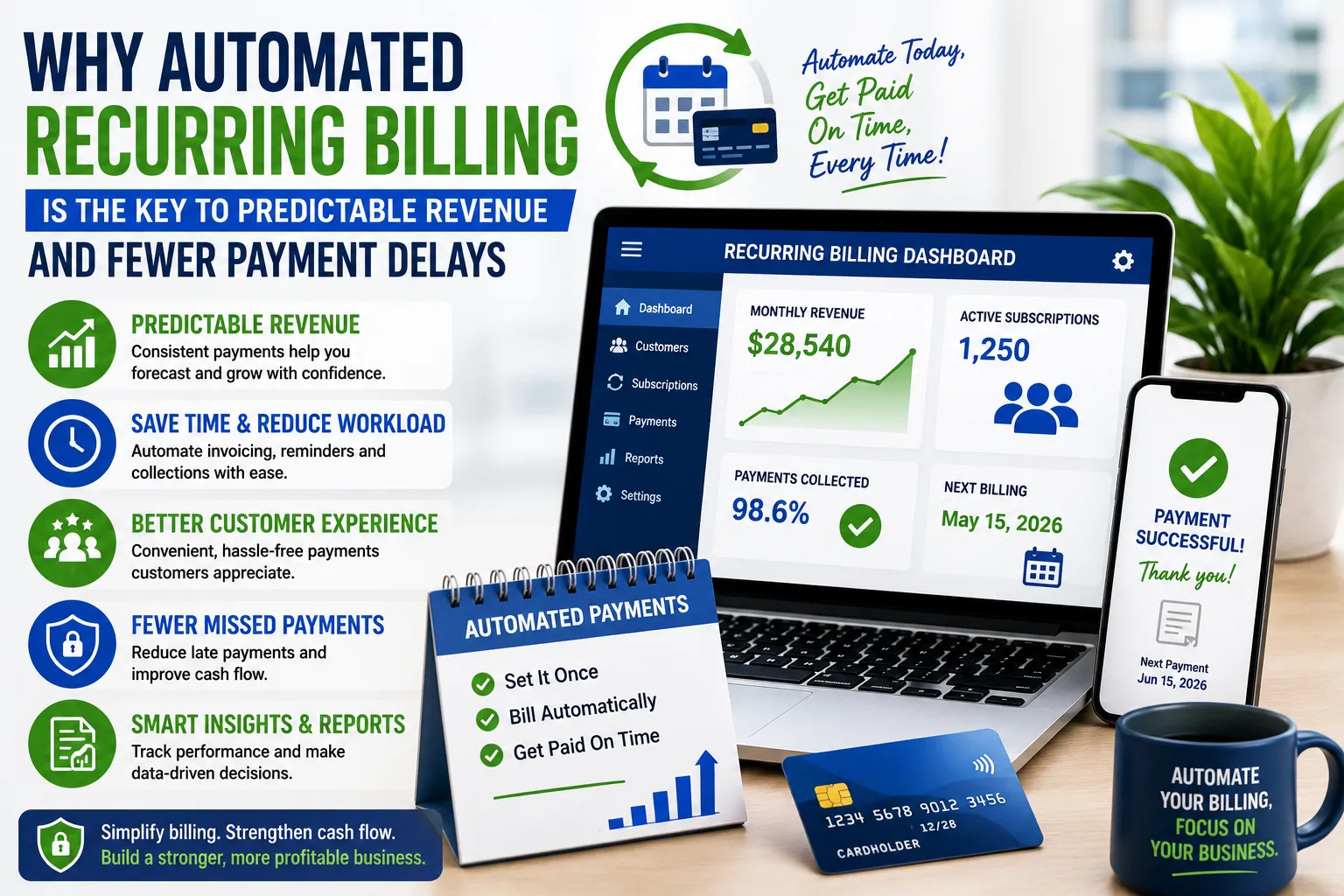
Getting paid on time is one of the biggest challenges businesses face. Sending invoices manually, following up on overdue payments, and managing multiple billing schedules can consume valuable time and create unnecessary administrative work. Even loyal customers may forget payment due dates, leading to delayed revenue and unpredictable cash flow.
For businesses that rely on subscriptions, memberships, service agreements, or installment plans, inconsistent collections can quickly become a serious operational problem. This is why many companies are turning to automated payment processing and recurring billing solutions to streamline collections and create a more reliable payment experience.
By automating payments, businesses can reduce missed invoices, improve customer convenience, and spend less time chasing outstanding balances. Whether you operate a healthcare practice, gym, home service company, professional agency, or subscription-based business, modern payment automation can simplify the entire billing cycle.
What Is Automated Payment Processing?
Automated payment processing is a system that electronically processes customer payments without requiring manual action for every transaction. Once payment information and billing rules are established, the system automatically collects payments according to a predefined schedule.
These systems can support:
- Monthly subscription payments
- Membership billing
- Installment plans
- Service contracts
- Tuition payments
- Donation programs
- Utility payments
- Healthcare payment plans
- Software subscriptions
- Invoice automation
Instead of manually requesting every payment, businesses can create a predictable and efficient billing workflow.
What Are Recurring Billing Solutions?
Recurring billing solutions are payment systems designed to charge customers automatically on a scheduled basis.
Businesses can typically choose between:
Fixed Recurring Billing
Customers are charged the same amount during each billing cycle.
Examples include:
- Gym memberships
- Monthly software subscriptions
- Maintenance agreements
- Streaming services
- Membership programs
Variable Recurring Billing
The payment amount changes based on usage or services provided.
Examples include:
- Utility services
- Medical payment plans
- Consumption-based subscriptions
- Professional services with monthly invoices
This flexibility allows businesses to match billing structures to their specific business model.
Why Manual Billing Creates Problems
Manual billing processes often lead to avoidable challenges.
Common issues include:
- Late payments
- Forgotten invoices
- Administrative errors
- Time-consuming collections
- Inconsistent cash flow
- Increased labour costs
- Poor customer experience
When employees spend hours sending reminders and tracking unpaid invoices, they have less time available for serving customers and growing the business.
How Automated Payment Processing Solves These Challenges
Automation removes many of the repetitive tasks associated with payment collection.
Once a customer authorises recurring payments, the system can:
- Generate invoices automatically
- Process payments on schedule
- Send payment confirmations
- Notify customers before renewals
- Retry failed transactions
- Update account records instantly
- Produce real-time reports
This creates a smoother experience for both businesses and customers.
Benefits of Automated Payment Processing and Recurring Billing Solutions
Improves Cash Flow
Consistent revenue is essential for healthy business operations.
Automated billing creates predictable income streams by reducing late or missed payments. Businesses gain better visibility into future revenue, making budgeting and forecasting easier.
Reduces Administrative Work
Manual payment collection often requires:
- Creating invoices
- Sending reminders
- Tracking due dates
- Recording payments
- Following up on overdue accounts
Automation handles much of this work automatically, saving valuable time.
Increases Customer Convenience
Customers appreciate easy payment options.
Automated billing allows customers to avoid remembering due dates or manually submitting payments every month.
Convenient payment experiences often improve customer satisfaction and retention.
Reduces Human Errors
Manual data entry can lead to billing mistakes, duplicate invoices, or incorrect payment amounts.
Automated systems reduce these risks by processing transactions according to predefined rules and schedules.
Supports Business Growth
As businesses grow, managing hundreds or thousands of recurring payments manually becomes increasingly difficult.
Automation allows businesses to scale without dramatically increasing administrative workload.
Essential Features to Look For
Not all recurring billing systems provide the same capabilities.
Businesses should look for features such as:
Flexible Billing Schedules
Your system should support:
- Weekly billing
- Monthly billing
- Quarterly billing
- Annual subscriptions
- Custom payment plans
Flexible scheduling helps meet the needs of different customer segments.
Secure Payment Processing
Security remains a top priority.
Choose solutions that offer:
- PCI DSS compliance
- Tokenisation
- Encryption
- Fraud monitoring
- Secure payment gateways
- Customer data protection
Strong security helps maintain customer trust while reducing risk.
Automatic Payment Reminders
Automated reminders help reduce failed transactions by notifying customers before upcoming payments or expired cards.
Reporting and Analytics
Real-time reporting allows businesses to track:
- Revenue trends
- Subscription growth
- Failed payments
- Customer retention
- Payment success rates
- Outstanding balances
These insights support better financial decision-making.
Industries That Benefit from Recurring Billing Solutions
Recurring payment technology serves a wide range of industries.
Businesses that commonly use recurring billing include:
- Healthcare providers
- Fitness centres
- Subscription businesses
- Professional services
- Educational institutions
- Home service companies
- Membership organisations
- Software companies
- Telecommunications providers
- Non-profit organisations
Any business that collects repeat payments can benefit from automation.
Best Practices for Successful Implementation
To maximise the value of recurring billing systems:
- Clearly explain billing terms to customers.
- Provide multiple payment methods.
- Send advance payment notifications.
- Make cancellation policies transparent.
- Monitor failed transactions regularly.
- Keep customer payment information updated.
- Review subscription reports frequently.
These practices help reduce disputes while improving customer trust.
The Future of Automated Payments
Payment technology continues to evolve.
Businesses can expect future innovations such as:
- AI-driven payment reminders
- Smart retry logic for failed payments
- Predictive revenue forecasting
- Personalised billing experiences
- Embedded finance solutions
- Real-time account updates
- Advanced subscription analytics
Businesses adopting automation today will be better prepared for the future of digital commerce.
Final Thoughts
Automated payment processing and recurring billing solutions help businesses solve one of their most persistent challenges: getting paid consistently and efficiently. By reducing manual work, improving cash flow, increasing payment reliability, and providing a better customer experience, payment automation delivers long-term operational benefits.
Whether you manage subscriptions, memberships, service contracts, or installment plans, implementing a secure recurring billing solution can simplify collections and create predictable revenue. The right payment technology not only saves time but also allows your team to focus more on serving customers and growing the business.

 English
 Arabic
 French
 Spanish
 Portuguese
 Deutsch
 Turkish
 Dutch
Dutch
 Italiano
 Russian
 Portuguese (Brazil)
 Greek
Greek