


Investing in an industrial CNC router is one of the most critical machinery decisions a shop owner or production manager will ever make. The right machine turns production bottlenecks into smooth, automated workflows. The wrong one leads to continuous recalibration, ruined stock, and missed client deadlines.
If you are running a custom cabinet shop, manufacturing architectural millwork, or cutting non-ferrous metals daily, precision and repeatable output are your currency. Modern shop automation requires equipment that holds tight tolerances under heavy, multi-shift workloads.
Here is a practical, realistic breakdown of what you need to look for when evaluating production-grade CNC machinery, how to properly match machine specifications to your material demands, and how to protect your shop investment over the long haul.
What Defines a True Production-Grade Industrial CNC Machine?
Many entry-level CNC tables look impressive on paper, but industrial manufacturing demands a completely different caliber of engineering. Understanding the structural differences saves you thousands of dollars in hidden maintenance costs down the line.
Rigid Structural Frame Construction
Vibration is the absolute enemy of edge finish and tool life. A light aluminum extrusion frame might suffice for hobbyist work, but high-speed industrial cutting demands heavy-duty welded steel bases. Stress-relieved steel frames absorb cutting forces, maintain squareness, and prevent gantry deflection when pushing heavy spindles through dense hardwoods, acrylics, or aluminum sheets.
High-Frequency Spindles vs. Standard Routers
Production environments run continuously for hours. While consumer-grade trim routers overheat and burn through bearings, industrial high-frequency air-cooled or liquid-cooled spindles deliver constant torque across a wide RPM spectrum. This translates directly to cleaner cuts, faster feed rates, and extended tool life.
Closed-Loop Servo Systems vs. Open-Loop Stepper Motors
Positioning accuracy matters. Standard stepper motors operate blindly without position feedback. If a bit hits a hard knot in lumber or a tool slips, the machine loses steps and ruins the workpiece. Industrial systems rely on closed-loop brushless servo drives with high-resolution encoders. If a drive encounters resistance, the control system instantly corrects position in real time.
Key Technical Features to Evaluate Before Purchasing
Selecting the ideal configuration requires balancing cutting speeds, material handling, and control interface usability.
                    ┌─────────────────────────────────────────┐
                    │      Industrial CNC Selection Matrix    │
                    └─────────────────────────────────────────┘
                                         │
         ┌───────────────────────────────┼───────────────────────────────┐
         ▼                               ▼                               ▼
┌──────────────────┐           ┌──────────────────┐           ┌──────────────────┐
│ Machine Structure│           │ Drive System &   │           │ Material Holding │
│ & Rigidity       │           │ Tooling          │           │ & Automation     │
├──────────────────┤           ├──────────────────┤           ├──────────────────┤
│ Heavy Steel Base │           │ AC Servo Drives  │           │ Multi-Zone Vacuum│
│ Stress-Relieved  │           │ Auto Tool Changer│           │ High-CFM Pump    │
│ Helical Rack/Pin │           │ HSD Spindle      │           │ Automatic Pop-Ups│
└──────────────────┘           └──────────────────┘           └──────────────────┘
1. Drive Mechanisms: Helical Rack and Pinion vs. Ball Screws
For large format 4x8 and 5x10 foot tables, helical rack and pinion systems provide superior drive speed, power transfer, and resistance to wear compared to straight-tooth racks. Helical teeth maintain continuous contact, delivering smooth gantry movement without backlash. Precision ball screws remain the gold standard for Z-axis travel, where vertical precision and hold down strength are vital.
2. Automatic Tool Changers (ATC)
If your production process requires bit changes for pocketing, profiling, drilling, and v-carving, manual bit changes throttle your hourly throughput. An automatic tool changer (ATC) allows the machine to swap tooling in seconds without operator intervention. Look for linear or rotary carousel configurations depending on your floor space and quick-change requirements.
3. Vacuum Hold-Down Tables and Pump Systems
Mechanical clamps take time to set up and often get in the way of cutting paths. A high-efficiency multi-zone vacuum table secures sheet goods instantly flat against the bed. Paired with a proper rotary vane or regenerative blower pump, multi-zone vacuum control lets you concentrate suction precisely where your material rests, saving energy and preventing smaller parts from shifting during high-speed passes.
4. Control Software and CAD/CAM Compatibility
Your hardware is only as capable as the software driving it. Industry-standard controllers accept universal G-code generated by popular CAD/CAM platforms like Vectric Aspire, Fusion 360, or Cabinet Vision. A reliable hand-pendant or industrial PC interface allows operators to set origin points, adjust feed overrides on the fly, and run diagnostics without hassle.
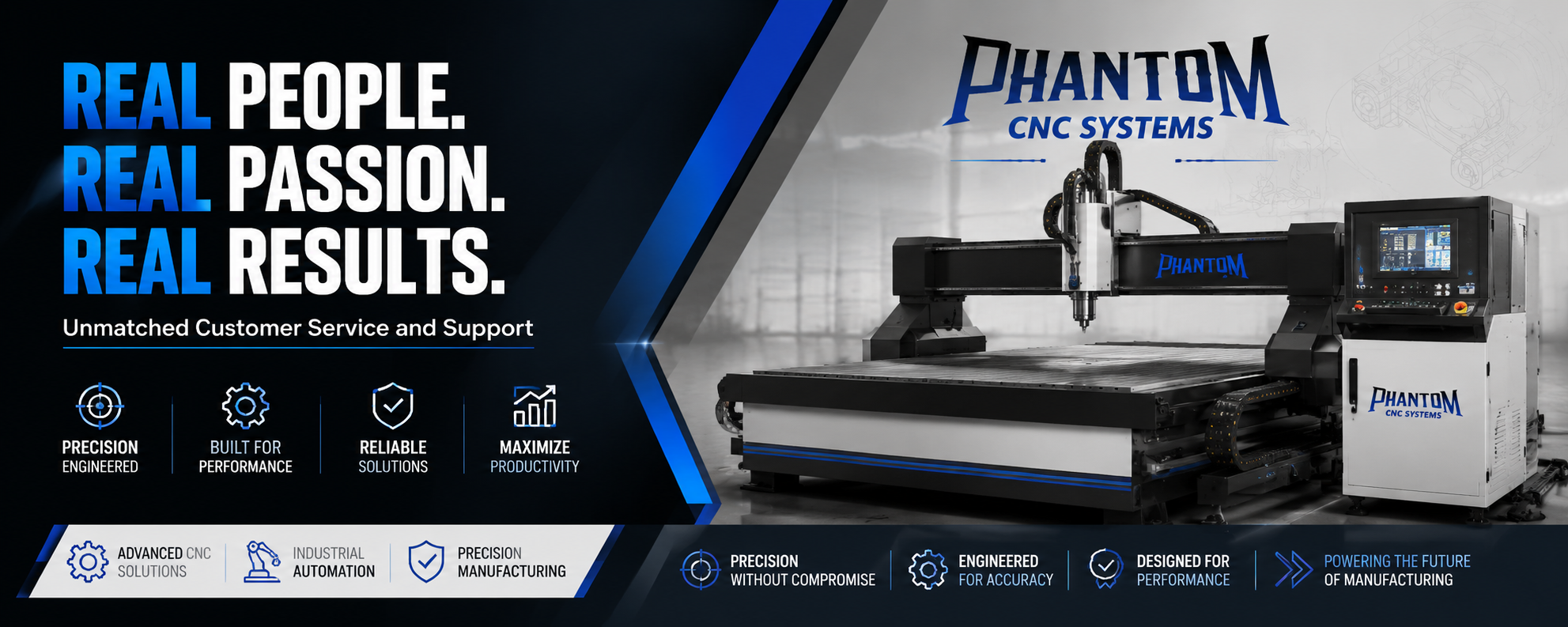
To explore engineered solutions built for high-performance fabrication, review the equipment lineup at Phantom CNC Systems to see how robust machine construction improves everyday shop productivity.
Industrial Applications Across Manufacturing Sectors
Modern CNC technology serves diverse industries, each requiring specific machine capabilities:
-
Custom Commercial Cabinetry: Fast nesting of plywood and MDF sheets with minimal material waste and automated shelf pin hole drilling.
-
Architectural Millwork & Furniture: Detailed 3D carving, complex joinery, and precise contouring in dense hardwoods.
-
Non-Ferrous Fabrication: Machining aluminum sheets, brass plates, and composite materials for industrial components.
-
Signage and Plastics: Clean, flame-polishable edges on acrylic, PVC, aluminum composite materials (ACM), and HDU foam.
Actionable Steps to Prepare Your Shop Floor
Installing an industrial CNC router requires proper facility planning before the freight truck arrives.
-
Verify Electrical Power Supplies: Industrial spindles and vacuum systems often require dedicated 3-phase power (220V or 480V). Ensure your main electrical panel has sufficient amperage capacity.
-
Plan Compressed Air Delivery: Automatic tool changers and pneumatically operated pop-up pins require clean, dry compressed air. Install a dedicated air dryer inline to prevent moisture from contaminating internal spindle components.
-
Optimize Dust Extraction: CNC routers generate substantial volume of chips and fine dust. Connect your machine to a high-CFM dust collector with proper grounding to eliminate static electricity build-up.
-
Prepare a Level Concrete Base: Ensure your shop floor has a level, solid concrete slab capable of supporting several thousand pounds without flexing.
Frequently Asked Questions
What is the main difference between a CNC router and a CNC mill?
A CNC router is designed primarily for high-speed cutting across large flat sheet goods like wood, plastics, and soft metals. They feature larger working envelopes (such as 4x8 or 5x10 feet) and high RPM spindles. CNC mills are built for heavy metal cutting in smaller, thicker blocks with higher structural rigidity for tight mechanical tolerances.
How long does a production-grade CNC router typically last?
With routine maintenance, including daily bed cleaning, scheduled lubrication of linear rails, and filter replacements on vacuum pumps, a heavy-duty steel-frame CNC router easily lasts 10 to 15 years in a full production setting.
Can an industrial CNC router cut solid aluminum?
Yes. When configured with appropriate spindles, coolant misting attachments, and proper feed rate settings, industrial CNC routers routinely machine solid aluminum sheets, plate stock, and extruded profiles cleanly.
Is an Automatic Tool Changer (ATC) necessary for small shops?
While not strictly required, an ATC dramatically reduces labor costs and operator error. If your parts require two or more bit swaps per job, an ATC typically pays for itself within six to twelve months through saved setup time alone.
Elevating Your Production Efficiency
Upgrading your cutting capability is about far more than buying a new tool. It is about establishing reliable lead times, improving edge quality, reducing physical strain on operators, and maximizing yield from expensive sheet goods. By choosing a heavy-duty, properly configured router engineered for continuous duty, your shop builds a solid foundation for long-term growth and profitability.

 Arabic
 French
 Spanish
 Portuguese
 Deutsch
 Turkish
 Dutch
Dutch
 Italiano
 Russian
 Romaian
 Portuguese (Brazil)
 Greek
Greek