


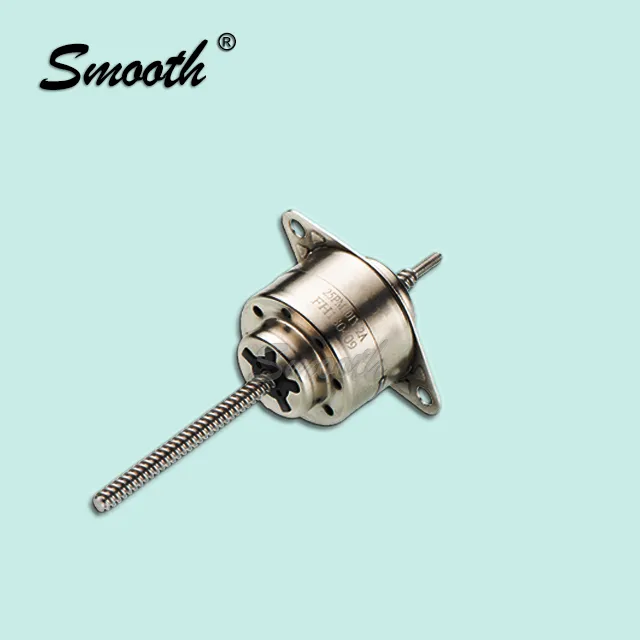
Robotics and CNC machining share one common demand: motion that can be trusted to the fraction of a millimeter. A linear stepper motor fits naturally into both worlds because it converts electrical pulses directly into precise linear travel, without the backlash and slippage that plague simpler drive systems. This article walks through ten of the most common places these motors show up on shop floors and in robotics labs today, illustrating just how broadly this single motion technology has been adapted across very different mechanical challenges. From tiny desktop devices to full industrial production cells, the underlying principle of predictable, step-based travel remains the same even as the surrounding hardware changes dramatically.
Robotic Arm Positioning and Tooling
Many small to mid-sized robotic arms use linear stepper technology to extend and retract end-of-arm tooling. Because the motion is repeatable down to a known step count, the same pick-up or placement point can be hit thousands of times without drift. This matters enormously in electronics assembly, where a misplaced component can ruin an entire board. Beyond simple pick-and-place motion, many arms also use this same technology to adjust gripper width or tool orientation, giving a single actuator platform multiple roles within the same piece of equipment and simplifying the spare parts inventory a facility needs to keep on hand.
CNC Router and Mill Axis Control
On CNC routers and mills, axis movement accuracy determines the finished part's quality. Stepper-driven linear axes give machinists a dependable way to control the X, Y, and Z travel without needing expensive closed-loop servo hardware, especially on hobbyist and prototype-grade machines where budget matters as much as performance. As machinists gain experience tuning acceleration curves and microstepping settings, many find they can push these systems to surprisingly high finish quality, closing much of the performance gap that once separated stepper-driven machines from their servo-equipped counterparts.
3D Printer Bed and Extruder Movement
Desktop and industrial 3D printers rely heavily on this same technology for bed leveling and extruder positioning. Layer height consistency depends on exact, repeatable vertical steps, and stepper-based linear motion delivers that consistency print after print. This reliability is especially valuable during long, unattended print jobs, where even a small amount of positional drift accumulated over thousands of layers could ruin hours of work, making dependable step-based motion one of the quiet reasons additive manufacturing has become accessible to so many hobbyists and small businesses.
Automated Inspection Stations
Vision-based inspection systems often need to move a camera or sensor across a part in tiny, controlled increments. Linear stepper motion gives inspection engineers a straightforward way to scan a surface methodically, capturing images at known intervals for defect detection. This predictable scanning behavior also makes it easier to correlate defect locations with exact physical coordinates on the part, which speeds up root cause analysis when a quality issue is traced back to a specific stage of the manufacturing process.
Test and Measurement Benches
Laboratories that need to move a probe or sensor along a fixed axis rely on the same repeatable stepping behavior to gather consistent measurement data across trials, ensuring that any variation observed in the results reflects the material or sample being tested rather than inconsistency in the equipment itself.
Where This Leaves Engineers Today
Across all ten applications, the common thread is predictable, repeatable motion without the cost and complexity of full closed-loop servo systems. As robotics and CNC applications keep pushing toward smaller footprints and tighter tolerances, this technology remains a practical, proven choice for teams that need reliable linear motion without reinventing their control architecture. Engineers who understand these cross-industry parallels can often borrow proven configuration approaches from one field and apply them successfully in another, shortening development time considerably.

 English
 Arabic
 French
 Spanish
 Portuguese
 Turkish
 Dutch
Dutch
 Italiano
 Russian
 Romaian
 Portuguese (Brazil)
 Greek
Greek