


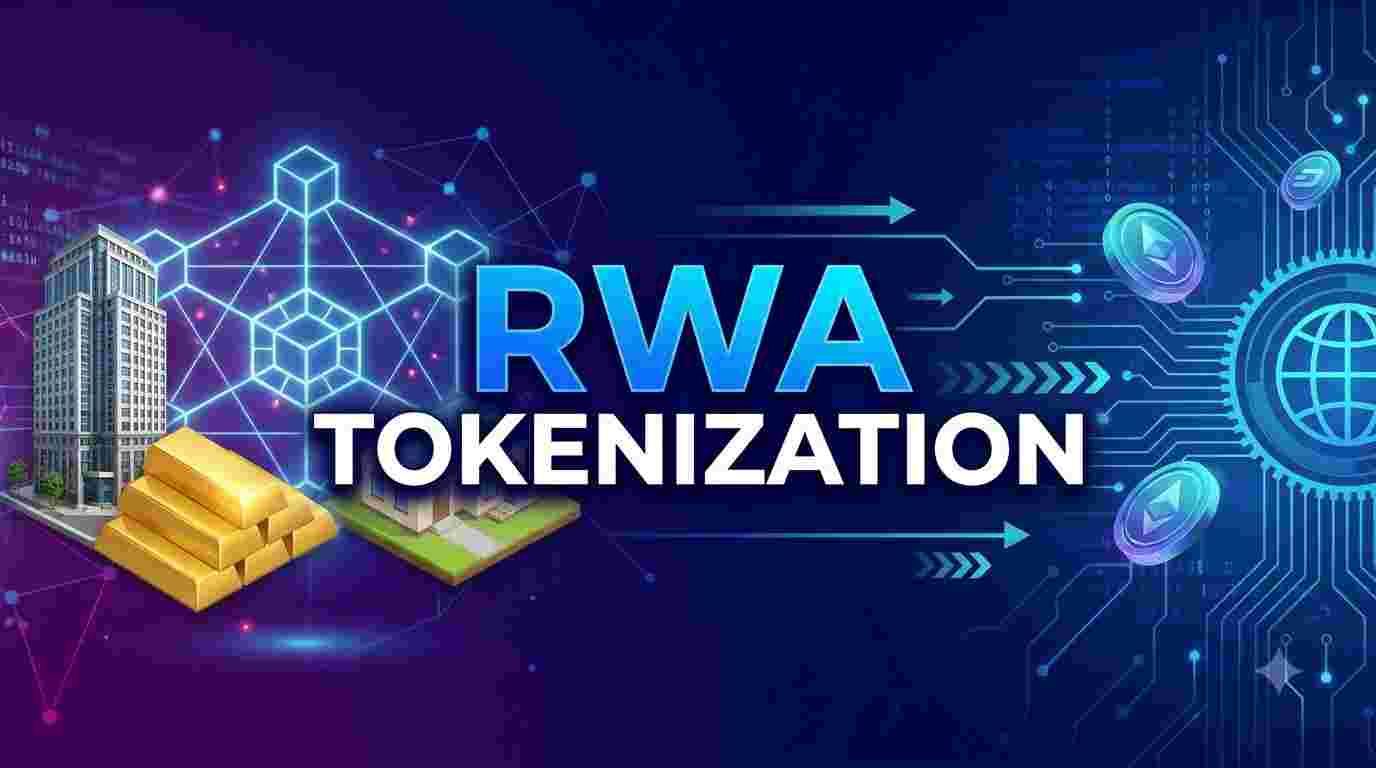
Real-world asset (RWA) tokenization is emerging as one of the most important applications of blockchain technology beyond cryptocurrencies. It involves creating blockchain-based digital tokens that represent ownership, economic rights, or claims associated with physical or traditional financial assets such as real estate, government bonds, private credit, commodities, artwork, and investment funds. Rather than simply putting a digital version of an asset on a blockchain, successful tokenization connects the on-chain token with enforceable legal rights, asset custody, compliance procedures, valuation mechanisms, and redemption processes.
The growing institutional interest in tokenization demonstrates that the concept is moving beyond experimentation. McKinsey has noted that tokenized financial assets are progressing from pilot projects toward larger-scale deployments, with potential benefits including greater operational efficiency, programmability, transparency, liquidity, and new financial products. At the same time, the Bank for International Settlements (BIS) has emphasized that tokenization brings both opportunities and risks, meaning that governance, regulation, and risk management remain essential.
What Is Real-World Asset Tokenization?
RWA tokenization is the process of representing an asset or an economic interest in an asset through blockchain-based tokens. For example, a property worth $1 million could potentially be structured into digital tokens representing fractional interests, subject to the legal and regulatory framework governing the offering. Similarly, a tokenized fund may represent an investor's share in a portfolio of Treasury securities.
The important distinction is that a token itself does not automatically establish ownership of an underlying asset. The legal structure must define what the token holder actually owns or has a claim to. Depending on the asset and jurisdiction, this may involve a special-purpose vehicle, custodian, trust, fund structure, contractual agreement, or another legally recognized arrangement.
This hybrid nature is increasingly evident in real-world deployments. Recent academic research examining RWA systems found that many current implementations combine blockchain-based token functionality with off-chain legal wrappers, custodial arrangements, compliance processes, and verification mechanisms. Therefore, RWA tokenization should be viewed as a combination of blockchain infrastructure and traditional asset-management, legal, and financial infrastructure rather than as a purely technical blockchain project.
Key Benefits of RWA Tokenization
1. Fractional Ownership and Greater Accessibility
One of the most frequently discussed advantages of tokenization is fractional ownership. Traditionally, assets such as commercial real estate, private credit instruments, fine art, or investment funds can require substantial capital to access. Tokenization can divide economic interests into smaller digital units, potentially lowering the minimum investment requirement where regulations permit.
For example, instead of one investor purchasing an entire commercial property, a properly structured tokenized offering could allow multiple investors to participate in its economic value. This does not necessarily make every asset available to every investor, because securities regulations, investor eligibility requirements, and jurisdictional restrictions may still apply. However, the underlying infrastructure can make fractional ownership more practical to administer.
2. Improved Operational Efficiency
Traditional asset transactions often involve multiple intermediaries, manual reconciliation, paperwork, separate databases, and lengthy settlement processes. Blockchain can create a shared record of transactions and ownership while smart contracts can automate predefined actions.
The BIS explains that tokenization can integrate information about an asset with rules and logic governing transfers, enabling conditional and programmable transactions. This could reduce repetitive administrative work associated with issuance, transfers, corporate actions, distributions, and settlement.
For financial institutions, this efficiency can become especially valuable when large numbers of transactions need to be reconciled across different systems.
3. Greater Transparency and Traceability
Blockchain-based records can provide a transparent history of token issuance and transfers. Depending on the blockchain and privacy architecture being used, authorized participants may be able to verify transaction activity without relying entirely on multiple disconnected databases.
This can improve auditability and reduce certain types of reconciliation problems. However, transparency should not be confused with complete visibility into the underlying asset. A blockchain can show that a token exists and has moved between wallets, but it cannot independently prove that a physical property, gold reserve, invoice, or security exists as represented. Reliable oracles, custodians, auditors, legal entities, and verification procedures therefore remain important.
4. Programmability and Automation
Programmability is arguably one of tokenization's most transformative features. Smart contracts can be designed to automatically execute predefined rules when specified conditions are satisfied.
A tokenized private-credit product, for example, could incorporate automated interest distribution according to predefined terms. A tokenized investment fund could potentially automate certain subscription, transfer, and distribution processes. Tokenized securities can also be programmed with compliance restrictions that prevent transfers to wallets that do not meet predefined requirements.
This programmable dimension is what differentiates tokenization from simply digitizing a paper certificate. The token can carry rules concerning ownership, transfers, eligibility, settlement, and other functions.
5. Potentially Broader Liquidity
Tokenization is frequently promoted as a way to make traditionally illiquid assets more liquid. A property, private credit position, or collectible can be difficult to trade because transactions may involve substantial costs, legal work, limited buyers, and long settlement periods.
Blockchain-based representations can make transfer infrastructure more efficient, but tokenization alone does not guarantee liquidity. A tokenized asset still needs buyers, appropriate market infrastructure, regulatory permissions, pricing mechanisms, and sufficient trading activity.
Recent research specifically examining RWA markets highlights this distinction: an asset being tokenized does not automatically mean that it becomes highly liquid. This is an important consideration for businesses developing tokenization platforms because creating tokens is only one part of establishing a functioning market.
Real-World Example: BlackRock's BUIDL
A significant example of institutional RWA tokenization is BlackRock's USD Institutional Digital Liquidity Fund, known as BUIDL, which was tokenized by Securitize. Launched in March 2024, the fund provides eligible investors with on-chain access to a fund investing in U.S. Treasury bills, cash, and other eligible assets.
In March 2025, Securitize announced that BUIDL had surpassed $1 billion in assets under management. The fund was designed to provide features such as daily dividend distributions and near-real-time peer-to-peer transfers. It subsequently expanded across additional blockchain networks, illustrating how interoperability can become an important part of institutional tokenization infrastructure.
The BUIDL example is significant because it demonstrates that RWA tokenization is not limited to experimental startups. Major financial institutions are exploring blockchain as an infrastructure layer for established financial products.
Major Challenges of RWA Tokenization
1. Regulatory and Legal Complexity
Regulation is arguably the biggest challenge facing RWA tokenization. Different jurisdictions classify assets and tokens differently. A token representing equity, debt, real estate interests, or fund shares may fall under different regulatory frameworks.
Businesses must determine who legally owns the underlying asset, what rights token holders receive, how transfers are restricted, what disclosures are required, and which investors are permitted to participate. Compliance can involve securities laws, anti-money-laundering requirements, know-your-customer procedures, tax rules, licensing, and data-protection obligations.
The BIS has emphasized that sound regulation, supervision, governance, and risk management are necessary if tokenization is to improve the safety and efficiency of financial markets.
2. The Oracle and Asset Verification Problem
Blockchain networks cannot inherently verify whether a real-world asset exists or whether its stated value is accurate. This creates what is often called the oracle or "off-chain truth" problem.
Suppose a platform issues tokens representing ownership in a building. The blockchain can record the tokens, but it cannot independently confirm that the building exists, that the issuer owns it, that its valuation is accurate, or that the property has not been pledged elsewhere.
Reliable asset verification therefore requires legal documentation, third-party audits, custodians, valuation providers, and trusted data feeds. Weak verification can undermine the entire tokenization model regardless of how secure the underlying smart contract may be.
3. Liquidity and Secondary-Market Limitations
A tokenized asset needs an active marketplace if investors are expected to trade it efficiently. Creating a token does not automatically create demand.
The industry continues to face fragmented liquidity across platforms and blockchain networks. Reuters reported that financial institutions have encountered difficulties building liquid secondary markets, with different institutions also developing separate blockchain infrastructures.
This makes interoperability, exchange infrastructure, market-making, investor participation, and standardized token formats important components of long-term RWA adoption.
4. Smart Contract and Cybersecurity Risks
Tokenization introduces software-related risks that do not exist in exactly the same form in traditional asset systems. Smart contract vulnerabilities, faulty access controls, compromised administrator keys, oracle manipulation, and blockchain infrastructure failures can potentially cause financial losses.
A professionally designed tokenization platform therefore requires extensive smart contract testing, security audits, access-control mechanisms, monitoring, emergency procedures, and carefully designed upgrade processes.
Security is especially important because blockchain transactions can be difficult or impossible to reverse once executed.
5. Interoperability and Technical Fragmentation
RWA assets may operate across Ethereum, Layer-2 networks, private blockchains, or other distributed ledger infrastructures. If these systems cannot communicate effectively, liquidity and usability can become fragmented.
Institutional adoption will therefore require greater interoperability between networks, wallets, custody systems, compliance platforms, payment infrastructure, and traditional financial databases. BUIDL's expansion across multiple blockchain networks provides an example of how tokenized products are beginning to address this challenge.
Balancing the Benefits and Challenges
The strongest RWA tokenization models will not attempt to replace every element of traditional finance with blockchain. Instead, they will combine blockchain's advantages with established legal, financial, and compliance infrastructure.
The most suitable assets are generally those where tokenization can solve a genuine problem, such as expensive administration, restricted access, fragmented ownership records, slow settlement, or limited transferability. A tokenization project should therefore begin with the asset's economic and legal requirements rather than starting with the blockchain technology itself.
Businesses exploring RWA tokenization development services should evaluate the complete ecosystem, including asset selection, legal structure, compliance, token standards, smart contracts, custody, investor onboarding, KYC/AML, payment systems, marketplace infrastructure, and secondary-market functionality. Likewise, organizations seeking RWA tokenization services should prioritize providers capable of integrating these components rather than treating token creation as an isolated technical exercise.
The Future of RWA Tokenization
The future of RWA tokenization is likely to be shaped by institutional adoption, regulatory clarity, interoperability, and practical utility. The strongest use cases may emerge where tokenization delivers measurable improvements rather than simply adding a blockchain layer to an existing process.
Government securities, private credit, funds, real estate, commodities, and other financial instruments are already being explored through tokenized structures. McKinsey's research indicates that tokenized financial assets are progressing toward larger-scale deployment, while the BIS sees tokenization as potentially significant for the future structure of financial markets.
Ultimately, the success of RWA tokenization will depend on whether blockchain-based systems can provide better outcomes for issuers and investors while maintaining strong legal enforceability, investor protection, security, and market integrity.
Conclusion
Real-world asset tokenization has the potential to reshape how traditional assets are issued, owned, transferred, and managed by combining blockchain's programmability, transparency, fractionalization, and automation with established financial infrastructure. However, its success depends on solving major challenges involving regulation, asset verification, liquidity, cybersecurity, interoperability, and legal enforceability. Organizations planning to enter this market need a technically capable and strategically experienced development partner that understands both blockchain infrastructure and the broader RWA ecosystem. Blockchain App Factory provides best RWA tokenization services, helping businesses explore secure, scalable, and customized tokenization solutions designed around their asset, compliance, and business requirements.

 English
 Arabic
 French
 Spanish
 Portuguese
 Deutsch
 Turkish
 Italiano
 Russian
 Romaian
 Portuguese (Brazil)
 Greek
Greek