


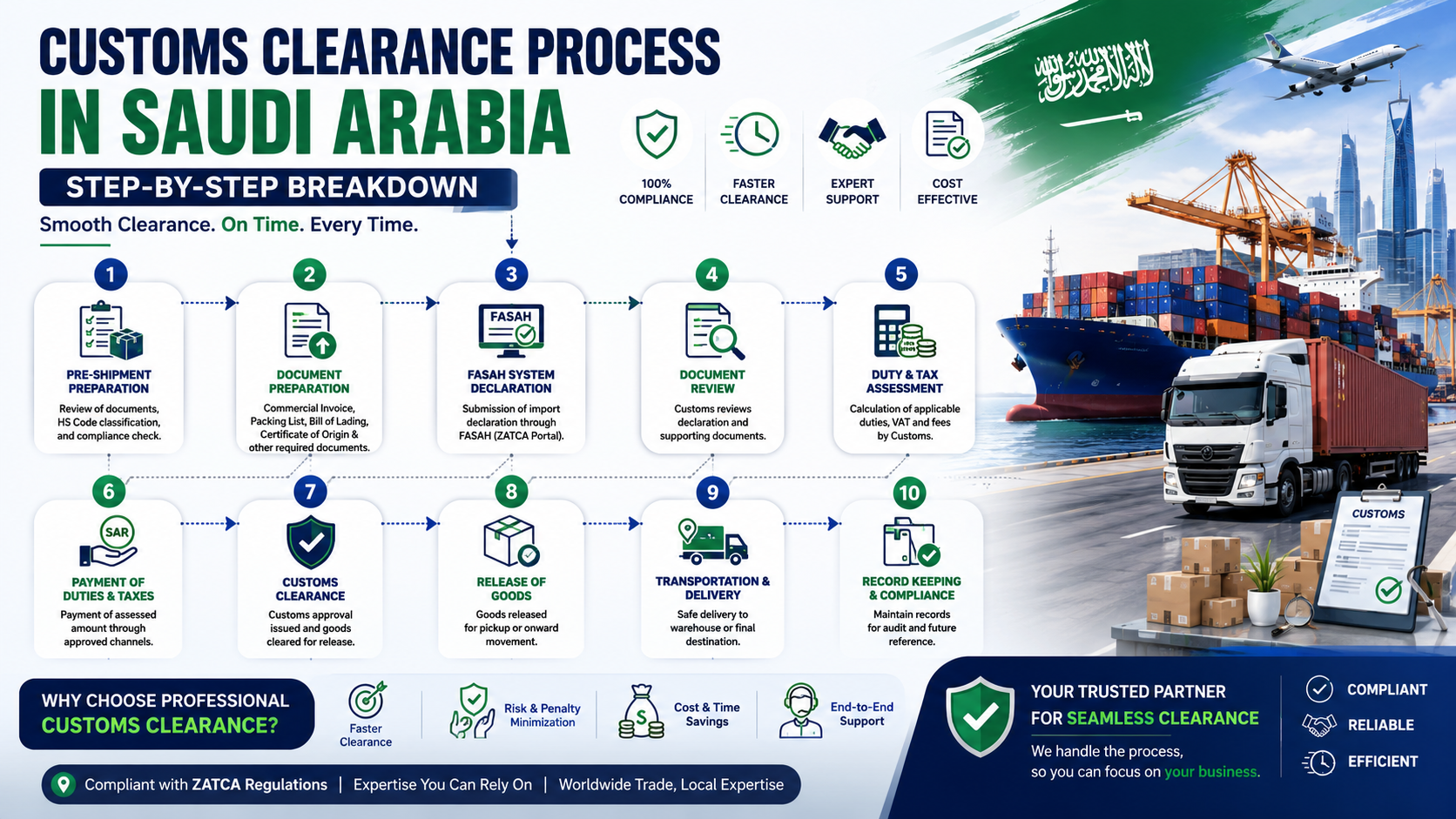
Expanding your business into the Kingdom of Saudi Arabia offers tremendous opportunities, but understanding customs clearance in Saudi Arabia is essential for ensuring your goods enter the country without delays or penalties. Saudi Arabia has established a modern customs system governed by the Zakat, Tax and Customs Authority (ZATCA), with strict import regulations designed to protect consumers, maintain product quality, and facilitate international trade.
Whether you're importing commercial goods, machinery, electronics, food products, or industrial equipment, following the correct customs procedures is crucial. This guide explains the complete customs clearance process, key regulations, required documents, and practical tips to help importers navigate Saudi customs smoothly.
Understanding Customs Clearance in Saudi Arabia
Customs clearance is the official process of obtaining permission from Saudi customs authorities to import or export goods. Before shipments are released, customs officials verify documentation, inspect cargo when necessary, calculate duties and taxes, and ensure compliance with national regulations.
The process involves coordination between importers, customs brokers, shipping companies, freight forwarders, and government authorities. Accurate documentation and regulatory compliance significantly reduce clearance time.
Why Customs Clearance Matters
Proper customs clearance offers several benefits:
-
Prevents unnecessary shipment delays
-
Ensures compliance with Saudi import regulations
-
Avoids customs penalties and fines
-
Reduces storage and demurrage charges
-
Speeds up delivery to customers
-
Improves supply chain efficiency
Businesses that prepare documents correctly often experience faster cargo release and lower logistics costs.
Saudi Customs Authorities
Saudi customs operations are managed by the Zakat, Tax and Customs Authority (ZATCA). The authority oversees:
-
Import and export procedures
-
Collection of customs duties
-
VAT implementation
-
Product inspections
-
Risk management
-
Anti-smuggling enforcement
-
Trade facilitation
Many regulated products must also comply with the SABER platform, especially consumer goods requiring conformity assessment before entering Saudi Arabia.
Key Documents Required
Preparing complete documentation is one of the most important parts of the customs clearance process.
Commonly required documents include:
Commercial Invoice
The invoice should clearly mention:
-
Product description
-
Quantity
-
Unit price
-
Total value
-
Country of origin
-
Buyer and seller details
Packing List
A packing list contains:
-
Number of packages
-
Package dimensions
-
Gross and net weight
-
Item breakdown
Bill of Lading or Airway Bill
This transport document confirms shipment ownership and transportation details.
Certificate of Origin
Many shipments require a Certificate of Origin issued by the exporting country's chamber of commerce.
Import Permit
Certain products require approval from relevant Saudi authorities before importation.
SABER Certificate
Regulated products require Product Certificate of Conformity (PCoC) and Shipment Certificate of Conformity (SCoC) through the SABER platform.
Step-by-Step Saudi Customs Clearance Process
Step 1: Shipment Preparation
Before exporting goods, verify:
-
Product eligibility
-
Required certifications
-
Correct HS code classification
-
Applicable import restrictions
Proper preparation minimizes customs issues upon arrival.
Step 2: Document Submission
The importer or customs broker submits all shipping documents electronically through Saudi customs systems.
Authorities verify:
-
Product classification
-
Customs value
-
Country of origin
-
Supporting certificates
Step 3: Customs Declaration
A customs declaration is filed containing detailed shipment information.
Incorrect declarations may result in:
-
Additional inspections
-
Financial penalties
-
Shipment delays
Step 4: Customs Assessment
Saudi customs officials evaluate:
-
Product classification
-
Customs duties
-
VAT
-
Regulatory compliance
The shipment may also undergo risk assessment.
Step 5: Cargo Inspection
Not every shipment is physically inspected.
However, customs may inspect cargo to verify:
-
Product quantity
-
Product description
-
Labeling
-
Safety requirements
-
Compliance with import regulations
Step 6: Payment of Duties and Taxes
After assessment, the importer pays:
-
Customs duties
-
Value Added Tax (VAT)
-
Other applicable government fees
Payment is generally completed electronically.
Step 7: Cargo Release
Once verification is complete and all payments are made, customs issues cargo release.
The shipment can then proceed to:
-
Warehouse
-
Distribution center
-
Final customer
Saudi Import Regulations
Saudi Arabia maintains strict import regulations to ensure product safety and consumer protection.
Importers should comply with:
Product Standards
Many products must meet Saudi technical regulations.
Examples include:
-
Electrical products
-
Children's toys
-
Automotive parts
-
Building materials
-
Cosmetics
-
Home appliances
Product Labeling
Products may require Arabic labeling that includes:
-
Product name
-
Country of origin
-
Manufacturer details
-
Safety information
-
Usage instructions
Restricted Goods
Certain goods require special permits or approvals before import.
Examples include:
-
Medical devices
-
Pharmaceuticals
-
Chemicals
-
Food products
-
Telecommunications equipment
Customs Duties and VAT
Saudi Arabia applies customs duties depending on the product classification.
Duty rates vary according to the Harmonized System (HS Code).
Additionally, VAT is generally applied to imported goods based on the customs value plus applicable duties.
Importers should verify current tariff rates before shipping.
Importance of HS Codes
HS Codes determine:
-
Applicable customs duty
-
Regulatory requirements
-
Import restrictions
-
Product classification
Using an incorrect HS code can result in:
-
Higher duties
-
Shipment delays
-
Customs disputes
-
Financial penalties
Professional customs brokers help classify products accurately.
Common Customs Clearance Challenges
Importers often face issues such as:
Missing Documents
Incomplete paperwork is one of the leading causes of shipment delays.
Incorrect Product Classification
Wrong HS codes affect customs duty calculations.
SABER Non-Compliance
Regulated products without required certificates cannot be released.
Incorrect Product Value
Undervaluation or inconsistent invoice values may trigger customs investigations.
Labeling Issues
Products lacking required Arabic labels may require correction before release.
How to Speed Up Customs Clearance
Businesses can improve clearance efficiency by:
-
Preparing complete documentation
-
Working with experienced customs brokers
-
Ensuring accurate product descriptions
-
Using correct HS codes
-
Completing SABER certification before shipping
-
Monitoring shipment status
-
Responding quickly to customs requests
Proactive planning significantly reduces clearance time.
Role of Customs Brokers
Professional customs brokers simplify the import process by handling:
-
Customs documentation
-
Duty calculations
-
Product classification
-
Electronic declarations
-
Regulatory compliance
-
Shipment tracking
-
Customs inspections
-
Cargo release
Their expertise helps businesses avoid costly mistakes while ensuring compliance with Saudi regulations.
Technology and Digital Customs
Saudi Arabia has modernized customs procedures through digital platforms.
Electronic systems now support:
-
Online declarations
-
Electronic payments
-
Shipment tracking
-
Risk assessment
-
Digital documentation
-
Faster processing
Digital transformation has greatly improved import efficiency across the Kingdom.
Tips for First-Time Importers
If you're importing into Saudi Arabia for the first time:
-
Research product regulations before purchasing goods.
-
Confirm whether SABER certification is required.
-
Choose a reliable freight forwarder.
-
Work with an experienced customs clearance company.
-
Verify all commercial documents before shipment.
-
Budget for customs duties and VAT.
-
Track your shipment throughout the process.
Proper planning minimizes delays and unexpected costs.
Benefits of Professional Customs Clearance Services
Partnering with a professional customs clearance provider offers several advantages:
-
Faster shipment processing
-
Reduced documentation errors
-
Compliance with Saudi regulations
-
Lower risk of customs penalties
-
Efficient duty calculations
-
Better coordination with shipping companies
-
Timely cargo delivery
Experienced service providers understand changing regulations and help businesses maintain uninterrupted supply chains.
Conclusion
Navigating customs clearance in Saudi Arabia requires careful planning, accurate documentation, and compliance with Saudi import regulations. From preparing shipping documents and obtaining required certifications to paying customs duties and completing inspections, every stage plays an important role in ensuring successful cargo release.
Businesses that understand the clearance process and partner with experienced customs professionals can avoid delays, reduce costs, and improve overall logistics efficiency. Whether you're importing commercial goods, industrial equipment, or consumer products, following the correct procedures will help ensure your shipments reach the Saudi market quickly and compliantly.

 English
 Arabic
 French
 Spanish
 Portuguese
 Turkish
 Dutch
Dutch
 Italiano
 Russian
 Romaian
 Portuguese (Brazil)
 Greek
Greek