


Introduction
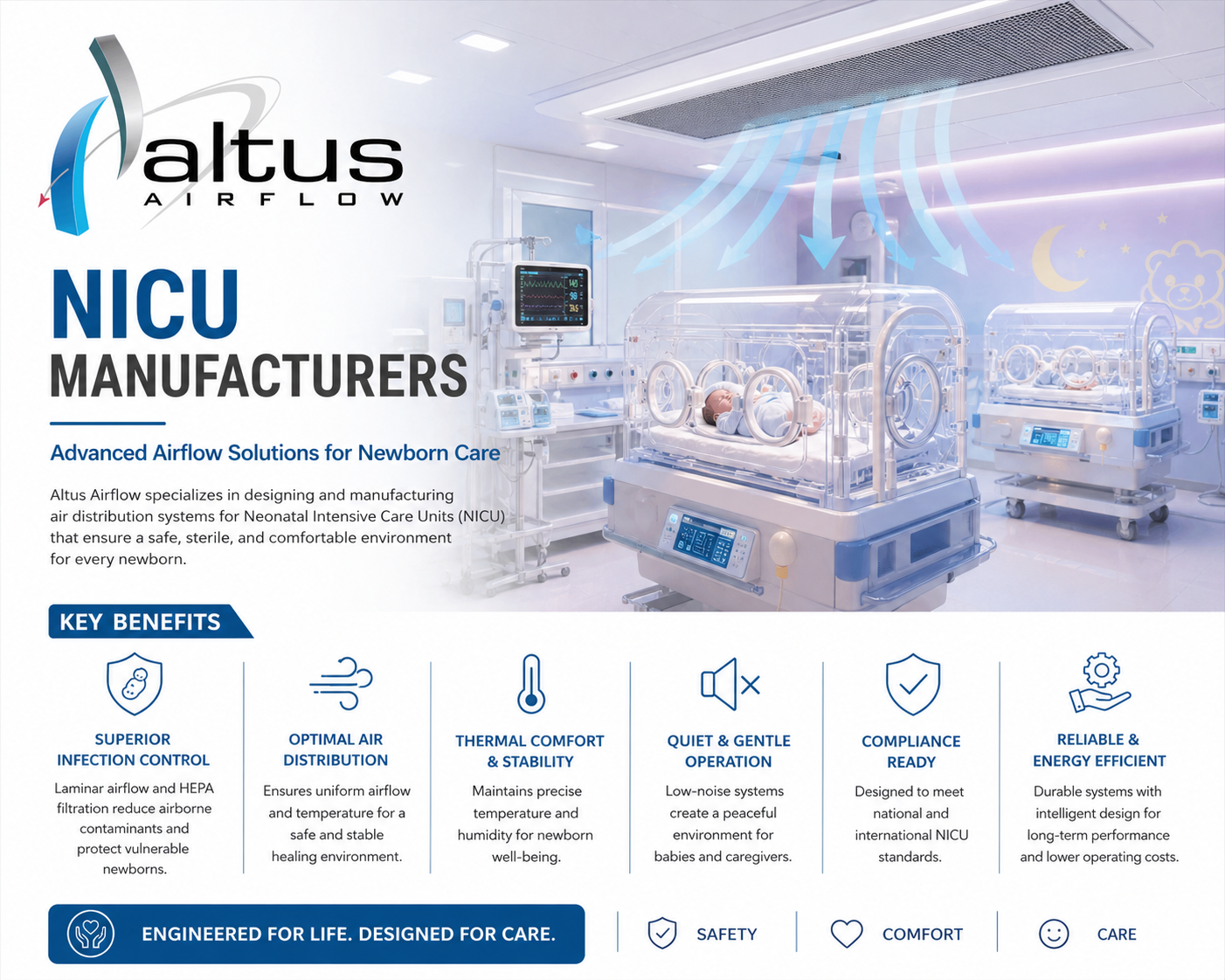
NICU Manufacturers provide specialized solutions that help hospitals establish safe, efficient, and well-organized Neonatal Intensive Care Units. Newborns, particularly premature and critically ill infants, require specialized monitoring, temperature control, respiratory support, infection prevention, and continuous medical attention. Manufacturers help hospitals address these requirements through customized infrastructure, advanced equipment integration, reliable utility systems, and professional installation services. Their solutions are designed to support healthcare professionals while creating a controlled environment for specialized neonatal care.
Customized NICU Planning
Hospitals have different space, capacity, and clinical requirements.
Manufacturers assess the available area, expected patient load, equipment requirements, staff workflow, and hospital infrastructure before developing a suitable NICU plan. Patient care areas, nursing stations, storage zones, equipment locations, and emergency pathways are carefully organized.
Customized planning helps hospitals use their available space efficiently while supporting neonatal care.
Advanced NICU Design Solutions
A well-designed neonatal unit requires careful attention to patient safety and staff accessibility.
NICU Manufacturers create layouts that provide appropriate space around neonatal beds and equipment. The design can incorporate dedicated areas for monitoring, treatment, storage, hand hygiene, and clinical operations.
An organized layout improves workflow and allows healthcare professionals to access newborns and essential equipment efficiently.
Neonatal Equipment Integration
Specialized equipment is essential for neonatal treatment.
Manufacturers integrate equipment such as neonatal incubators, radiant warmers, patient monitors, ventilators, infusion pumps, syringe pumps, phototherapy units, suction systems, and emergency care equipment.
Strategic equipment placement helps medical teams monitor newborns and provide treatment without unnecessary movement.
Medical Gas Solutions
Respiratory support is an important part of neonatal care.
Manufacturers install oxygen pipelines, compressed air systems, vacuum outlets, medical gas terminal units, pressure regulators, and alarm systems. These systems provide essential medical gases required for respiratory treatment and emergency procedures.
Reliable medical gas infrastructure supports continuous neonatal care.
Infection Control Solutions
Newborns in intensive care require a controlled and hygienic environment.
Manufacturers incorporate HEPA filtration, advanced ventilation, controlled airflow, hygienic surfaces, and easy-to-clean materials to support infection prevention.
These measures help reduce potential contamination and contribute to a safer environment for vulnerable patients.
Temperature and Humidity Management
Environmental conditions are carefully controlled in neonatal units.
Manufacturers provide temperature and humidity management systems to help maintain stable conditions within the NICU. These systems complement neonatal incubators and radiant warmers.
Stable environmental conditions support newborn comfort and appropriate clinical care.
Central Monitoring Solutions
Central monitoring allows healthcare professionals to observe multiple patients efficiently.
Manufacturers integrate centralized monitoring systems that can display vital parameters such as heart rate, oxygen saturation, respiratory rate, blood pressure, and temperature.
Centralized observation helps staff identify changes in patient conditions and respond promptly.
Electrical and Backup Power Solutions
NICU equipment requires reliable electrical power.
Manufacturers provide medical-grade electrical systems, UPS units, emergency lighting, grounding protection, and backup power arrangements to support continuous operation of critical equipment.
Dependable power infrastructure helps prevent interruptions to patient monitoring and treatment.
Communication and Nurse Call Systems
Efficient communication supports coordinated neonatal care.
Manufacturers can integrate nurse call systems, intercom facilities, and communication networks that help healthcare professionals coordinate patient care and respond to requests efficiently.
These systems improve communication within the clinical environment.
Storage and Utility Solutions
Organized storage is necessary for an efficient NICU.
Manufacturers can plan dedicated areas for medical supplies, medications, protective equipment, emergency resources, and other essential materials. Utility areas can also be incorporated into the overall layout.
Well-organized storage reduces clutter and improves accessibility.
Emergency Care Infrastructure
Neonatal units must be prepared for urgent situations.
Manufacturers plan accessible locations for neonatal resuscitation equipment, emergency medications, suction devices, airway management tools, and other critical resources.
Emergency-ready layouts allow healthcare professionals to access essential equipment quickly.
Installation and Commissioning
Professional installation ensures that all components operate as intended.
Manufacturers coordinate the installation of medical equipment, medical gas systems, electrical infrastructure, ventilation systems, and other supporting components. They can also conduct system testing and commissioning before the facility begins operation.
Proper commissioning helps verify the performance and readiness of the NICU.
Maintenance and Technical Support
Long-term support is important for maintaining reliable neonatal facilities.
Manufacturers may provide preventive maintenance, equipment servicing, calibration, inspections, repairs, and technical assistance.
Regular support helps hospitals maintain the performance of essential systems and equipment.
Modernization and Expansion
Healthcare facilities may need to upgrade their neonatal units as technology and clinical needs evolve.
Manufacturers offer modernization solutions that can include infrastructure upgrades, equipment replacement, technology integration, improved ventilation, and expansion planning.
Flexible solutions help hospitals adapt their NICUs to future requirements.
Compliance and Quality Considerations
Safety and quality are considered throughout NICU development.
Manufacturers take into account applicable healthcare guidelines, engineering practices, infection control requirements, electrical safety measures, and hospital protocols during planning and implementation.
Following appropriate requirements supports a dependable neonatal care environment.
Conclusion
Hospitals can benefit from comprehensive neonatal care solutions that combine customized planning, specialized infrastructure, medical equipment integration, medical gas systems, infection control, environmental management, electrical support, emergency preparedness, and technical services. These solutions create organized and reliable care environments where healthcare professionals can focus on monitoring and treating newborn patients effectively.
FAQs
1. Which solutions do NICU Manufacturers offer hospitals?
NICU Manufacturers offer customized planning and design, neonatal equipment integration, medical gas systems, infection control solutions, temperature and humidity management, central monitoring, electrical infrastructure, communication systems, emergency care infrastructure, installation, maintenance, and modernization services.
2. What equipment can be integrated into a NICU?
Common equipment includes neonatal incubators, radiant warmers, patient monitors, ventilators, infusion pumps, syringe pumps, phototherapy units, suction devices, and emergency equipment.
3. Why are infection control solutions important in NICUs?
They help maintain a hygienic environment and reduce potential exposure to contaminants for vulnerable newborn patients.
4. How do medical gas systems support neonatal care?
Medical gas systems provide oxygen, compressed air, and vacuum services needed for respiratory support and clinical procedures.
5. Do NICU manufacturers provide maintenance support?
Many manufacturers provide preventive maintenance, equipment servicing, calibration, repairs, inspections, and technical assistance to support long-term facility performance.
Read Our Previous Blog----------->What equipment is provided by ICU Manufacturers?

 Arabic
 French
 Spanish
 Portuguese
 Deutsch
 Turkish
 Dutch
Dutch
 Italiano
 Russian
 Romaian
 Portuguese (Brazil)
 Greek
Greek