


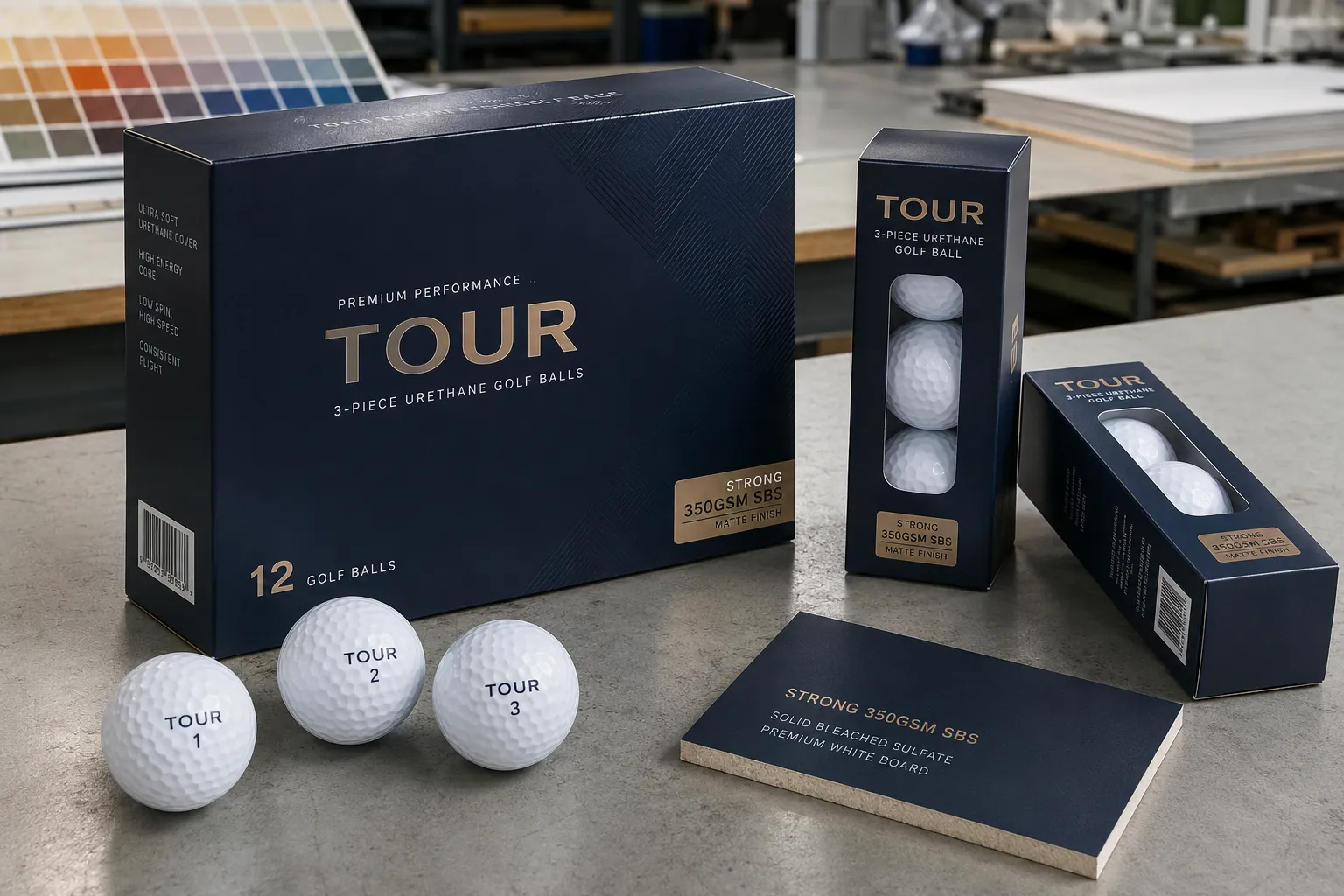
Packaging golf balls for retail comes down to a small set of well-established formats, sleeves, dozen packs, and half-dozen boxes, but the details within those formats vary widely in how much branding real estate and shelf durability they offer.
Golf equipment companies sourcing packaging for the first time benefit from understanding what each format is actually built for before committing to a print run.
Getting the format right at the outset also simplifies future SKU expansion, since a well-chosen structural dieline can often be reused across new ball models with only the printed graphics changing.
Common Golf Ball Packaging Formats - Sleeves, Dozens, Half-Dozens
Sleeves, typically holding three balls, are the smallest and most economical format and are commonly used for pro shop counter displays or promotional giveaways.
Dozen packs are the standard retail unit for most consumer purchases, usually in a small folding carton, while half-dozen boxes serve a middle ground for gifting or premium product lines.
Structural Requirements for Shelf and Shipping Durability
Golf balls are dense and unforgiving on packaging that isn't built to hold their shape, a folding carton needs adequate board weight to resist bulging or corner splitting under the concentrated weight of a full dozen.
E-commerce orders add another layer of stress during parcel shipping, which is why many brands pair a retail carton with a simple corrugated outer for online orders.
Branding Real Estate on Small-Format Packaging
Small-format packaging like sleeves offers limited surface area, which pushes most branding onto a single bold logo treatment rather than detailed messaging.
Dozen-pack cartons have more room to work with and are where most brands place performance claims, model names, and secondary branding elements.
Material Choices for Cost-Effective Retail Runs
Standard folding carton board in the 300–350 GSM range is generally sufficient for golf ball packaging, since the product itself is rigid and doesn't need the same crush protection as fragile goods.
Brands running frequent SKU variations, different ball models across a similar box design, can reduce cost by standardizing the structural dieline and varying only the printed graphics.
Seasonal Planning for Golf Retail Packaging Orders
Golf retail follows a fairly predictable seasonal curve, with demand concentrated in spring and early summer across most of the US market, which means packaging orders need to be planned well ahead of the buying season rather than reactively.
Brands that wait until demand is already climbing often find themselves competing for supplier production slots against other seasonal categories placing orders at the same time.
Planning packaging orders alongside the ball production schedule, rather than as a separate afterthought, also helps avoid the common scenario where finished product sits in a warehouse waiting on packaging that's still weeks from completion.
Brands entering new retail accounts should also confirm packaging compatibility with the retailer's shelf specifications ahead of time, since some pro shops and big-box sporting goods accounts have their own display or sizing requirements that can affect the final carton dimensions.
Retailers introducing a golf brand for the first time may also request point-of-sale display packaging alongside standard retail cartons, which is worth planning for separately since display packaging typically has different structural and branding requirements than the individual sleeves or dozen packs sold from it.
Coordinating this with the core packaging order, rather than treating it as a late addition, keeps both elements on the same production and delivery timeline.
Quick Specification Checklist for Retail Golf Ball Packaging
● Board weight (300–350 GSM range) confirmed adequate for the format
● Branding scaled appropriately to sleeve, half-dozen, or dozen format
● Structural dieline standardized for reuse across SKU variations
● Separate corrugated shipper planned for e-commerce orders
● Packaging orders scheduled ahead of peak seasonal demand
● Retailer-specific shelf or sizing requirements confirmed before production
Common Mistakes When Packaging Golf Balls for Retail
● Using undersized board for dozen packs, leading to bulging cartons that don't display cleanly on a shelf.
● Designing detailed branding for a sleeve format that doesn't have enough surface area to support it legibly.
● Ordering a single large run instead of testing shorter digital-print runs across multiple SKU variations first.
● Rushing a new SKU into an existing packaging format mid-season without the usual proofing and testing steps, increasing the risk of quality issues under a compressed timeline.
Frequently Asked Questions About Packaging Golf Balls
What's the standard packaging format for golf balls at retail?
Dozen packs in a folding carton are the standard consumer retail unit, with sleeves and half-dozen boxes used for promotional or gifting purposes.
What board weight is needed for golf ball packaging?
Standard folding carton board in the 300–350 GSM range is generally sufficient, since golf balls themselves are rigid and don't require heavy crush protection.
Should e-commerce golf ball orders use a separate shipping box?
Yes, pairing the retail carton with a simple corrugated outer for online orders helps prevent shipping damage to the branded packaging.
When should golf brands place packaging orders ahead of peak season?
Given the concentrated spring and early-summer demand curve, packaging orders should typically be placed several months ahead of peak retail season.
Do retailers have specific packaging requirements for golf balls?
Some pro shops and larger sporting goods accounts have their own shelf display or sizing specifications, so it's worth confirming these before finalizing carton dimensions.
Should new golf ball SKUs wait for a planned production cycle?
Where possible, yes - introducing a new SKU within the normal production and proofing cycle reduces the risk of quality issues that a rushed mid-season change can introduce.
Key Takeaways
● Sleeves, dozen packs, and half-dozen boxes each serve a different retail or promotional purpose within golf ball packaging.
● Standard 300–350 GSM folding carton board is generally sufficient given the rigidity of the product itself.
● Small-format packaging like sleeves needs simplified branding due to limited surface area, while dozen packs allow more detailed messaging.
● Seasonal demand concentration means packaging orders should be planned well ahead of peak buying season.
● A standardized structural dieline across SKU variations reduces cost and complexity as a product line expands.
Final Thoughts
Packaging golf balls well for retail is less about elaborate design and more about matching the right format, board weight, and branding scale to how the product actually reaches the customer. Brands that plan packaging orders alongside their seasonal production schedule avoid the scramble that comes with reactive, last-minute sourcing during peak demand.
Brands introducing a new ball model mid-season should also weigh the tradeoff between rushing a new SKU into the existing packaging format versus waiting for the next planned production cycle, since a rushed packaging change can introduce quality issues that are harder to catch under a compressed timeline.

 English
 Arabic
 French
 Spanish
 Portuguese
 Deutsch
 Turkish
 Dutch
Dutch
 Russian
 Romaian
 Portuguese (Brazil)
 Greek
Greek