


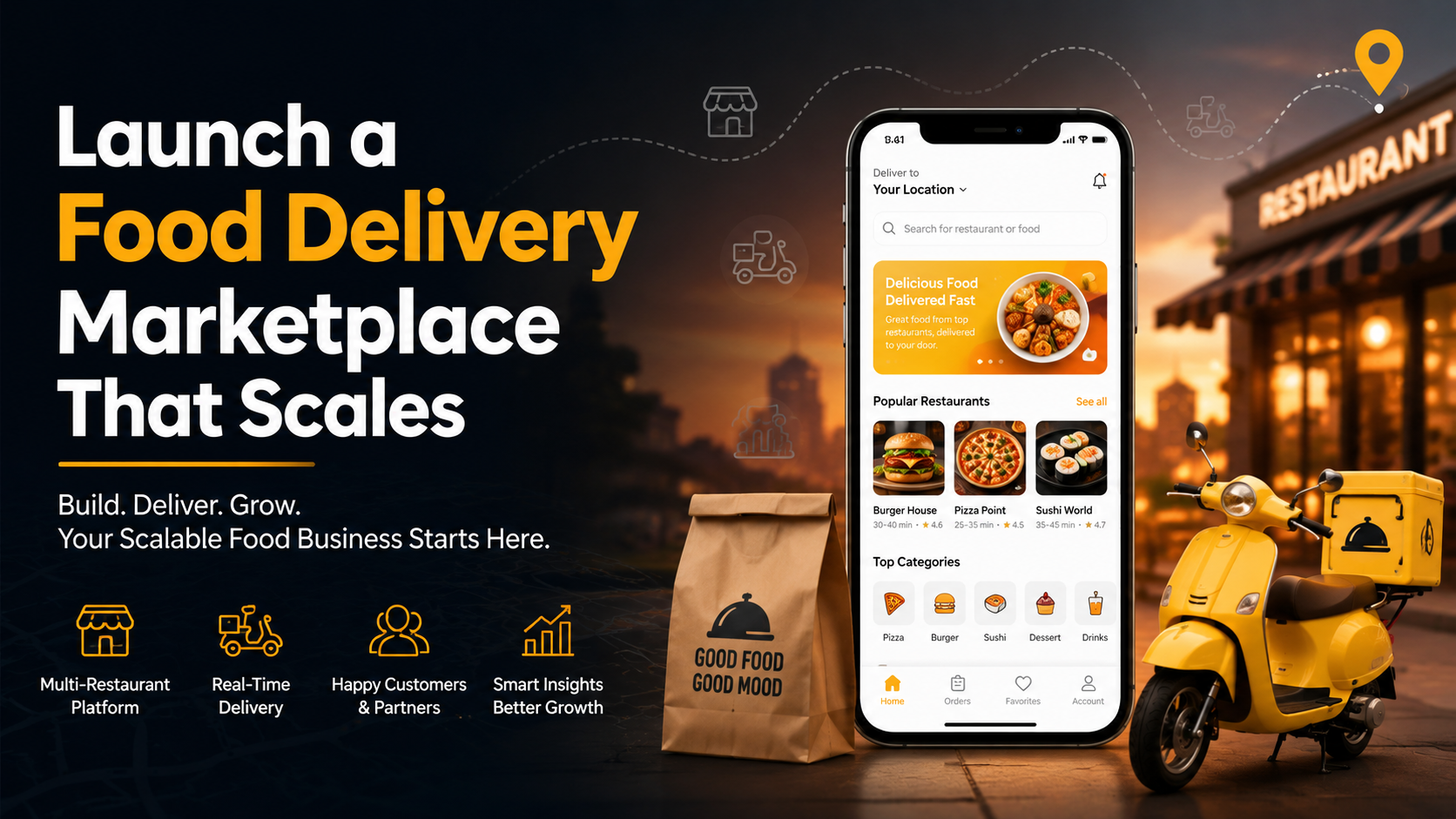
The food delivery marketplace is evolving beyond simple online ordering. Businesses entering this space today need more than an app that connects restaurants with customers. They need a scalable marketplace capable of managing restaurants, delivery partners, customers, payments, promotions, and real-time orders while creating multiple opportunities for revenue.
For entrepreneurs and startups, this shift creates a significant opportunity: build a digital food ecosystem that can adapt to changing customer expectations while giving restaurants and delivery partners a reason to stay on the platform.
Why the Food Delivery Marketplace Model Is Growing
Consumers increasingly expect convenience, speed, flexible payment options, personalized recommendations, and real-time delivery visibility. At the same time, restaurants want digital channels that help them acquire customers without depending entirely on traditional platforms.
This creates a three-sided marketplace involving customers, restaurants, and delivery partners.
A successful platform connects all three efficiently. Customers discover and order food, restaurants manage menus and incoming orders, while delivery partners accept and complete deliveries. The marketplace operator coordinates the entire ecosystem through a centralized technology platform.
For B2B businesses, this model can create several revenue opportunities, including:
-
Commission on restaurant orders
-
Delivery and service fees
-
Restaurant subscription plans
-
Featured restaurant promotions
-
Advertising opportunities
-
Customer membership programs
-
Surge or priority delivery fees
Rather than relying on a single income source, entrepreneurs can develop a diversified monetization strategy based on their target market.
Food Delivery App Features That Create Competitive Advantage
Launching another generic ordering platform is unlikely to create strong differentiation. Modern businesses need features that improve marketplace efficiency and user retention.
AI-powered personalization can recommend restaurants and dishes based on previous orders, preferences, location, and purchasing patterns. This can help customers discover relevant options while increasing opportunities for repeat orders.
Real-time order tracking has also become an important part of the customer experience. Customers want visibility from restaurant confirmation through delivery completion.
For restaurants, centralized restaurant management tools can simplify menu updates, order processing, promotions, analytics, and customer management.
Delivery partners need efficient delivery management features, including order assignment, route optimization, earnings tracking, availability controls, and navigation integration.
The platform should also provide an admin dashboard where marketplace owners can monitor restaurants, customers, drivers, transactions, commissions, disputes, promotions, and overall marketplace performance.
These capabilities are not simply technical additions. They directly influence operational efficiency, customer satisfaction, and the ability to scale.
Trends and Challenges Shaping the Market
The next generation of food delivery businesses will increasingly compete on experience rather than availability alone.
Hyperlocal delivery is becoming an important opportunity for businesses targeting specific cities or communities. Instead of attempting to compete everywhere immediately, entrepreneurs can establish strong restaurant and delivery networks within selected locations before expanding.
Subscription-based models are another potential growth strategy. Customers may be encouraged to pay a recurring fee for reduced delivery charges, exclusive offers, or priority benefits. This can create more predictable revenue while encouraging customer retention.
However, the industry also has significant challenges.
Customer acquisition can become expensive when businesses compete for the same users. Delivery logistics can affect profitability, particularly when orders have low average values. Restaurants may also resist high commission structures, while customers increasingly expect competitive pricing and fast delivery.
This means technology alone does not guarantee marketplace success.
Businesses need a clear market-entry strategy, sustainable commission structure, efficient delivery operations, strong restaurant acquisition, and continuous customer engagement.
Build for the Market, Not Just the Launch
A food delivery marketplace should be designed with future expansion in mind. Starting with a focused geographic market allows businesses to validate demand, onboard restaurants, optimize delivery operations, and understand customer behavior before expanding into new locations.
A scalable technology foundation can then support additional restaurants, delivery partners, locations, services, and monetization models without forcing the business to rebuild its entire platform.
For entrepreneurs, this creates a more practical path from market entry to marketplace expansion.
Turn the Opportunity Into a Business
The food delivery market remains competitive, but competition also proves that customers and restaurants are actively adopting digital food commerce. The opportunity lies in building a marketplace that solves real operational problems while delivering a better experience for every participant.
If you're planning to enter the food delivery industry, a ready-to-customize marketplace solution can help accelerate your launch, reduce development complexity, and give your business the foundation needed to compete.

 Arabic
 French
 Spanish
 Portuguese
 Deutsch
 Turkish
 Dutch
Dutch
 Italiano
 Russian
 Romaian
 Portuguese (Brazil)
 Greek
Greek