


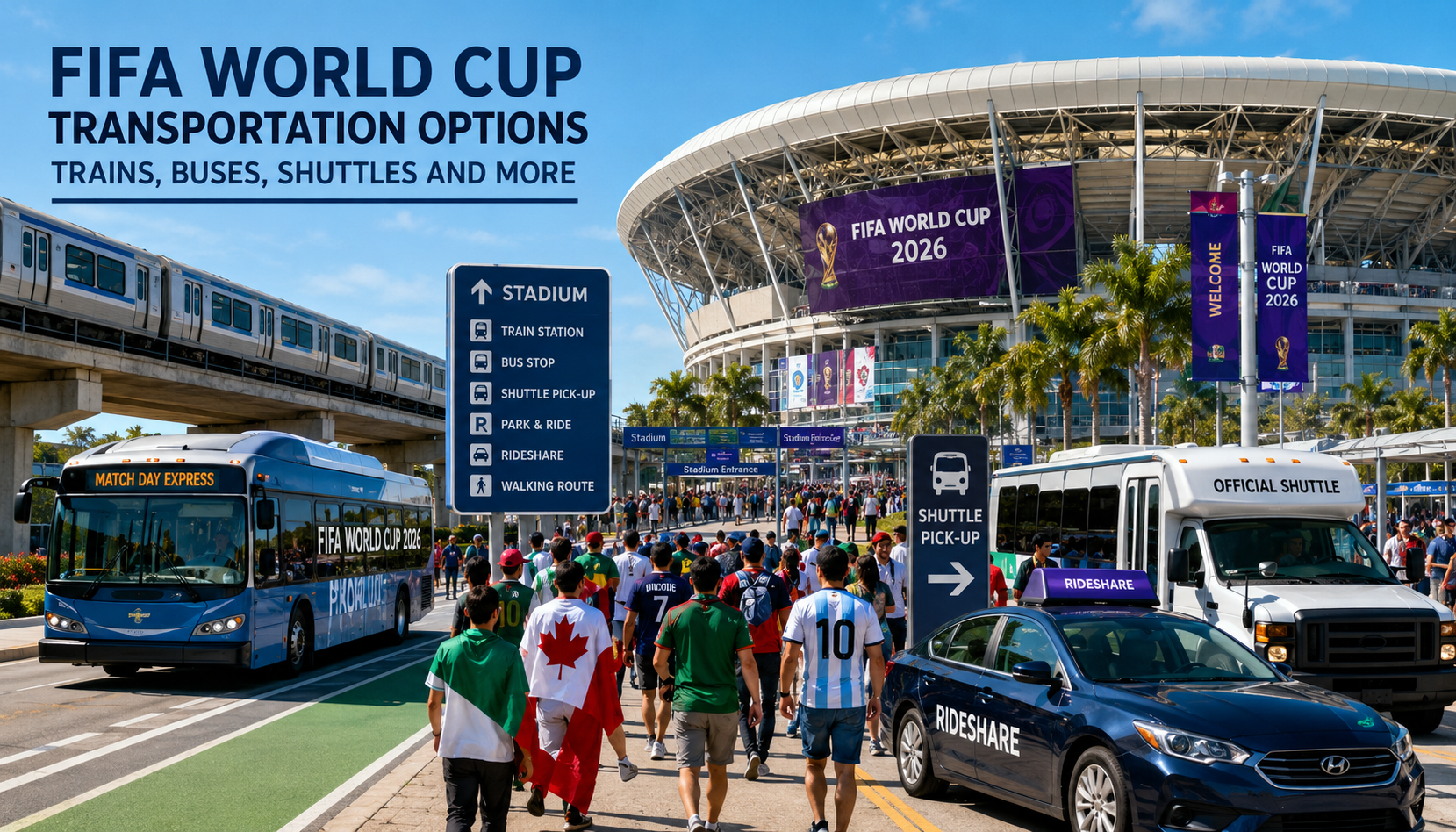
Getting to a FIFA World Cup match is about more than simply finding the nearest stadium. With the 2026 tournament spread across 16 host cities in Canada, Mexico and the United States, transportation will be a major part of the fan experience. Learn More about your city's options before match day so you can choose between trains, buses, shuttles, rideshare services, taxis and other available options.
The best choice depends on the stadium, your starting point, the match schedule and local traffic conditions. FIFA's venue guidance encourages fans to plan their journey in advance and arrive early, while individual host cities have their own transportation arrangements.
Understanding FIFA World Cup Transportation
The 2026 FIFA World Cup is different from previous editions because matches are being hosted across a huge geographic area. Canada, Mexico and the United States will collectively host 104 matches in 16 cities.
That means transportation planning can involve two separate journeys. The first is getting to the host city, which may require air or long-distance rail travel. The second is getting from your hotel, airport or another part of the city to the stadium.
For match day, public transportation and official shuttle services can often be more convenient than driving directly to the venue. FIFA's stadium transportation pages provide venue-specific information because available services differ from one host city to another.
Trains and Rail Transportation
Rail can be one of the most practical choices when a stadium has a convenient connection to a local or regional station. Trains avoid much of the road congestion that can occur around major sporting events and can provide a predictable way to reach the stadium area.
For example, FIFA's Houston transportation guidance identifies the METRORail Red Line as a direct option to the stadium, with Stadium Park/Astrodome Station located within walking distance. On match days, trains are scheduled to run approximately every six minutes.
Toronto also provides several rail and transit connections for fans. FIFA's Canadian ticket-office guidance points to GO Train service to Exhibition GO Station as well as TTC connections from Union Station.
Before leaving your accommodation, check the latest local transit information rather than assuming normal service patterns will apply during a World Cup match.
Buses and Public Transit
City buses can be useful when rail service does not reach the stadium directly. They can also connect hotels, transit hubs and park-and-ride locations with the wider transportation network.
Public transit is particularly useful for visitors who do not have access to a car. However, major tournament matches can produce unusually heavy passenger demand, so fans should allow extra time for queues, crowded vehicles and transfers.
Philadelphia provides an example of how public transit can be integrated into World Cup match operations. FIFA says SEPTA's Broad Street Line provides direct access to NRG Station near the stadium, with free public transit or subway egress being provided for the tournament's six matches.
Fans should still check the specific match-day instructions because transit arrangements can differ by venue.
Shuttle Services for Match Days
Official or event-specific shuttles can be especially useful when stadium access is restricted or when organizers want to reduce traffic around the venue.
Miami provides a clear example. FIFA says free shuttles will operate from selected rail hubs beginning 3.5 hours before a match and continuing until 1.5 hours after the match. Fans using those buses must have a ticket for that day's match.
Miami also plans free round-trip shuttle service from designated park-and-ride locations, although parking passes are required for vehicles using those lots.
These services can be particularly helpful for visitors who prefer to leave their cars outside the busiest stadium area.
Rideshare and Taxi Services
Rideshare apps and taxis offer flexibility because they can take passengers closer to designated stadium access points. They can be convenient for travelers carrying luggage, families or groups staying away from major transit stations.
The downside is that demand can become extremely high immediately before and after a match. FIFA's Houston guidance warns that rideshare demand is expected to be very high during the tournament and that surge pricing may apply.
For this reason, relying exclusively on a rideshare vehicle can create uncertainty. It may be smarter to use public transportation for one part of the journey and rideshare or a taxi for another, depending on local arrangements.
Driving and Park-and-Ride Options
Driving can provide greater flexibility, but parking directly at a World Cup stadium may not be as simple as it is for an ordinary event.
FIFA's Miami guidance, for example, states that general parking must be purchased through the official FIFA World Cup 26 parking system. It also identifies designated park-and-ride locations where fans can leave their vehicles and continue toward the stadium using shuttle services.
Park-and-ride can be a useful compromise for visitors who need a car to reach the host city but want to avoid the most congested areas around the stadium.
Benefits
The biggest benefit of using public transportation, trains and official shuttles is that they can reduce the stress of navigating match-day traffic. Fans can avoid searching for last-minute parking and may have a more predictable journey to the stadium.
Public transportation can also make it easier to explore the host city before or after a match. Instead of moving a vehicle through crowded streets, visitors can use the city's existing transportation network and spend more time enjoying restaurants, attractions and fan activities.
Another advantage is flexibility. A transportation plan does not have to rely on one method. A fan might take a train to the city center, transfer to a shuttle and walk the final part of the journey. Explore the Available Options on the official stadium and host-city transportation pages before match day to identify the combination that works best.
Pros
Public transportation can be cost-effective and can reduce the need for stadium parking. Rail services can also provide a reliable alternative to heavily congested roads, while dedicated shuttles may simplify the final connection to the stadium.
For international visitors, using trains and buses can also eliminate the need to rent a car. This can make a trip easier when the visitor is staying in a central area with strong public transit connections.
Cons
The main disadvantage is that transportation systems can become crowded around popular matches. A journey that is normally quick may take substantially longer when thousands of fans are traveling at the same time.
Rideshare services can also become expensive when demand rises, while driving can involve parking restrictions, road closures and designated access points. Transportation arrangements can change, so relying on information from an ordinary day may lead to problems.
How to Plan Your Match-Day Transportation
Start by checking the official transportation information for your specific stadium. Do not assume that two host cities will operate in the same way.
Next, identify your starting point and work backward from the stadium. Consider the distance from your hotel, the nearest rail or bus station, transfer times and the expected walking distance.
Leave extra time for security, queues and crowded transportation. FIFA's venue guidance repeatedly encourages fans to plan ahead and arrive early.
It is also sensible to have a backup plan. If a train is delayed or a rideshare pickup area becomes difficult to reach, knowing the nearest alternative station or shuttle location can save valuable time.
Bottom Line
FIFA World Cup transportation will vary considerably from one host city and stadium to another. Trains, buses, public transit, official shuttles, rideshare services, taxis and park-and-ride facilities can all play a role, but the best option depends on your particular match and location.
The safest approach is to check official venue guidance before every match, plan your route in advance and allow more time than you would for an ordinary day. With a little preparation, transportation can become a manageable part of the World Cup experience rather than a source of match-day stress.
FAQs
What is the best transportation option for a FIFA World Cup match?
There is no single best option for every stadium. Public transportation or official shuttles may be preferable where they provide direct or convenient access, while rideshare, taxis or park-and-ride can be useful in locations with different transportation networks.
Should I drive to a FIFA World Cup stadium?
Driving can work when official parking is available, but fans should check the stadium's parking rules before match day. Some locations may require advance parking arrangements or encourage fans to use park-and-ride services.
How early should I leave for a FIFA World Cup match?
Leaving early is strongly recommended because roads and public transportation can become significantly busier around matches. Check your stadium's official guidance for opening times, shuttle schedules and recommended arrival information before setting out.

 English
 Arabic
 French
 Spanish
 Portuguese
 Deutsch
 Turkish
 Dutch
Dutch
 Russian
 Romaian
 Portuguese (Brazil)
 Greek
Greek